When it comes to choosing the right battery technology, the decision often hinges on trade-offs that can substantially impact system performance and safety. Should we prioritize energy density and portability or focus on longevity and safety? These factors are critical, yet complex, and understanding the underlying chemistry and application requirements is essential. The choice isn’t straightforward, and exploring the nuances can reveal which option aligns best with our specific needs—something worth considering carefully as we proceed.
Key Takeaways
- Lifepo4 offers superior safety, thermal stability, and longer lifespan, making it ideal for stationary and industrial applications.
- Lithium-ion provides higher energy density, suitable for portable devices and electric vehicles requiring compact, lightweight batteries.
- Lifepo4 is more environmentally friendly and easier to recycle, reducing hazardous waste concerns.
- Lithium-ion batteries require more complex thermal management and vigilant maintenance to prevent safety risks.
- Consider your application’s power needs, safety priorities, size constraints, and environmental impact when choosing between the two.
How Do Lifepo4 and Lithium-Ion Batteries Differ in Chemistry and Design?
While both Lifepo4 (lithium iron phosphate) and traditional lithium-ion batteries rely on lithium chemistry, their core differences stem from their electrode materials and cell design. Lifepo4 uses a phosphate-based cathode, resulting in a more stable chemical structure, which enhances battery lifespan and reduces degradation over cycles. Conversely, lithium-ion batteries typically employ cobalt or nickel-based cathodes, enabling higher energy density but at the expense of faster capacity fade. Manufacturing processes also diverge, with Lifepo4 cells requiring specific synthesis techniques to guarantee uniform phosphate distribution, impacting overall durability. These design distinctions influence performance, longevity, and manufacturing complexity, ultimately shaping how each battery type is optimized for various applications. Understanding these fundamental differences clarifies their respective strengths in chemistry and manufacturing.
Which Battery Type Offers Better Safety and Thermal Stability?
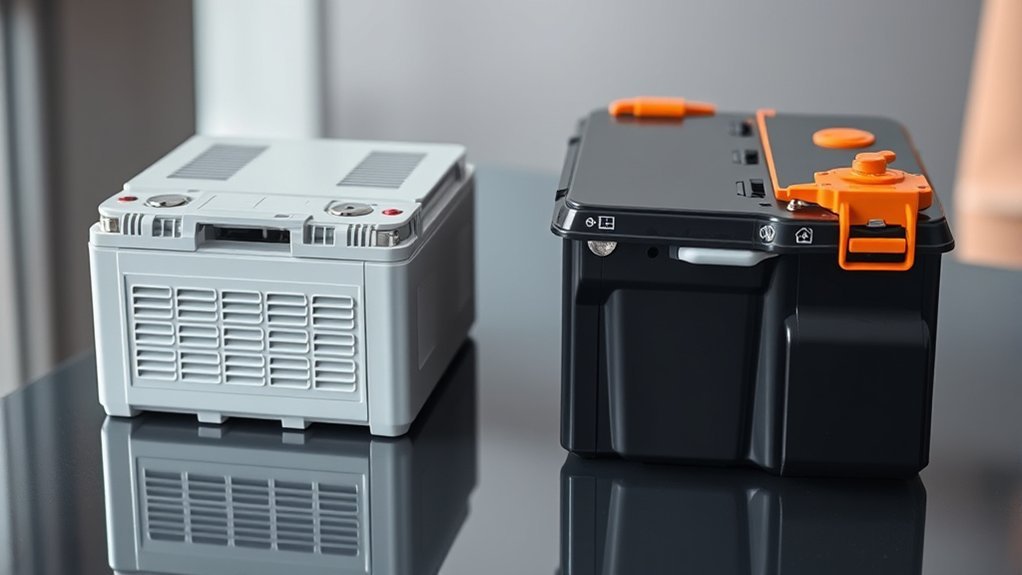
When comparing safety and thermal stability, we focus on the risks of thermal runaway and fire resistance, which vary considerably between Lifepo4 and lithium-ion batteries. Lifepo4 cells generally exhibit lower fire risks and more stable thermal behavior due to their chemistry, while lithium-ion batteries often incorporate advanced safety mechanisms to mitigate hazards. Understanding these differences helps determine which battery type provides more reliable safety in critical applications.
Thermal Runaway Risks
Thermal runaway remains a critical safety concern in battery technology, as it involves a rapid, uncontrolled increase in temperature that can lead to fires or explosions. Lifepo4 batteries are inherently more thermally stable due to their chemical composition, reducing the risk of runaway incidents compared to traditional lithium-ion cells. This stability stems from the robust nature of their cathode material, which is less prone to thermal decomposition. Additionally, battery manufacturing processes for Lifepo4 emphasize safety features that mitigate heat buildup. Recycling processes also influence safety; Lifepo4’s stable chemistry simplifies safe disposal and reduces the chance of hazardous reactions. In contrast, lithium-ion batteries with cobalt or nickel cathodes pose higher risks during thermal events, underscoring Lifepo4’s advantage in safety and stability.
Fire Resistance Levels
Which battery type demonstrates superior fire resistance and safety under thermal stress? Lifepo4 batteries generally outperform lithium-ion counterparts due to their inherent chemical stability, reducing risks of thermal runaway. Their manufacturing processes focus on stable cathode chemistry and robust separator materials, which contribute to enhanced thermal stability. Additionally, battery aesthetics play a role; Lifepo4 cells often have a more uniform construction, minimizing weak points that could lead to overheating. Lithium-ion batteries, with their more volatile electrolyte composition, are more susceptible to ignition when exposed to high temperatures or mechanical damage. Consequently, from a safety perspective, Lifepo4 offers better fire resistance, making it the more thermally stable choice. This distinction is vital when evaluating long-term safety and reliability in various applications.
Safety Mechanisms Implemented
Building on the inherent fire-resistant properties of Lifepo4 batteries, their safety mechanisms are designed to further enhance thermal stability and prevent catastrophic failures. During battery manufacturing, strict quality controls ensure uniform electrode composition and separator integrity, reducing risks of internal short circuits. Lifepo4 cells feature stable electrochemical properties, which inherently lower thermal runaway likelihood. Additionally, advanced safety features like built-in current interrupt devices and thermal fuses act as fail-safes under abnormal conditions. Recycling processes for Lifepo4 batteries are also safer, as they produce fewer toxic byproducts and are easier to dismantle, minimizing environmental risks. In contrast, lithium-ion batteries often require additional safety circuitry to manage thermal stability, emphasizing Lifepo4’s naturally superior safety profile across manufacturing, use, and recycling stages.
How Do Lifepo4 and Lithium-Ion Compare in Terms of Cost and Longevity?
While lithium-ion batteries generally offer lower upfront costs, Lifepo4 batteries tend to be more economical over their lifespan due to their superior longevity and stability. Lifepo4’s durability stems from its stable chemistry, which reduces degradation during charge cycles. In terms of battery manufacturing, Lifepo4 batteries require more precise cell assembly but benefit from fewer safety-related failures, extending their usable life. Market availability also favors lithium-ion batteries, as they dominate consumer electronics and EV sectors, leading to broader production and lower costs. However, as Lifepo4 gains popularity for stationary storage and renewable applications, economies of scale are improving. Overall, although initial costs for Lifepo4 may be higher, its extended longevity and stability make it a cost-effective choice over time.
What Are the Performance Differences for Various Applications?
When comparing Lifepo4 and lithium-ion for different applications, variations in energy density, charge/discharge rates, and temperature resilience are critical factors. These performance characteristics influence suitability across sectors like transportation, renewable energy storage, and portable electronics. Analyzing these differences helps optimize battery selection for specific operational demands.
Energy Density Variations
Energy density is a critical factor that influences the suitability of Lifepo4 and lithium-ion batteries for various applications. Generally, lithium-ion batteries exhibit higher energy densities, making them preferable for portable devices and electric vehicles where space and weight are constrained. Lifepo4 batteries, with lower energy density, prioritize safety and longevity, which suits stationary storage and specialized industrial uses. Battery manufacturing techniques are evolving to optimize energy density across both chemistries, yet market trends show a persistent preference for lithium-ion in consumer markets due to its higher energy capacity. Understanding these variations helps in selecting the appropriate battery type for specific needs. While lithium-ion offers superior energy density, Lifepo4’s stability and safety profile make it advantageous in applications where these factors outweigh density concerns.
Charge and Discharge Rates
Charge and discharge rates directly impact the performance and suitability of Lifepo4 and lithium-ion batteries across different applications. High rates are essential for demanding uses like power tools or electric vehicles, influencing battery longevity and safety. Lifepo4 batteries typically support higher charge/discharge rates with stable cycle life, making them favorable in market trends prioritizing rapid charging and durability. Lithium-ion batteries, while offering higher energy density, often have lower maximum rates, affecting their application scope. Understanding these differences is vital in battery manufacturing for optimizing performance. The table below summarizes these key aspects:
| Battery Type | Max Charge Rate | Max Discharge Rate | Typical Applications |
|---|---|---|---|
| Lifepo4 | 1C–3C | 1C–5C | E-bikes, Storage |
| Lithium-ion | 0.5C–2C | 1C–3C | Consumer Electronics |
Temperature Resilience
Although both Lifepo4 and lithium-ion batteries are widely used across various applications, their performance under temperature extremes varies considerably. Lifepo4 batteries generally exhibit superior temperature resilience, partly due to their stable chemistry and robust battery packaging, which withstands thermal fluctuations better. In contrast, lithium-ion batteries tend to degrade faster in high temperatures, influenced by manufacturing processes that often prioritize energy density over thermal stability. The design and materials used in battery packaging are vital; Lifepo4’s more stable chemistry allows for safer operation across a broader temperature range. Conversely, lithium-ion batteries require sophisticated thermal management systems to mitigate temperature-related risks. These differences make Lifepo4 more suitable for applications with harsh or variable temperature conditions, while lithium-ion demands controlled environments for ideal performance.
Which Battery Is More Environmentally Friendly and Easier to Recycle?
When evaluating environmental impact, lithium iron phosphate (LiFePO4) batteries generally emerge as the more eco-friendly and easier to recycle option compared to traditional lithium-ion batteries. LiFePO4’s composition minimizes toxic metals, simplifying eco friendly disposal and reducing environmental hazards. Recycling processes for LiFePO4 are more straightforward, involving less hazardous chemicals and generating fewer toxic waste products. In contrast, lithium-ion batteries contain hazardous materials like cobalt and nickel, which require complex, costly recycling methods to recover valuable metals safely. These processes are often less efficient and pose higher environmental risks. Overall, LiFePO4 batteries present a more sustainable option due to their safer chemical profile and streamlined recycling methods, making them a preferable choice for environmentally conscious applications.
How Do Charging and Maintenance Requirements Vary Between Lifepo4 and Lithium-Ion?
While both LiFePO4 and lithium-ion batteries require proper charging protocols to guarantee longevity and safety, their maintenance requirements differ considerably due to their chemical and operational characteristics. LiFePO4 batteries generally have a longer battery lifespan and are less sensitive to overcharging, thanks to their stable chemistry. Conversely, lithium-ion batteries demand more precise voltage regulation during charging to prevent capacity loss and degradation. Manufacturing processes also influence maintenance; LiFePO4’s robust chemistry reduces the need for frequent monitoring, whereas lithium-ion cells benefit from advanced battery management systems (BMS) to optimize performance and safety.
- LiFePO4’s stable chemistry extends battery lifespan with less frequent maintenance
- Lithium-ion batteries require vigilant voltage and temperature monitoring
- Manufacturing quality affects the consistency of charging and performance
- Proper BMS integration is critical for lithium-ion safety
- Over time, these differences impact operational costs and reliability
Which Battery Type Provides Better Scalability for Large-Scale Projects?
Scaling large energy storage projects requires choosing a battery technology that can efficiently meet increasing capacity demands while maintaining safety, cost-effectiveness, and reliability. Lifepo4 batteries generally offer advantages in manufacturing processes, with simpler, safer production and less hazardous materials involved. Their design also facilitates more straightforward battery recycling, which supports sustainable large-scale deployment. Lithium-ion systems, however, often require complex manufacturing processes involving hazardous materials, complicating recycling efforts and increasing environmental impact. As projects grow, the ability to efficiently recycle batteries and streamline manufacturing becomes critical for scalability. While lithium-ion batteries deliver higher energy density, Lifepo4’s safer, more sustainable manufacturing and recycling processes make them better suited for extensive projects prioritizing long-term sustainability and operational safety.
What Are the Key Factors to Consider When Choosing Between Lifepo4 and Lithium-Ion?
Choosing between Lifepo4 and lithium-ion batteries involves analyzing several critical factors that impact performance, safety, and long-term viability. Key considerations include battery aesthetics, which influence installation and integration; manufacturing processes, affecting consistency and quality control; safety profiles, particularly thermal stability; cycle life and degradation rates for longevity; and energy density, impacting space and weight constraints. Lifepo4 batteries generally offer superior safety and longer cycle life, but may have less appealing aesthetics due to size and design. Lithium-ion batteries often excel in energy density and compactness but involve more complex manufacturing processes that can affect reliability. Understanding these factors helps in making an informed choice aligned with specific application needs and system requirements.
How Do Lifepo4 and Lithium-Ion Batteries Impact Overall System Efficiency?
The choice between Lifepo4 and lithium-ion batteries considerably influences overall system efficiency through differences in energy density, charging performance, and thermal stability. While Lifepo4 offers enhanced thermal safety and longer cycle life, lithium-ion batteries typically provide higher energy density and quicker charging capabilities. Understanding these trade-offs allows us to optimize system design for specific operational requirements.
Energy Density Differences
How considerably does energy density influence the overall efficiency of battery systems? Higher energy density directly impacts system efficiency by enabling more compact, lightweight designs, which reduce energy losses during transmission and improve portability. Lithium-ion batteries typically have a higher energy density than Lifepo4, allowing for longer runtime and more efficient space utilization. However, this comes with trade-offs in battery lifespan and manufacturing costs, as higher energy density often accelerates degradation and increases production complexity.
- Greater energy density means less weight and volume for the same energy
- Lower energy density can extend battery lifespan through reduced stress
- Manufacturing costs tend to rise with increased energy density
- System efficiency benefits from higher energy density are balanced against durability considerations
- Design choices depend on prioritizing weight, lifespan, or cost efficiency
Charging Efficiency Variances
Have you ever considered how charging efficiency differences between Lifepo4 and lithium-ion batteries influence overall system performance? Lifepo4 batteries typically exhibit higher charge acceptance rates and lower self-discharge, leading to improved charging efficiency. This directly benefits system efficiency by reducing energy losses during charge cycles, extending battery lifespan, and minimizing operational costs. Conversely, lithium-ion batteries may experience slightly higher internal resistance, resulting in marginally lower charging efficiencies. These variances also impact manufacturing costs, as Lifepo4’s simpler chemistry can lead to more cost-effective production and longer-lasting batteries, reducing replacement frequency. Overall, the superior charging efficiency of Lifepo4 contributes to better energy utilization and system reliability, making it a compelling choice where efficiency and longevity are prioritized.
Thermal Stability Impact
Given their differing thermal behaviors, Lifepo4 and lithium-ion batteries greatly influence overall system efficiency through thermal stability. Lifepo4’s superior stability reduces thermal runaway risk, leading to safer operation and less cooling demand, which enhances energy efficiency. Conversely, lithium-ion batteries generate more heat during charge-discharge cycles, increasing cooling needs and energy loss. This thermal profile impacts manufacturing costs, as Lifepo4’s stable chemistry simplifies thermal management systems, potentially lowering costs. Additionally, improved thermal stability extends battery lifespan, reducing frequent replacements and associated recycling efforts.
- Safer operation minimizes system downtime
- Reduced cooling requirements improve efficiency
- Longer lifespan decreases battery recycling frequency
- Lower manufacturing costs due to simplified thermal management
- Enhanced thermal stability supports sustainable lifecycle management
Which Battery Is the Best Fit for Your Specific Needs and Use Case?
Determining the most suitable battery type for your application requires careful consideration of specific performance requirements and operational conditions. For example, if longevity and safety are priorities, Lifepo4’s thermal stability and durability may be advantageous. Conversely, Lithium-ion batteries often excel in energy density and compact design. To make an informed choice, consider factors like battery aesthetics, which influence installation and integration, and brand reputation, ensuring reliability and quality assurance. Here’s a comparison:
| Criterion | Lifepo4 | Lithium Ion |
|---|---|---|
| Battery Aesthetics | Modular, often bulkier | Sleek, lightweight |
| Brand Reputation | Growing, focused on safety | Established, diverse options |
| Operational Fit | Heavy-duty, stable environments | Portable, high energy density |
This analysis helps identify which fits your specific needs best.
Frequently Asked Questions
How Do Lifepo4 and Lithium-Ion Batteries Perform in Extreme Weather Conditions?
In extreme weather, Lifepo4 batteries maintain stability, extending battery lifespan and reducing environmental impact, unlike lithium-ion batteries, which degrade faster and pose higher safety risks. We recommend Lifepo4 for resilient, eco-friendly performance under harsh conditions.
Are There Differences in Charging Speed Between Lifepo4 and Lithium-Ion Batteries?
In our testing, LiFePO4 batteries charge slightly slower than lithium-ion, impacting battery longevity and cost. For instance, faster charging reduces wear, but initial costs are higher; analyzing these trade-offs helps determine the best choice.
Which Battery Type Is More Suitable for Portable Electronic Devices?
We find lithium-ion batteries more suitable for portable electronics due to their higher energy density and faster charging, but Lifepo4 offers longer battery lifespan and better cost comparison over time, making it a balanced choice depending on usage needs.
How Do Lifepo4 and Lithium-Ion Batteries Affect Overall System Weight?
Lifepo4 batteries are roughly 30% lighter than lithium-ion, markedly reducing overall system weight. They also offer longer lifespan and lower environmental impact, making them a more efficient choice for weight-sensitive applications.
Can Lifepo4 Batteries Be Used for High-Drain Applications?
Lifepo4 batteries handle high-drain applications effectively due to their stable chemical structure, offering longer battery lifespan and safer recycling considerations. We find them reliable for demanding uses, balancing performance with environmental and safety benefits.
Conclusion
In summary, choosing between Lifepo4 and lithium-ion batteries depends on your specific priorities. Lifepo4’s superior safety and longevity make it ideal for stationary and industrial uses, while lithium-ion’s higher energy density suits portable and high-demand applications. Interestingly, Lifepo4 batteries can last over 2,000 cycles—twice as long as many lithium-ion options—highlighting their potential for long-term, sustainable energy solutions. Carefully evaluating your needs guarantees ideal performance and safety in your energy systems.