? Are you thinking about upgrading your golf cart battery to something lighter, longer-lasting, and smarter?

Quick product snapshot
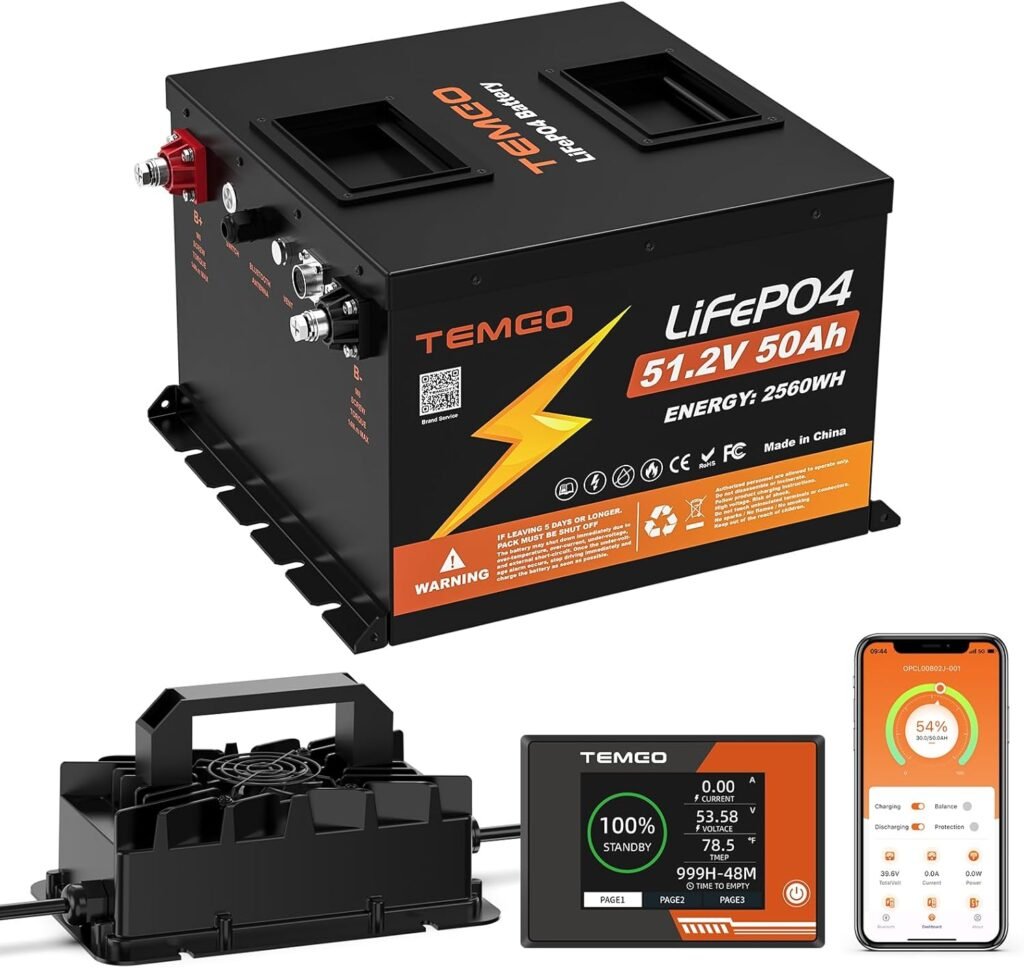
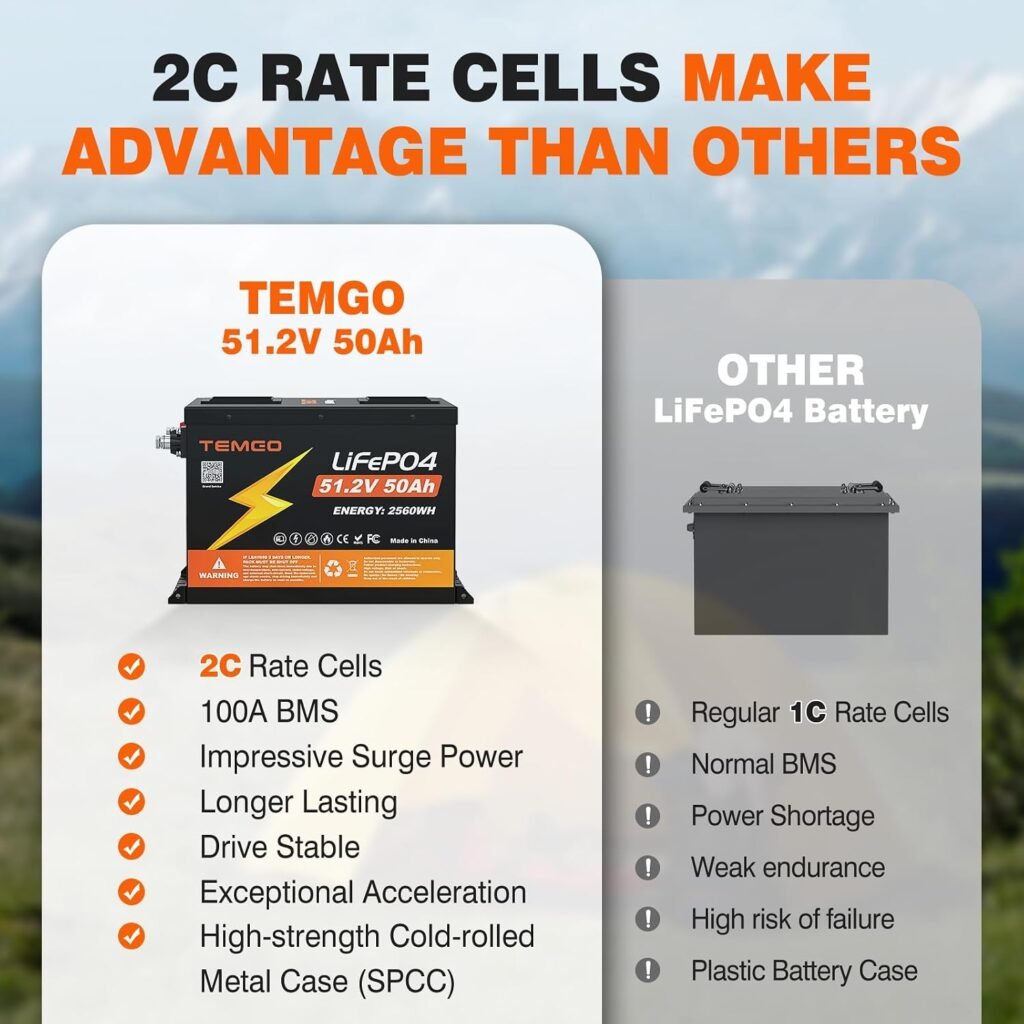
You’ll find this TEMGO 51.2V (48V) 50Ah LiFePO4 Lithium Golf Cart Battery is built to replace traditional lead-acid packs while giving you modern features like a built-in 100A BMS, a monitor and mobile app, and an iron case for protection. It’s rated for 5000+ cycles and claims a continuous 5.12 kW power output, which translates into solid performance for golf carts and many other EV applications.
What this section tells you
You get a short, friendly overview so you can decide whether to read the deeper sections. You’ll get the essentials without wading through specs first, and that helps you focus on what matters to your use case.
Key specifications at a glance
You should be able to see the main numbers quickly to judge fit. Below is an easy table to break down the most important technical points so you can compare them to your current battery or to other options.
| Feature | Specification / Notes |
|---|---|
| Nominal Voltage | 51.2V (marketed as 48V system replacement) |
| Capacity | 50Ah (2.56 kWh energy: 51.2V × 50Ah) |
| Continuous Discharge | 100A → ~5.12 kW output |
| Peak Discharge | 200A for seconds (short bursts) |
| Chemistry | LiFePO4 (Lithium Iron Phosphate) |
| Cycle Life | 5000+ cycles (manufacturer claim) |
| BMS | Built-in 100A BMS with protections (over-charge, over-discharge, over-current, high/low temp, short circuit) |
| Case | High-strength cold-rolled metal plate (SPCC), fireproof and shockproof |
| Ingress Protection | IP67 rated (water/dust resistant) |
| Charger | 56.8V, 10A LiFePO4 charger included |
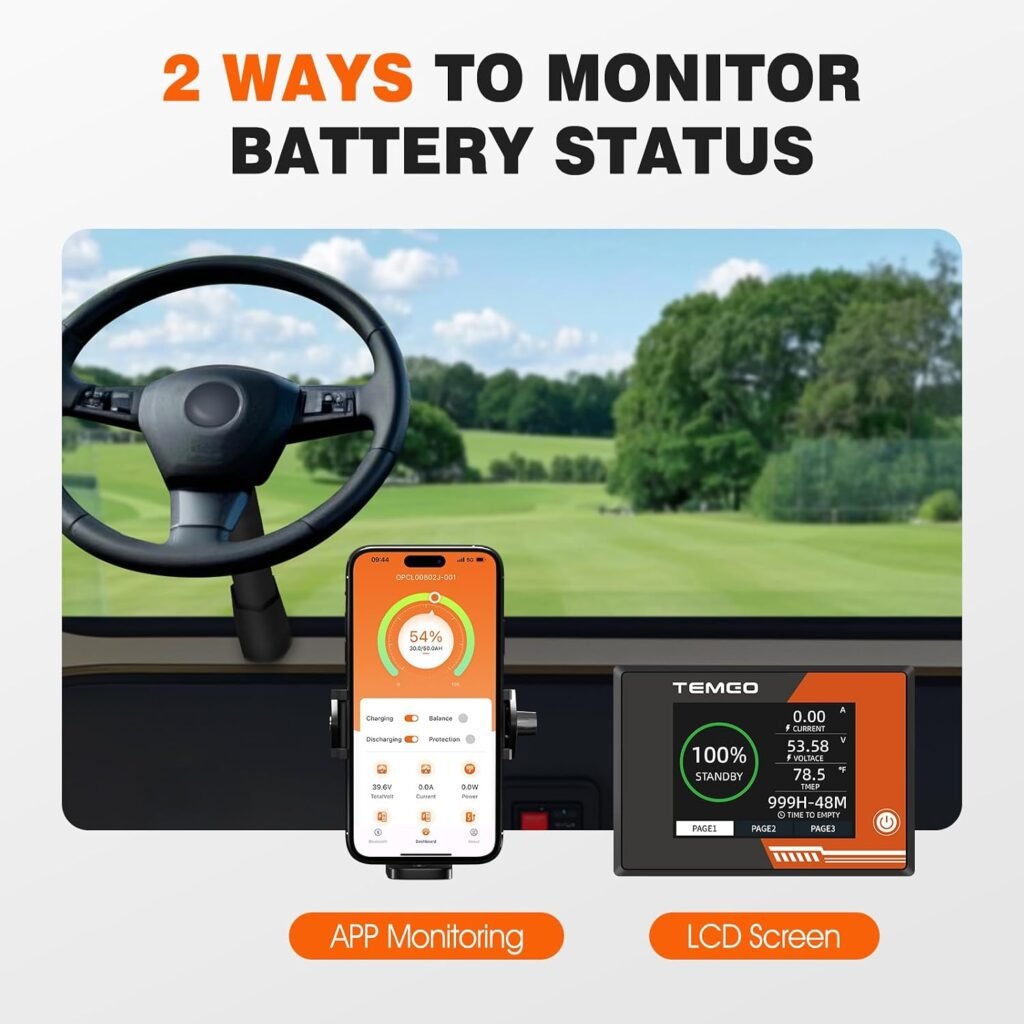
| Display | Onboard screen for real-time status |
| Connectivity | Mobile app monitoring (SOC and data read/control) |
| Extra | External switch and cable; main switch with green indicator |
| Warranty / Service Life | 5-year service life stated by manufacturer |
Why this matters
You can use this table to quickly decide whether the battery’s voltage, capacity, and protections match your cart and driving habits. The 2.56 kWh capacity gives you a reasonable amount of usable energy without the bulk of lead-acid packs.
How performance translates to real-world use
You’ll appreciate how the specs match the demands of a typical golf cart. The 100A continuous discharge at 51.2V gives you roughly 5.12 kW, which is strong enough for sustained riding, hills, and moderate loads like carts carrying gear or small trailers.
Practical runtime and range expectations
If you use moderate power—let’s say an average draw of 1500–2000W while driving—you should get several hours or many miles depending on terrain and speed. The manufacturer states up to around miles on a single charge under favorable conditions, which is plausible for low-speed, mostly flat golf cart use. Keep in mind that heavy loads, frequent stops on hills, or aggressive acceleration will shorten range.
Charging: speed, efficiency, and math
You’ll likely want to know how long charging takes and what the included charger gives you. The 56.8V 10A charger charges at about 10A × 56.8V = ~568W of ideal power input. For a 2.56 kWh battery, theoretical full charge from empty is roughly 2.56 kWh / 0.568 kW = ~4.5 hours.
Real-world charging time
Expect roughly 4.5–6 hours for a full charge from near-empty because efficiency losses, BMS balancing, and tapering at high SOC add time. If you only top-charge between rounds, you’ll spend less time and still get useful range for your next outing.

Battery Management System (BMS) and safety features
You should be reassured by the 100A built-in BMS. It handles over-charge, over-discharge, over-current, temperature limits, and short-circuit protection. These features protect the battery, the cart, and you.
Why the BMS matters day-to-day
The BMS prevents abuse that would dramatically shorten life or create dangerous conditions. If the battery detects excessive temperature or current, it will cut back or disconnect outputs. That means less maintenance worry and safer operation for non-technical users.
Mobile app and onboard monitoring
You’ll like the convenience of both a physical screen and a mobile app. The display shows battery data in real time, and the app lets you read SOC and some control parameters remotely.
How you’ll use the app
Check state-of-charge, voltage, and diagnostic info without climbing into the cart. The app can help you keep track of how your usage patterns affect battery health and plan charging sessions accordingly.
Case, construction, and environmental protection
The battery is encased in SPCC cold-rolled metal plate, which is both fire-resistant and shock-resistant. With IP67 rating, you can expect good protection against dust and temporary water immersion—handy for carts that see wet grass, rain, or damp storage areas.
What that means during use
You can be less worried about splashes and debris during normal operation. The metal case also offers more physical protection from impacts or from being stored in a tight battery compartment.
Durability and lifecycle
The claim of 5000+ cycles is excellent for LiFePO4 chemistry and means the battery will likely outlast many lead-acid alternatives by a large margin. You’ll see a strong life-to-cost advantage if you use your cart frequently.
Comparing to lead-acid and other chemistries
Lead-acid batteries typically live a few hundred to maybe a thousand cycles under good care. If you’re doing the math, that means you might replace multiple lead-acid packs in the same timeframe this LiFePO4 unit remains healthy. That results in lower total cost of ownership and less hassle.
Weight and performance trade-offs
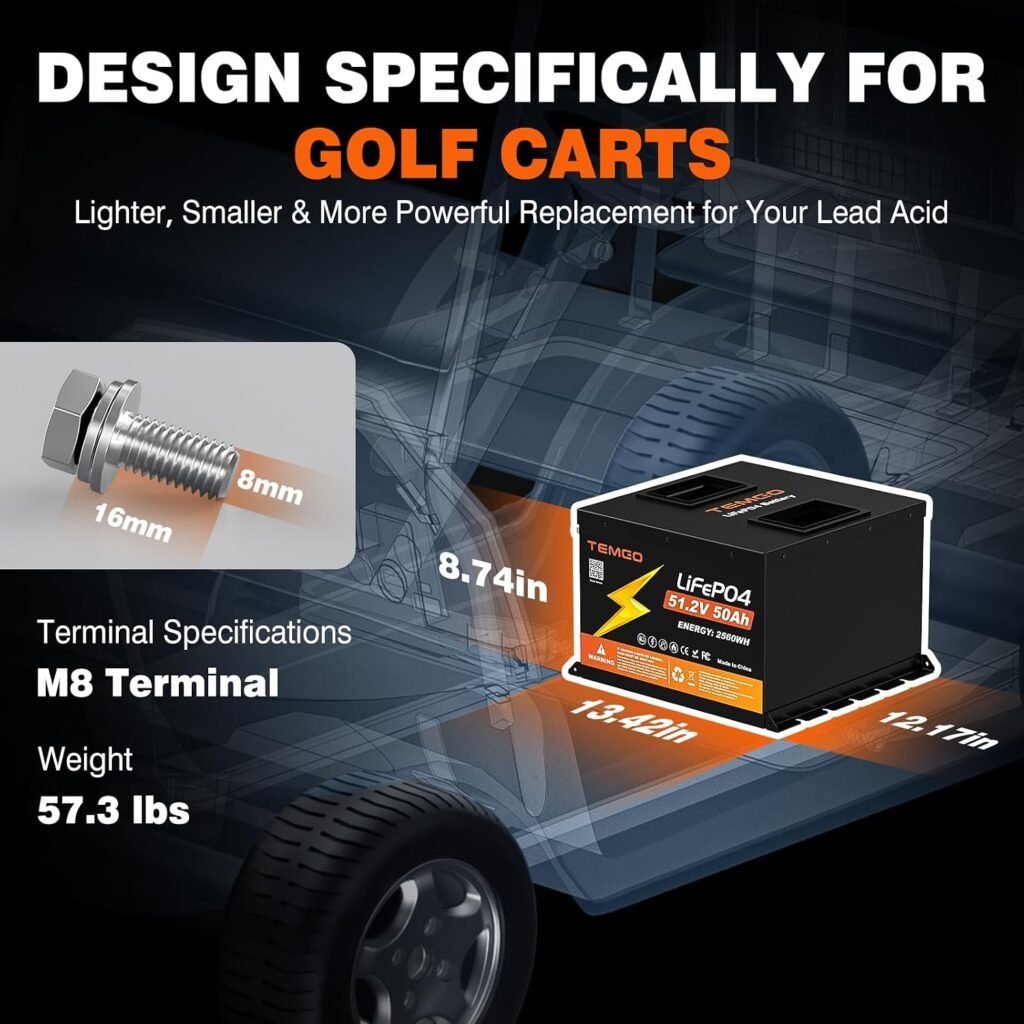
You’ll notice this pack is significantly lighter than equivalent lead-acid configurations—manufacturer states roughly a 50% weight reduction. A lighter battery reduces strain on the motor and can improve range and handling.
How lighter weight helps you
Lighter weight means quicker acceleration, less motor heat, and lower rolling resistance—so in practical terms your cart can be nimbler and more efficient. It also simplifies installation and handling when you’re swapping batteries.
Installation and setup tips
You’ll find installation relatively straightforward but there are a few best practices to follow for safety and performance. Use the included external switch and cable if you want a dash-mounted cutoff, and mount the battery securely to minimize vibration.
Step-by-step pointers
- Verify compatibility with your cart’s controller and wiring.
- Keep wiring short and use appropriately sized cables and fuses.
- Do not mix this battery with older or different-chemistry cells in the same system.
- Use the included charger and follow manufacturer charge parameters.
- Install the external switch near the dash for easy access and safer storage between outings.
Compatibility and application flexibility
This battery is marketed as compatible with major golf cart controllers and also fits electric vehicles, trolling motors, marine engines, and more. You’ll find its universal attributes useful if you use it outside a golf cart.
Things to check before buying
Make sure your controller and charger accept the battery’s voltage range, and confirm the physical dimensions and terminal locations will fit your battery compartment. If you plan to use multiple batteries in series or parallel, contact the manufacturer for guidance and ensure identical batteries are used.
Parallel or series setups — cautions
You may want to expand capacity by adding more batteries. You can do that, but you must use identical batteries, match state of charge before connecting, and follow professional wiring and balancing practices.
Why you must be careful
Mixing voltages, chemistries, or capacities can quickly damage batteries and void warranties. Uneven charge states or mismatched BMS settings can create dangerous current flows and premature failure.
Maintenance — what you need to do
You’ll love that LiFePO4 batteries are largely maintenance-free compared to lead-acid. There’s no watering, no equalizing charges, and no frequent topping-off needed.
Occasional checks you should do
- Inspect terminals for corrosion and clean as needed.
- Confirm firmware updates or app connectivity occasionally.
- Check mounting hardware and cable integrity every few months.
- Store the battery at a moderate charge (if storing long-term, around 40–60% SOC is often recommended for LiFePO4).
Warranty, service life, and manufacturer claims
The listing highlights a five-year service life and 5000+ cycles. You should read warranty terms carefully to understand coverage specifics like manufacturing defects, prorated replacements, or required proof of installation.
How to keep warranty valid
Register the battery if required, follow the charging and installation instructions, and keep receipts and documentation in case you need to claim service. Avoid unauthorized modifications that could void coverage.
Safety considerations and best practices
You’ll be safer when you treat the battery like a high-energy device: secure mounting, correct fusing, and proper connectors are essential. Use a qualified technician for significant electrical work.
Additional safety reminders
- Never crush or puncture the battery case.
- Avoid exposing the battery to extreme heat beyond manufacturer limits.
- If the battery shows swelling, strange odors, or excessive heat, disconnect and seek support.
- Make sure the charging area is ventilated and free from flammable materials.
Pros — what you’ll likely appreciate
You’ll notice many practical advantages quickly: long cycle life, significant weight savings, integrated BMS, included fast charger, app and screen monitoring, and solid build quality with IP67 protection.
Practical upside
These features mean fewer replacements, less maintenance, and improved daily usability. If you rely on your cart frequently, that’s a meaningful convenience and cost benefit.
Cons — what to consider carefully
You’ll need to check compatibility with your cart and be prepared for a higher upfront cost than a single cheap lead-acid replacement. Also, while the manufacturer claims are strong, real-world results depend on usage and installation.
Potential deal-breakers
If you need to mix with older lead-acid batteries or your system demands a battery form factor that doesn’t match this pack, you may need additional modifications. Always confirm fit and electrical compatibility before buying.
Comparison: TEMGO LiFePO4 vs typical lead-acid setup
You’ll find the following broad differences helpful when deciding whether to invest.
Side-by-side benefits
- Cycle life: TEMGO (~5000+ cycles) vs lead-acid (~300–1000 cycles).
- Weight: TEMGO ~50% lighter than equivalent lead-acid strings.
- Maintenance: TEMGO maintenance-free vs lead-acid requires watering and equalization.
- Efficiency: TEMGO higher usable depth-of-discharge (DoD) and lower self-discharge.
- Safety: LiFePO4 is thermally stable compared to other lithium chemistries and usually safer than lead-acid under many failure modes.
Use cases beyond golf carts
You’ll find this battery useful for trolling motors, small electric vehicles, backup power applications, solar systems (with proper inverter/charger), and more. Its app, IP67 rating, and robust metal case make it a versatile choice.
When to pick this battery
If you want a modern battery with long life, smart monitoring, and better performance per pound than lead-acid, this unit is highly suitable. If you have heavy continuous loads beyond the continuous 100A rating, you’ll want to verify peak needs and consider a larger or multiple-battery setup.
Troubleshooting common questions
You’ll probably ask how to handle common scenarios like slow charging, unexpected shutoffs, or connectivity issues. Most problems are resolved by checking connections, confirming charger settings, and making sure the app pairing was completed.
Simple checks you can perform
- Make sure the main switch (green indicator) is on.
- Verify charger output voltage and current are correct.
- Inspect wiring for correct polarity and tight terminals.
- If the app won’t connect, ensure Bluetooth is enabled and permissions are granted.
Final considerations and buying advice
You’ll want to weigh upfront cost against long-term benefits. This TEMGO battery is targeted at users who want reliable, low-maintenance power with modern safeguards and monitoring.
Who this battery suits best
It’s ideal for frequent users, small fleet operators, or anyone who values long cycle life and reduced maintenance. It’s also a good option if you use your cart in wet or rough conditions thanks to the IP67 rating and robust case.
Final verdict
You’ll get a strong package of performance, safety, and convenience with the TEMGO 51.2V (48V) 50Ah LiFePO4 Lithium Golf Cart Battery. The combination of 100A BMS, mobile app and display, included fast charger, and high cycle life make it a compelling upgrade from lead-acid. If the battery dimensions and terminal layout fit your vehicle and you follow installation best practices, this unit should give you years of reliable service and noticeably better day-to-day performance.
Last friendly tip
Before you buy, measure your battery compartment, confirm controller compatibility, and plan how you’ll charge and maintain the battery. If you do those simple checks, you’ll maximize the value and longevity of your new TEMGO battery.
Disclosure: As an Amazon Associate, I earn from qualifying purchases.