We’ll lay out the honest pros and cons of LiFePO4 batteries with a measured, evidence-based view. They offer strong thermal stability, long cycle life, and safer, cleaner operation, but trade off with moderate energy density, heavier packs, and higher upfront costs. Real-world performance hinges on temperature, charging practices, and thermal management. We’ll weigh costs, maintenance, and degradation realities against safety and reliability, then map fit for your project—with concrete checks to contemplate as we go.
Key Takeaways
- LiFePO4 offers strong safety and thermal stability with reduced risk of thermal runaway, making it reliable for varied environments.
- It delivers long cycle life (often 2,000–5,000+ cycles) with minimal capacity fade under proper charging and temperature control.
- The chemistry provides stable real-world performance with flat discharge curves, aiding predictable energy delivery in stationary and high-cycle apps.
- Gravimetric energy density is moderate and volumetric density is lower than nickel-based or NMC chemistries, affecting space and weight-sensitive designs.
- Total cost of ownership can be favorable over time due to longer life and lower replacement frequency, though upfront module costs may be higher.
What LiFePO4 Is and How It Stacks Up Against Other Chemistries
LiFePO4, or lithium iron phosphate, is a cathode chemistry known for stability, safety, and long cycle life. We compare it against common chemistries to clarify where it fits in battery chemistry. Its gravimetric energy density is moderate, while volumetric density is lower than nickel-based or NMC systems, affecting pack size for a given energy. We observe superior thermal stability and reduced risk of thermal runaway, contributing to safer operation in diverse environments. Cycle life typically exceeds 2,000–5,000 cycles with minimal capacity fade under appropriate conditions, though high-rate scenarios can temper this. Cost stability benefits from abundant iron and phosphate precursors, yet higher upfront cell costs may arise relative to high-energy chemistries. Lifecycle tradeoffs favor durability and safety for stationary storage and moderate-power applications.
When to Use LiFePO4: Quick Decision Framework
We start from our comparison of LiFePO4 against other chemistries and map its fit to real-world use. We present a quick decision framework: identify load profile, temperature range, cycle life, and space constraints, then align these with LiFePO4 strengths. For high-cycle, low-weight, or long-duration standby applications, LiFePO4 often reduces total cost of ownership despite higher upfront cost. In mobile or remote systems, its stable chemistry supports safer operation and simpler thermal management, improving reliability. For stationary deployments with moderate depth of discharge, its flat discharge curve and robust cycle life translate to predictable energy delivery. When evaluating environmental impact, LiFePO4 shows lower toxic byproducts and long life favoring lower replacement frequency. Use our quick comparison to determine fit, then validate with field testing.
LiFePO4 Safety in Practice: Stability, Thermal Behavior, and Risks
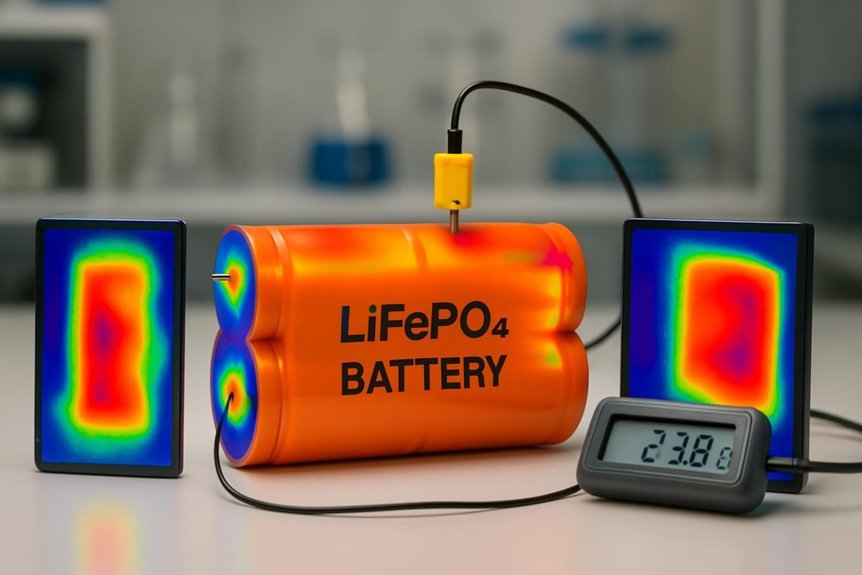
We review LiFePO4 safety through stability indicators and known risks, focusing on how pack design and usage affect equilibrium and failure modes. We examine thermal behavior, including heat generation, temperature rise, and mitigation strategies like proper venting, cooling, and state-of-charge management. We present evidence-based guidance to minimize risks in real-world operation, highlighting practical checklists and response protocols for abnormal temperatures or cells, and we invite readers to contemplate how these factors influence overall safety.
Stability Indicators and Risks
How stable are LiFePO4 systems in practice, and what risks accompany their use? We assess stability with objective indicators, focusing on safety margins and degradation signals. Our stability indicators include voltage plateaus, state-of-charge consistency, and impedance rise under load, which collectively reflect cell health and pack balance. Early warning signs—capacity fade rate, self-discharge, and anomalous temp drift—prompt risk assessment and corrective actions. In practice, LiFePO4 chemistry exhibits robust thermal and chemical stability, but risks persist from improper packaging, abuse, or mechanical damage that can drive internal shorting or exposure to high temperatures. We prioritize conservative design, qualified components, and monitoring to maintain predictable behavior, enabling proactive response and documented risk assessment without compromising performance.
Thermal Behavior and Mitigation
Thermal behavior in LiFePO4 systems centers on predictable temperature margins under operation and the mechanisms that drive heat generation. We describe how internal resistance, ambient loading, and rate effects combine to set safe limits and reveal thermochemical misalignment risks when cooling fails. By examining heat flux paths and phase stability, we identify mitigation levers: controlled charging, prudent C-rates, and thermal management strategies that limit runaway potential. We emphasize that phase transition risks are low under proper design, yet still demand monitoring for abnormal heat spikes and pack inconsistency. Effective mitigation relies on data-driven controls, validated testing, and system-level integration. Overall, disciplined design reduces temperature excursions while preserving performance and safety margins for real-world use.
| Column A | Column B | Column C |
|---|---|---|
| Heat sources | Thermal paths | Management acts |
| Resistance | conduction | Cooling strategy |
| Rate effects | convection | Safety checks |
| Ambient influence | insulation | Monitoring cadence |
Real-World Cons: Cost, Degradation, and Maintenance Realities
Are the real-world costs, degradation patterns, and maintenance demands of LiFePO4 batteries manageable or prohibitive for practical use? We assess total cost of ownership, not just sticker price, noting that LiFePO4 cells offer long cycle life and stable chemistry, but upfront hardware, BMS, and installation expenses matter. Cost comparison shows lower long-term replacement costs versus NMC, yet premium modules, housings, and thermal controls influence economics in commercial systems. Degradation remains predictable: gradual capacity fade accelerates near end-of-life curves, but calendar aging is subdued with proper charging, temperature control, and moderate C-rates. Maintenance realities center on monitoring, software updates, and connector integrity; routine inspections prevent parasitic drains and corrosion. We conclude LiFePO4 can be economical where duty cycles align, provided maintenance plans and lifecycle expectations are explicit.
LiFePO4 Performance Across Temperatures: Heat and Cold Effects
We summarize LiFePO4 performance across temperatures by focusing on heat sensitivity limits, cold temp capacity, and the charging temperature range. In our assessment, elevated temperatures can accelerate degradation and reduce usable life, while low temperatures decrease available capacity and increase internal resistance. We also define safe charging windows to balance performance, safety, and longevity across typical operating environments.
Heat Sensitivity Limits
Although LiFePO4 cells are renowned for thermal stability relative to other Li-ion chemistries, their performance is still bounded by temperature: high heat increases impedance and accelerates degradation, while cold slows electrochemical reactions and reduces capacity. In our assessment, heat sensitivity defines the upper boundary of usable current and cycle life, with elevated temperatures accelerating loss mechanisms such as lattice strain and SEI instability on cathode surfaces. Temperature risk becomes evident in elevated parasitic currents, reduced coulombic efficiency, and shortened calendar life when exposure exceeds design margins. Our data indicate a conservative operating window where safe, moderate temps preserve capacity and longevity. We advise monitoring ambient, pack, and cell temperatures, implementing thermal management, and avoiding sustained high-temperature exposure to minimize heat-related performance penalties.
Cold Temp Capacity
How does cold affect LiFePO4 capacity across temperatures, and what does that mean for real-world performance? We examine capacity retention and internal resistance as temperature declines. At subzero to moderately cold conditions, LiFePO4 shows modest capacity loss compared with many chemistries, but energy delivery can be limited by higher internal resistance and slower diffusion, reducing peak current and usable capacity during high-drain events. At cold storage or cold transport temperatures, voltage recovery after discharge shortens effective available capacity and may trigger protective cutoffs earlier. Data from standardized tests indicate gradual, predictable degradation, not abrupt failure, allowing careful system design to offset losses via controlled thermal management and duty cycling. Practical implications emphasize conservative sizing, thermal insulation, and monitoring to sustain performance under cold storage and cold transport scenarios.
Charging Temperature Range
Charging temperature range for LiFePO4 considerably influences both charging efficiency and cycle life. We evaluate how ambient heat accelerates ionic movement yet risks electrolyte stress, while cold slows kinetics and can extend charge times. At high temperatures, charging safety margins tighten as protective circuits limit current, reducing peak power but protecting cells from degradation. Optimal operation generally sits near 0 to 40°C, with performance dropping outside this band; excessive heat also accelerates side reactions, shortening lifecycle. We debunk lifecycle myths that temperature alone dictates longevity—we must also consider charge protocol, state of charge, and depth of discharge. Proper thermal management and moderation of charging currents maintain efficiency and safety, especially in harsh climates. Informed charging strategies minimize risk, preserving capacity and reliability.
Charging LiFePO4: Profiles, BMS Needs, and Setup Tips
What charging profiles matter for LiFePO4, and how do we choose the right setup? We, as practitioners, assess profile options by cell voltage, current limits, and termination criteria. A standard profile uses a constant-current/constant-voltage (CC/CV) approach with a termination threshold near 3.6–3.65 V per cell and a taper to stop at 3.5–3.6 V under light load; charge current scales with pack size to maintain C-rates within manufacturer specs. BMS needs dictate safety margins, temperature monitoring, and cell balancing strategy. Pack chemistry favors a moderate CV termination to minimize stress and aging. We verify compatibility between charger, BMS, and thermal controls, and we document limits for voltage, current, and temperature. The result is predictable performance, longer cycle life, and reliable protection during charging.
Total Cost of Ownership: Upfront, Maintenance, and Longevity
Is total cost of ownership (TCO) a practical lens for LiFePO4 adoption, or do upfront prices obscure long-term value? We assess TCO by separating upfront, maintenance, and longevity, then weighing reliability and performance against competing chemistries. Our evidence points to lower operating costs over time, driven by longer cycle life and stable degradation. We emphasize cost comparisons across brands, warranties, and end-of-life handling to prevent hidden expenses from skewing decisions. Warranty coverage often offsets initial risk, improving TCO perception when failures are mitigated early.
- Upfront depreciation and installed system costs
- Routine maintenance, efficiency losses, and replacement cycles
- Longevity benefits, resale value, and warranty protections
Is LiFePO4 Right for Your Project? Quick Checks and Next Steps
Are LiFePO4 cells the right fit for your project, and if so, how can you confirm suitability quickly? We approach qualification with clear, data-driven checks that match technical requirements to our goals. First, assess energy density needs, discharge rate, and operating temperature, then compare with LiFePO4 specifications and vendor test data. Next, evaluate cycle life, safety margins, and thermal behavior under worst-case scenarios. For quick validation, run a short prototype test: verify voltage stability, SOC-OCV correlations, and response to load steps. If results align with project targets, proceed to a formal risk assessment and supply-chain review. Two word discussion idea 1, two word discussion idea 2—documented evidence and traceable testing support confident decisions. This approach minimizes ambiguity and accelerates next steps.
Frequently Asked Questions
How Long Does a Lifepo4 Battery Pack Last Under Typical Use?
We expect a LiFePO4 pack to last about 5–15 years under typical use, depending on depth of discharge and cycle count. We monitor high rate charging, perform battery recycling, and optimize aging for accurate life estimates.
Can Lifepo4 Handle High-Rate Charging Safely?
We can handle high-rate charging with Lifepo4, but safety considerations include cell balance, thermal management, and charger compatibility; our assessment shows feasible high-rate operation within specified C-rates, while monitoring temperature and voltage to prevent degradation and safety risks.
Do Lifepo4 Cells Require a Dedicated BMS?
“Necessity breeds safety.” We do, as a team, say Lifepo4 cells require a dedicated BMS for cell balance and protection. Need for BMS and battery safety are integral; without it, risks rise and performance suffers.
What Maintenance Does Lifepo4 Realistically Need?
We do maintenance that’s minimal but essential: monitor cell balance, inspect connections, and keep them within specified voltage ranges; follow manufacturer guidance for charging safety, temperature, and SOC limits to ensure longevity and reliable performance.
Are Lifepo4 Packs Scrap/Recyclable-Friendly Options?
Yes, lifepo4 packs are recyclable-friendly but face recyclability challenges we must address; we source ethically. We assess materials, end-of-life processes, and regulatory compliance, ensuring our approach minimizes waste and maximizes recovery while protecting environmental health.
Conclusion
LiFePO4 batteries deliver robust safety, long cycle life, and stable performance across temperatures, making them a strong fit for long-term, duty‑cycle applications. Their moderate energy density and higher upfront pack costs are real tradeoffs, but field testing confirms reliability with proper thermal management and charging protocols. If you’re optimizing lifecycle costs and safety over time, LiFePO4 can outperform expectations—yes, it’s potentially the “superhero” choice for many projects, provided you plan for thermal and energy density limits.