When selecting a battery for our RV, understanding the nuanced differences between Lifepo4 and lithium-ion options is essential. Both offer compelling advantages, but their distinct chemistries impact safety, lifespan, and overall performance. By evaluating these factors critically, we can determine which technology aligns best with our travel needs and safety priorities. The decision isn’t straightforward, and the implications extend beyond initial costs—so, examining each aspect thoroughly becomes vital before making a choice.
Key Takeaways
- Lifepo4 offers greater safety, thermal stability, and longer cycle life, making it more reliable for RV use.
- Lithium-ion batteries have higher energy density, allowing for more compact and lightweight RV battery systems.
- Lifepo4 is generally more cost-effective long-term due to its durability and lower maintenance needs.
- Lithium-ion batteries charge faster and support quick charging but pose higher safety and fire risks if not managed properly.
- Overall, Lifepo4 is better suited for RV applications prioritizing safety, longevity, and environmental sustainability.
What Are Lifepo4 and Lithium-Ion Batteries? A Quick Overview
Lithium-ion batteries are a widely used energy storage solution characterized by their high energy density and lightweight design, making them suitable for portable electronics and electric vehicles. Their popularity stems from advanced battery technology that enables efficient energy transfer and storage. Lithium-ion cells offer high charging efficiency, allowing rapid recharge cycles with minimal energy loss, which is essential for applications requiring frequent cycling, such as RV power systems. Conversely, LiFePO4 (lithium iron phosphate) batteries, a subset of lithium-ion technology, prioritize thermal stability and safety. While they may have slightly lower energy density, their longer cycle life and enhanced charging efficiency under demanding conditions make them a compelling choice for RV applications. Both technologies exemplify the ongoing evolution in battery technology aimed at optimizing performance and safety.
Key Differences in Chemistry and Performance
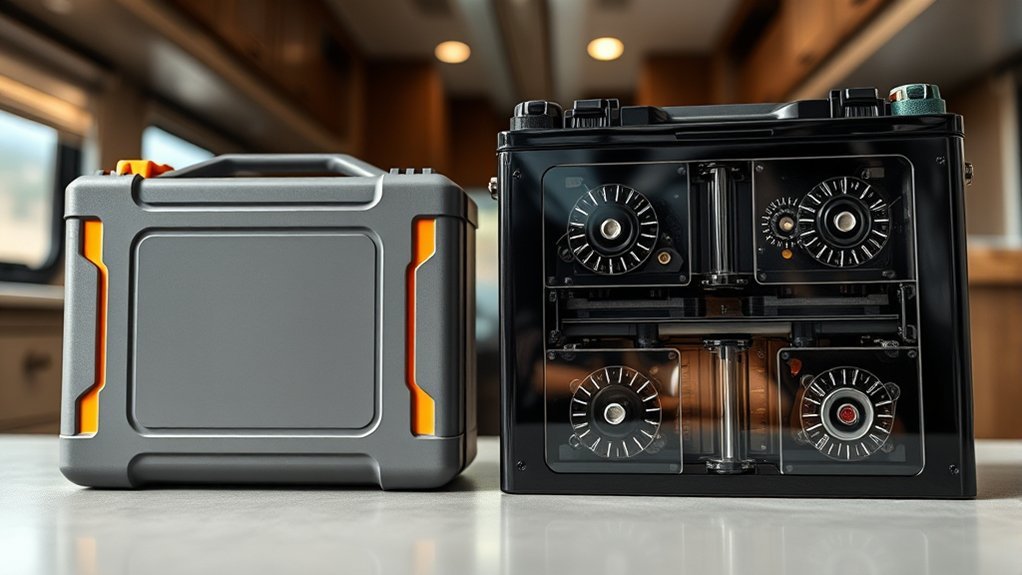
The fundamental chemical differences between Lifepo4 and lithium-ion batteries directly impact their performance and lifespan. Lifepo4’s stable chemistry offers improved cycle life and thermal stability, while traditional lithium-ion chemistries typically provide higher energy density. Understanding these distinctions allows us to evaluate how each chemistry influences overall reliability and suitability for RV applications.
Battery Chemistry Variations
While both Lifepo4 and traditional lithium-ion batteries rely on lithium-based chemistries, their fundamental differences in chemistry markedly impact performance. Lifepo4 batteries use lithium iron phosphate, offering enhanced thermal stability and safety, while lithium-ion cells typically employ cobalt or nickel-based cathodes, affecting energy density. These variations influence battery manufacturing, as Lifepo4’s stable chemistry simplifies production and reduces safety concerns. However, this stability often results in lower energy density compared to lithium-ion variants, impacting overall capacity. The table below highlights key chemistry distinctions:
| Feature | Lifepo4 | Lithium-ion (cobalt/nickel) | Impact |
|---|---|---|---|
| Chemistry Composition | Lithium Iron Phosphate | Lithium Cobalt/Nickel | Safety, stability |
| Energy Density | Lower | Higher | Capacity, runtime |
| Thermal Stability | Excellent | Moderate | Safety, durability |
| Battery Manufacturing | Simplified | Complex | Cost, scalability |
| Lifecycle & Performance | Longer lifespan | Shorter lifespan | Maintenance, longevity |
Performance and Longevity
Because of their distinct chemical compositions, Lifepo4 and traditional lithium-ion batteries exhibit significant differences in performance and longevity. Lifepo4 chemistry offers a more stable electrochemical profile, resulting in better thermal management and fewer capacity losses over time. This stability extends battery lifespan, often surpassing 2,000 charge cycles, compared to 500–1,000 cycles for typical lithium-ion options. Battery manufacturing quality directly impacts longevity; reputable brands with strict quality controls tend to produce more durable Lifepo4 batteries. Brand reputation also influences performance consistency and reliability, especially in demanding RV applications. While Lifepo4 batteries may have higher initial costs, their consistent performance and extended lifecycle make them a strategic investment, providing dependable power over the long term.
Which Battery Type Offers Better Safety for RV Use?
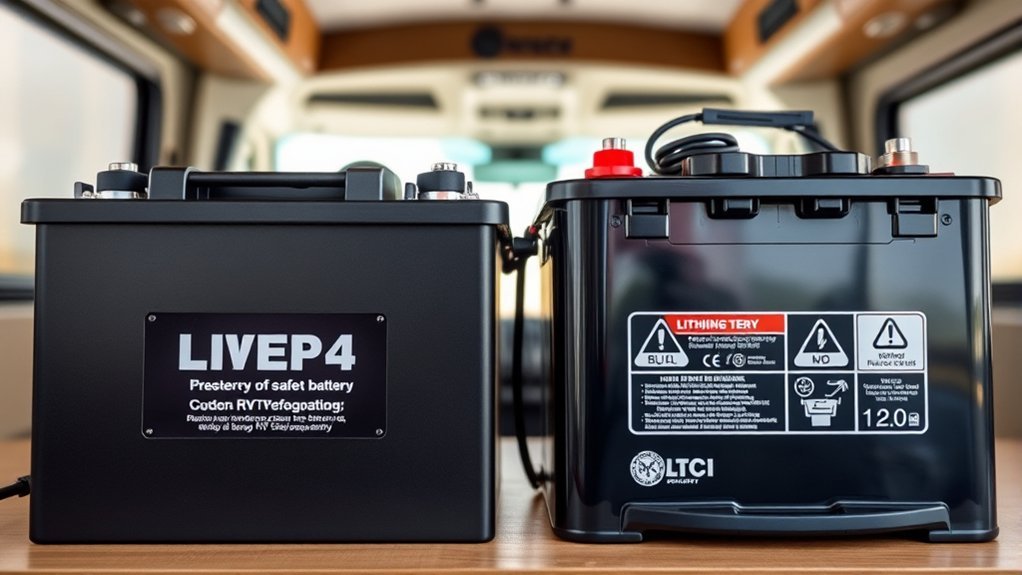
When evaluating safety for RV batteries, thermal stability and the potential for fire hazards are critical factors. Lithium iron phosphate (LiFePO4) batteries generally exhibit greater thermal stability and lower risk of thermal runaway compared to traditional lithium-ion types. Additionally, safety certifications and adherence to standards play a key role in determining which battery offers more reliable protection during use.
Thermal Stability and Risks
Thermal stability is a essential factor when evaluating battery safety for RV applications, as it directly impacts the risk of overheating, thermal runaway, and potential fires. Lithium iron phosphate (LiFePO4) batteries excel in this aspect due to their inherent chemical stability, reducing risks during battery installation and operation. Their lower power density means less heat generation under load, enhancing safety margins. Conversely, lithium-ion batteries with higher energy and power densities can pose increased thermal risks if not properly managed. The stability of LiFePO4 minimizes the likelihood of catastrophic failures, even during extreme conditions or improper handling. This makes them a safer choice for RV use, where safety margins are essential, and thermal management plays a critical role in overall battery system reliability.
Fire Hazard Potential
Which battery type presents a lower fire hazard for RV applications? Lifepo4 batteries generally pose a lower fire risk compared to lithium-ion counterparts due to their thermal stability. They are less prone to thermal runaway, even during improper battery installation or overcharging. Lithium-ion batteries, especially those with liquid electrolytes, can ignite if damaged or exposed to high temperatures, increasing safety concerns at charging stations. The solid electrolyte in Lifepo4 reduces the likelihood of short circuits and fires. Proper battery management systems (BMS) and rigorous safety standards further mitigate risks. When considering fire hazards, Lifepo4’s inherent stability makes it a safer choice for RVs, especially in scenarios involving frequent battery maintenance, charging station use, or potential damage from vibration or impact.
Safety Certifications and Standards
Safety certifications and standards serve as critical indicators of a battery’s reliability and compliance with industry regulations, especially for RV applications where safety is paramount. Both Lifepo4 and lithium-ion batteries undergo rigorous testing, but Lifepo4 batteries often meet stricter certifications due to their inherently stable chemistry. Brand reputation influences certification quality, as established brands prioritize safety and consistent quality. Battery aesthetics also reflect manufacturing standards and quality control, indirectly affecting safety. Certifications such as UL, CE, and UN38.3 ensure batteries withstand transport and operational hazards. The table below compares key certifications and safety aspects:
| Certification | Strictness | Typical Use Cases |
|---|---|---|
| UL 2580 | High | RV, Marine |
| CE | Moderate | European markets |
| UN38.3 | Mandatory | Transport safety |
| IEC 62133 | High | Portable electronics |
| Battery Aesthetics | Varies | Consumer confidence |
Comparing Lifepo4 and Lithium-Ion Lifespan and Durability
When evaluating the longevity and resilience of battery technologies for RV applications, Lifepo4 batteries generally outperform lithium-ion counterparts in both lifespan and durability. Lifepo4 cells typically endure 2,000–5,000 cycles, compared to 1,000–2,000 for standard lithium-ion batteries, translating into longer service life. Their robust manufacturing processes and stable chemistry contribute to higher thermal stability and reduced degradation over time. Additionally, Lifepo4 batteries are more resilient to deep discharges, enhancing durability under frequent use. From an environmental perspective, improved battery recycling options and more sustainable manufacturing practices further support Lifepo4’s longevity. Overall, these factors make Lifepo4 a more durable and reliable choice for RV power needs.
- Longer cycle life and deeper discharge capacity
- Enhanced thermal stability and safety margins
- Resistance to capacity fade over time
- Greater resilience to temperature fluctuations
- More sustainable lifecycle through better recycling
How Do Charging and Maintenance Requirements Differ?
Lifepo4 and lithium-ion batteries have distinct charging voltage requirements that impact their operational protocols, with Lifepo4 typically needing a lower voltage cutoff. Maintenance frequency also varies, as Lifepo4 batteries require less frequent balancing and monitoring compared to lithium-ion counterparts. Additionally, the complexity of their battery management systems differs, influencing the overall maintenance and safety procedures for each type.
Charging Voltage Differences
Although both Lifepo4 and lithium-ion batteries require precise charging protocols, their ideal charging voltages differ considerably, impacting maintenance routines and system design. Proper voltage regulation is vital during battery installation to guarantee optimal performance and longevity. Lifepo4 cells typically operate at a nominal voltage of around 3.2V and require a charge voltage of approximately 3.65V per cell, while lithium-ion batteries often operate near 3.6-3.7V with a slightly higher charging threshold. These differences influence charger compatibility, system safety, and overall efficiency. Properly managing these voltage parameters minimizes risks of overcharging or undercharging, which can lead to capacity loss or safety hazards. Guaranteeing correct voltage regulation is essential for both battery types, particularly in RV applications where reliable power is paramount.
- Battery chemistry-specific charger settings
- Impact on system safety and longevity
- Voltage thresholds affecting cycle life
- Compatibility with existing charge controllers
- Importance of precise voltage regulation
Maintenance Frequency Variations
The differing charging voltage requirements between Lifepo4 and lithium-ion batteries directly influence their maintenance routines. Lifepo4 batteries typically demand less frequent maintenance due to their stable chemistry and lower risk of capacity fade, especially when properly installed. Conversely, lithium-ion batteries may require more regular checks of electrolyte levels and voltage balances to guarantee peak power capacity over time. Proper battery installation is essential; secure connections minimize performance issues and reduce maintenance frequency. Lifepo4’s inherent stability often translates into fewer calibration needs, whereas lithium-ion systems might need periodic balancing to maintain consistent power output. Overall, Lifepo4 batteries tend to offer a more straightforward maintenance schedule, while lithium-ion batteries require proactive monitoring to sustain their power capacity and longevity.
Battery Management System Needs
Charging and maintenance requirements for Lifepo4 and lithium-ion batteries differ considerably due to their distinct chemistry and BMS (Battery Management System) needs. Lifepo4 batteries often require a tailored BMS to monitor voltage, temperature, and state of charge, ensuring safety and longevity, especially given their stable chemistry. Lithium-ion batteries demand a more sophisticated BMS capable of managing higher energy density and preventing overcharge, which directly impacts battery capacity and lifespan. The charging infrastructure must accommodate these differences, with Lifepo4 often needing specific charging protocols to optimize performance. Proper management reduces risks of capacity fade and thermal issues.
- Battery capacity management impacts charging cycle efficiency
- BMS safeguards against overvoltage and overcurrent
- Lifepo4 systems need thermal monitoring for safety
- Charging infrastructure must support precise voltage control
- Maintenance protocols depend on BMS complexity
Cost Analysis: Which Battery Provides Better Value?
When evaluating the cost-effectiveness of Lifepo4 versus lithium-ion batteries for RV applications, we need to consider both upfront costs and long-term value. Lifepo4 batteries typically have a higher initial investment but offer superior solar compatibility and increased durability, translating into better overall cost efficiency over time. Lithium-ion batteries often have lower upfront prices but may require replacements sooner and have higher maintenance costs.
| Battery Type | Initial Cost | Longevity & Maintenance | Solar Compatibility |
|---|---|---|---|
| Lifepo4 | Higher | Longer, lower costs | Excellent |
| Lithium-ion | Lower | Shorter, higher costs | Good |
| Cost Efficiency | Moderate | High with Lifepo4 | Superior with Lifepo4 |
Weight and Size: Which Fits Better in Your RV?
Choosing the right battery for your RV hinges considerably on its weight and size, as these factors directly impact installation feasibility and overall vehicle balance. Lithium-ion batteries generally offer higher energy density, allowing for more compact power storage solutions. In contrast, certain Lifepo4 batteries may be slightly larger but provide comparable capacity with enhanced safety. When evaluating battery chemistry, consider that smaller form factors can reduce the load on your RV’s chassis, improving handling and fuel efficiency. The key considerations include:
- Energy density differences affecting size and weight
- Impact of battery chemistry on overall power storage
- Space constraints within RV compartments
- Weight distribution’s effect on vehicle stability
- Long-term benefits of compact design versus physical bulk
These factors help determine which battery type best fits your RV’s spatial and weight limitations.
Compatibility With Your RV’s Electrical System
Ensuring your RV’s electrical system is compatible with the selected battery type is essential for safe and efficient operation. Lithium-ion and Lifepo4 batteries differ in their voltage stability, charging profiles, and compatibility with existing circuitry. Lifepo4 batteries typically offer higher storage capacity and better longevity, but may require system adjustments to maximize solar efficiency. Lithium-ion batteries often integrate seamlessly with standard systems, providing rapid charging and consistent voltage output. Evaluating your RV’s inverter and charger specifications is critical to match the battery’s voltage and current demands. Proper integration minimizes risks of overcharging or system damage, ensuring peak performance. Ultimately, compatibility hinges on system flexibility and your ability to adapt wiring and control systems to support the specific characteristics of your chosen battery type.
Environmental Impact and Recycling Considerations
The environmental footprint of lithium-ion and Lifepo4 batteries substantially influences their overall sustainability profiles. Both types impact ecological footprint and resource sustainability, especially as renewable energy adoption increases. Lifepo4 batteries generally have a lower ecological footprint due to fewer toxic materials and longer lifespan, reducing waste. Recycling processes for lithium-ion batteries are complex, often involving hazardous chemicals, which pose environmental risks. Conversely, Lifepo4 batteries are easier to recycle, with less environmental contamination. Key considerations include:
Lifepo4 batteries have a lower environmental impact and longer lifespan compared to lithium-ion batteries.
- Material sourcing and mining impacts
- Recycling infrastructure and efficiency
- Toxicity and disposal hazards
- Longevity and reuse potential
- Contribution to renewable energy integration
These factors are critical in evaluating each battery’s true environmental impact and their roles in sustainable energy systems.
Making the Final Choice: Which Battery Suits Your Travel Style?
Selecting the appropriate battery type ultimately depends on your specific travel style and energy demands. For those prioritizing longevity and safety, Lifepo4 batteries offer superior thermal stability and longer cycle life, which align with extended travel plans. Conversely, lithium-ion batteries may appeal to users seeking higher energy density and a more compact design, enhancing battery aesthetics in limited space. User testimonials often highlight Lifepo4’s robustness and safety, while lithium-ion users appreciate its lighter weight and quick charging. Analytical evaluation suggests that your choice should consider factors like maintenance needs, environmental conditions, and aesthetic preferences. Ultimately, matching your travel habits with the technical strengths and user experiences associated with each battery type guarantees an informed, practical decision tailored to your RV lifestyle.
Frequently Asked Questions
Can Lifepo4 Batteries Handle Deep Cycling More Effectively Than Lithium-Ion?
We find Lifepo4 batteries handle deep cycling more effectively than lithium-ion, maintaining higher battery capacity over numerous cycles and offering faster charging speeds, which makes them more reliable and efficient for demanding RV use.
How Do Temperature Extremes Affect Lifepo4 Versus Lithium-Ion Batteries?
Extreme temperatures challenge batteries like a roaring lion, impacting Lifepo4 and lithium-ion differently. Lifepo4’s stable chemistry offers better temperature resilience, maintaining charge efficiency and safety; lithium-ion’s charging speed and weight vary considerably, risking damage in harsh conditions.
Are Lifepo4 Batteries More Resistant to Overcharging Than Lithium-Ion?
We find Lifepo4 batteries more resistant to overcharging than lithium-ion, thanks to their stable chemistry. They typically weigh more but offer comparable charging speeds, making them better suited for managing overcharge risks in RV applications.
Which Battery Type Has Better Performance in Cold Weather Conditions?
Cold weather favors Lifepo4 batteries, as their lower internal resistance outperforms lithium-ion in cold conditions. They’re lighter and charge faster, making them the powerhouse choice for reliable RV energy storage in chilly climates.
How Do Warranty Periods Typically Compare Between Lifepo4 and Lithium-Ion Batteries?
We find that Lifepo4 batteries typically offer longer warranty periods than lithium-ion, due to their stability and safety. Their faster charging speed and easier battery recycling processes also contribute to their overall reliability and longevity.
Conclusion
In the end, choosing between Lifepo4 and lithium-ion batteries is like picking your favorite child—if one was undeniably safer, longer-lasting, and more eco-friendly, it’s clearly the smarter choice for your RV adventures. While lithium-ion might tempt with quick charges and compact size, Lifepo4’s superior safety and durability make it the dependable workhorse you can trust on the road. After all, your RV’s power system should be as resilient as your travel stories—preferably, without the fireworks.