Power Queen 12V 100Ah Battery: Quick Overview
Is a compact lithium battery at $239.99 a sensible upgrade for an RV, solar-storage setup, or another deep-cycle application? The Power Queen 12V 100Ah battery is aimed at that question, but it isn’t a universal replacement: the manufacturer describes it as an energy-storage battery rather than a starter battery and advises against using it to start engines or power golf carts.
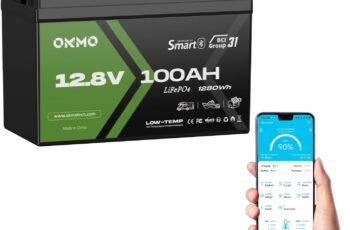
The Power Queen 12V 100Ah battery is listed as a 12.8V nominal, 100Ah LiFePO4 battery in Group sizing. Its stated package includes four Grade-A cells, an upgraded 100A BMS, and a five-year warranty.
For us, the Power Queen 12V 100Ah battery looks most relevant to shoppers replacing a Group lead-acid battery or building a compact energy-storage system. Before choosing it, we would check the physical fit, terminal arrangement, LiFePO4 charging setup, cycle-life claims, connection options, and intended loads. Those details will determine whether its feature set translates into a practical upgrade.

Design, Group Fit, and Installation Considerations
The physical replacement claim is one of this battery’s clearest selling points. The manufacturer says the Power Queen 12V 100Ah battery meets the BCI standard minimum size for Group batteries and is designed to fit Group battery boxes. It also states compatibility with Group and Group sizes, although that should not be read as a guarantee that every compartment or box will accept it.
For lead-acid owners, the advertised drop-in approach is appealing because the product description says an existing electrical system or wiring does not need modification for the upgrade. Even so, the Power Queen 12V 100Ah battery still needs suitable terminal connections and charging equipment. A nominally compatible box can have different clearances, polarity orientation, or terminal access.
Installation should be handled in this order:
- Confirm the compartment space, polarity, and terminal arrangement.
- Check whether the supplied terminal hardware matches the cable ends.
- If OT terminals are attached directly with screws and are under 2mm thick, add gaskets; the same precaution applies to clamps, helping prevent loosening or overheating.
- Secure the connection without leaving cables under strain.
- Verify that the charger or solar controller is suitable for LiFePO4 chemistry before energising the system.
The Power Queen 12V 100Ah battery is therefore easiest to consider as a replacement when the existing enclosure and wiring arrangement already suit the intended installation.


October 14, 2026 6:44 pm
Battery Cells and the Upgraded 100A BMS
The Power Queen 12V 100Ah battery uses four Grade-A LiFePO4 cells. The manufacturer connects those cells with heightened energy density and power delivery, but the supplied information does not provide a continuous discharge figure or a measured output result. We should therefore treat the cell specification as an indication of the battery’s chemistry and construction, not as proof that every demanding appliance will run.
Its upgraded 100A battery management system is the principal stated protection layer. The Power Queen 12V 100Ah battery is described as having protection against:
- Overcharge
- Over-discharge
- Over-current
- Over-voltage
- Overload
- Short circuit
That list is useful, but a BMS rating should not be treated as a promise that all connected equipment is compatible. The available product information does not state peak-current duration, low-temperature charging behaviour, or app monitoring. It also does not tell us how the BMS will behave with every inverter or motor load.
We would match the Power Queen 12V 100Ah battery to the inverter, solar controller, cable protection, and expected loads as one complete system. Check the equipment specifications first, then consider whether the anticipated demand is appropriate for the battery’s stated protection architecture. Built-in safeguards can reduce certain electrical risks, but they cannot correct an unsuitable system design.
October 14, 2026 6:44 pm
Charging, Capacity, and Claimed Cycle Life
The manufacturer recommends charging the Power Queen 12V 100Ah battery at 14.6V and 20A. Using the supplied calculation, 100Ah divided by 20A equals approximately five hours for a full charge. That is an estimate rather than a guaranteed charging time, since the charger, charging profile, starting state, and final charging stage can affect the result.
The advertised cycle figures vary with depth of discharge. The Power Queen 12V 100Ah battery is listed at 4,000 cycles at 100% DOD, more than 6,000 cycles at 80% DOD, and up to more than 15,000 cycles at 60% DOD. Those figures should be read as manufacturer claims, not guaranteed real-world results. The supplied details do not identify the test temperature, load profile, test method, or end-of-life capacity threshold.
We would set up charging in this sequence:
- Confirm that the charger or solar controller supports LiFePO4 batteries.
- Use the recommended voltage and current where the equipment allows those settings.
- Make sure connections are secure and the installation has adequate ventilation.
- Follow the battery system’s charging instructions rather than relying on a generic lead-acid profile.
The stated lifespan of up to years and the five-year warranty are separate from cycle-life claims. A warranty is a coverage term, while cycle figures describe an advertised usage expectation; neither should be treated as an assurance of identical performance in every installation.
Series and Parallel Expansion Options
The Power Queen 12V 100Ah battery supports both series and parallel connections, giving shoppers a way to increase system voltage, capacity, or both. The product description states that up to batteries can be arranged in a 4P4S configuration, producing a 51.2V 400Ah battery bank with a maximum energy output of 20.48kWh.
In plain terms, 4P4S means four batteries or battery groups are placed in parallel at each stage to increase capacity, while four of those parallel stages are connected in series to increase voltage. The Power Queen 12V 100Ah battery can therefore form part of a larger bank, but the expansion claim does not remove the need for careful system planning.
For a multi-battery installation, we would use matched batteries and keep wiring lengths consistent where practical. Before adding units, confirm that the inverter, charger, fuses, disconnects, and cabling support the planned voltage and current. The Power Queen 12V 100Ah battery should also be evaluated alongside the protection equipment, since a larger bank changes the electrical demands of the complete system.
Our recommended expansion process is straightforward: decide whether the project needs more voltage, more capacity, or both; map the intended series and parallel arrangement; check every component against that arrangement; and only then assemble the bank. The advertised maximum is useful for planning, but it is not a reason to expand beyond what the rest of the installation can safely support.
Power Queen 12V 100Ah Battery for RVs and Solar Storage
The Power Queen 12V 100Ah battery is presented for efficient solar energy storage systems, RV camping, and compact deep-cycle power setups. That target is more relevant than starter-battery use because the manufacturer specifically says it is an energy-storage battery and advises against using it to start engines or power golf carts.
For an RV owner, the Group positioning may help when replacing a battery in a confined compartment. The Power Queen 12V 100Ah battery makes sense to investigate when the available enclosure, terminal layout, charger, and expected daily energy use line up with the installation. We would also consider whether an inverter will be used, what loads it must support, and whether the battery will operate alone or as part of a bank.
Solar shoppers should view the Power Queen 12V 100Ah battery as one component in a complete system. The panels, charge controller, inverter, protection devices, and wiring all need to work together. A battery’s capacity alone does not establish how much solar energy the system can collect or how much appliance demand it can handle.
Before purchase, we would write down the storage role, expected daily use, charging source, and peak equipment demands. Shoppers needing an engine-starting battery or a product designed for golf carts should choose a model intended for those duties instead of treating this deep-cycle storage battery as a universal substitute.
October 14, 2026 6:44 pm
What Customers Are Saying
No star rating, review count, or individual verified-buyer comments were supplied with the product information available for this review. We therefore cannot honestly claim that buyers praise the Power Queen 12V 100Ah battery, nor can we report recurring complaints as established customer patterns.
If review information is added later, we would separate installation feedback from performance feedback. Comments about the Power Queen 12V 100Ah battery fitting a Group box or replacing a lead-acid unit would answer a physical-installation question; they would not, by themselves, confirm charging behaviour, usable capacity, or long-term reliability.
Relevant review themes to examine include:
- Group fit and ease of replacement
- Charging behaviour with RV or solar equipment
- Terminal security and connection quality
- Performance in RV energy storage
- Solar-storage results and long-term reliability
We would also investigate repeated reports of fit discrepancies, charging interruptions, BMS cutoffs, loose terminals, or capacity concerns. A single unverified anecdote is not measured capacity testing, while several specific reports describing the same conditions deserve closer attention.
Our review-checking method would be to sort for recent comments, compare RV and solar users separately, look for details about installation and charging, and give more weight to repeated, specific experiences than to one-line praise. That approach should help shoppers assess the Power Queen 12V 100Ah battery without inventing customer evidence that is not present.
How It Compares With Similar 100Ah LiFePO4 Batteries
Two names shoppers may also encounter are the LiTime 12V 100Ah LiFePO4 Battery and the Renogy 12V 100Ah Smart LiFePO4 Battery. We do not have enough supplied information to make factual claims about either model’s specifications, price, rating, warranty, or performance, so the comparison should focus on what each listing documents rather than on assumptions based on the shared 12V and 100Ah labels.
For the Power Queen 12V 100Ah battery, the documented points to compare are Group replacement positioning, stated compatibility with Group and Group sizes, a 100A BMS, a five-year warranty, the published cycle-life claims, recommended charging figures, series and parallel support, and the $239.99 current price. We have not been supplied with equivalent verified details for the two alternatives.
Before choosing, we would create a side-by-side table with these columns:
- Physical dimensions and terminal layout
- Group-size or replacement claims
- BMS protections and monitoring features
- Charging requirements
- Warranty and cycle-life claims
- Series and parallel support
- Current price
The Power Queen 12V 100Ah battery has its clearest documented advantages in the Group replacement design, broader Group and compatibility claims, stated expansion capacity, and five-year warranty. We would still verify that LiTime or Renogy models are intended for the same energy-storage role, since not every 12V 100Ah lithium battery is a starter battery or a direct physical replacement.
Who Should Buy This Battery?
The strongest match for the Power Queen 12V 100Ah battery is an RV owner, solar-storage user, or lead-acid owner seeking a Group LiFePO4 energy-storage option. Its stated five-year warranty, built-in protection, cycle-life claims, and ability to connect multiple batteries may appeal to buyers planning a compact system now with possible expansion later.
We would be more cautious if the intended job is engine starting, golf-cart operation, app-based monitoring, or a system that needs explicitly documented low-temperature charging behaviour. The supplied product details do not establish those capabilities. The Power Queen 12V 100Ah battery should be judged against the actual job, not simply against its nominal voltage and capacity.
Our pre-purchase checklist is:
- Measure the available compartment and confirm the battery-box arrangement.
- Confirm that the terminal layout and cable connections are compatible.
- Verify the charger’s LiFePO4 settings and recommended charging values.
- Calculate the expected loads and daily energy use.
- Check that the inverter and protection equipment suit those loads.
- Decide whether future series or parallel expansion is required.
We would choose the Power Queen 12V 100Ah battery when those checks support its energy-storage role. Buyers who need different monitoring, starting capability, or temperature documentation should compare products designed around those specific needs instead.
Pros and Cons
Pros
- Group replacement positioning with stated compatibility claims for Group and Group sizes
- 100Ah LiFePO4 capacity with four Grade-A cells
- Upgraded 100A BMS with stated overcharge, over-discharge, over-current, over-voltage, overload, and short-circuit protection
- Five-year warranty and advertised cycle-life figures at different depths of discharge
- Supports series and parallel expansion up to the stated 4P4S configuration
Cons
- Not advised for engine starting or golf-cart use
- The supplied information does not include a star rating, review count, or individual customer comments
- No supplied details confirm app monitoring, low-temperature charging behaviour, continuous discharge rating, or peak-current duration
- Physical fit and terminal arrangement still need to be checked for the specific compartment
- Advertised cycle-life and lifespan figures lack supplied test conditions and should not be treated as guaranteed results
Final Verdict
Key Takeaways
- The battery is a 12.8V nominal, 100Ah LiFePO4 energy-storage model intended for RV and solar deep-cycle use, not engine starting or golf carts.
- Its documented selling points include Group replacement positioning, compatibility claims for Group and Group sizes, a 100A BMS, and a five-year warranty.
- Charging should be planned around the manufacturer’s recommended 14.6V and 20A figures, using equipment suitable for LiFePO4 chemistry.
- The advertised cycle life varies by depth of discharge, but the supplied information does not provide test conditions or guarantee real-world results.
- At $239.99, it is worth considering when the battery compartment, charging equipment, expected loads, and future expansion plans all match.
Frequently Asked Questions
Is this battery suitable for starting an engine?
No. The product description identifies it as an energy-storage battery and advises against using it to start engines or power golf carts.
What charging setup does it require?
The manufacturer recommends a 14.6V charging voltage and 20A charging current. The charger or solar controller should also be suitable for LiFePO4 chemistry.
Can it be connected to other batteries?
Yes. The listing states that the battery supports series and parallel connections, including a maximum 4P4S arrangement using up to batteries.
Are customer ratings available for this review?
No star rating, review count, or individual buyer comments were included in the supplied product data, so customer sentiment cannot be reported responsibly.
Who is this battery best suited to?
It is primarily aimed at RV, solar-storage, and other compact deep-cycle energy-storage applications, especially where a Group replacement is needed.
Disclosure: As an Amazon Associate, I earn from qualifying purchases.