We’ll assess the ECO-WORTHY 24V 100Ah LiFePO₄ battery for RV, solar, and backup use, focusing on its 100A BMS, Bluetooth 5.1 monitoring, and low-temperature protection. We’ll also consider its metal enclosure, stacking support, dimensions, and installation requirements. Its safety features and expansion options look practical, but cold-weather cutoffs and Bluetooth access may affect day-to-day use—so let’s examine what the specifications mean in practice.
Key Takeaways
- The ECO-WORTHY 24V 100Ah LiFePO₄ battery includes a built-in 100A BMS, Bluetooth monitoring, and low-temperature protection.
- Its flame-retardant metal casing, internal cell fixture, and discharge safety switch add safety features.
- At 50.7 pounds, it measures 15.36 × 11.82 × 5.79 inches and may be awkward to handle.
- It supports stacking and expansion up to 2P2S, with a stated maximum system capacity of 10.24 kWh; extra batteries are sold separately.
- It suits RV, solar, and home backup use, but installation requires care and cold-weather cutoffs may limit operation; the warranty is three years.
Bluetooth 5.1 Monitoring
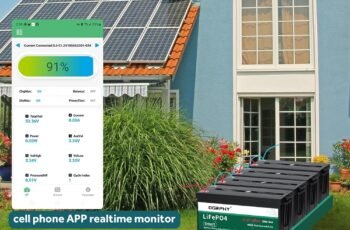
With Bluetooth 5.1, we can monitor the battery from a phone without relying solely on its built-in indicators. App monitoring provides access to voltage, current, capacity, and estimated remaining lifespan, helping us assess operating status during use.
We can check these readings while managing an RV, off-grid installation, or home backup system, provided the phone maintains a Bluetooth connection. If the app can’t connect, connection troubleshooting starts by disconnecting other devices using the link.
If that doesn’t restore access, we can fully discharge the battery, let it rest for one minute, then recharge it to reset the Bluetooth module and try again.
Detailed features
Beyond Bluetooth monitoring, this 24V, 100Ah battery has a built-in 100A BMS and a flame-retardant metal casing designed to resist fire and impact. We also get an internal metal fixture that helps limit cell expansion, plus a safety switch that interrupts discharge. Turn it off before connecting or disconnecting.
| Feature | Specification |
|---|---|
| Low temperature protection | Stops charging below 20°F and discharging below −4°F |
| Recovery | Resumes automatically at 32°F |
For system planning, we can stack units with stabilizing feet and accessories in configurations up to 2P2S, reaching 10.24 kWh. The battery measures 15.36 × 11.82 × 5.79 inches and weighs 50.7 pounds.
Pros and Cons
We’ll weigh the battery’s built-in 100A BMS, Bluetooth monitoring, low-temperature protection, and stackable design against its 50.7-pound weight and configuration limits.
We’ll also consider its installation and charging requirements, including the need for a dedicated LiFePO₄ charger if activation is necessary. This comparison will help you assess its practical advantages and trade-offs for your system.
Pros
A key advantage of the ECO-WORTHY 24V 100Ah LiFePO₄ battery is its built-in 100A BMS, which provides low-temperature protection and works with a safety switch that disconnects the discharge circuit during installation or removal. We also get Bluetooth 5.1 monitoring for voltage, current, capacity, and estimated lifespan through a phone.
Its flame-retardant metal casing and internal fixture help protect the cells, while the compact footprint suits RVs and solar installations. Stabilizing feet and included accessories support secure stacking. We can expand the system in configurations up to 2P2S, reaching 10.24 kWh. The three-year warranty adds documented manufacturer coverage.
Cons
Despite its safety features and expandability, the ECO-WORTHY battery has practical limitations: at 50.7 pounds, it may be awkward to handle, and its 15.36 × 11.82 × 5.79-inch footprint requires adequate installation space.
We’ll also need to account for installation complexity when stacking units or wiring a 2P2S bank; incorrect connections can compromise system performance. Its cold weather limits may restrict winter use: charging stops below 20°F, while discharge protection activates below −4°F, and operation resumes at 32°F.
The package includes only one battery, so expansion requires additional purchases. A low arrival charge or Bluetooth connection issue may also require troubleshooting.
Concluding thoughts
Overall, the ECO-WORTHY 24V 100Ah LiFePO₄ battery combines a built-in 100A BMS, Bluetooth monitoring, low-temperature protection, and a flame-retardant metal casing in a stackable 50.7-pound package. We see useful installation flexibility for RVs, solar systems, and backup setups, with expansion up to 2P2S and 10.24 kWh.
The app reports voltage, current, capacity, and remaining lifespan, while temperature cutoffs help protect cells in cold conditions. Before wiring, switch off the discharge circuit; use a compatible LiFePO₄ charger if activation is needed. We’d weigh its three-year warranty and safety features against system requirements to judge long term value.
Frequently Asked Questions
What Charger Should I Use With This Battery?
We recommend a dedicated 24V LiFePO₄ Battery charger compatible with lithium chemistry. Check its specified Charging voltage against the battery manufacturer’s requirements, and choose pulse activation if charging fails or the battery arrives deeply discharged.
What Should I Do if the Battery Arrives With a Low Charge?
Initial charging guidance: We should charge it with a dedicated LiFePO₄ charger featuring pulse activation. Low voltage precautions: If charging or discharging fails, we should use pulse activation; don’t assume shipping-related low charge indicates battery damage.
How Do I Reset the Bluetooth Module if It Won’T Connect?
For Bluetooth pairing, we can first disconnect other devices using the battery’s connection. If it still won’t connect, perform a module reset: fully discharge the battery, wait one minute, then recharge it.
What Does the Safety Switch Do During Installation?
The Safety Switch Function cuts the battery’s discharge circuit. For Installation Power Control, we should turn it OFF before connecting or disconnecting cables to reduce sparks and electric-shock risk; keep it ON during normal operation.
What Is the Manufacturer’s Warranty Period?
We get three years of manufacturer warranty coverage—brief, perhaps, beside a battery’s long ambitions. For claim process details, we should contact the manufacturer; the provided information doesn’t specify claim steps, exclusions, or coverage conditions.
Conclusion
Overall, we see the ECO-WORTHY 24V 100Ah LiFePO₄ battery as a practical option for RV, solar, and backup systems that benefit from Bluetooth monitoring and built-in low-temperature protection. Its 100A BMS and metal casing add useful safeguards, while stabilizing feet support expansion up to 2P2S. At 50.7 pounds, it also delivers substantial capacity in a compact package. We recommend planning for cold-weather cutoffs and installation clearance, and checking Bluetooth connectivity during setup.