ECO-WORTHY Cubix100 Battery: Product Overview
Can a $1,679.99 two-battery rack system deliver practical value for solar storage and home backup in 2026? The ECO-WORTHY Cubix100 battery is worth considering if we already have a compatible 48V-class inverter and want a substantial fixed storage foundation, but it isn’t a complete solar kit. The price is attractive for the stated capacity and certifications, while compatibility and installation details will determine whether the savings are real.
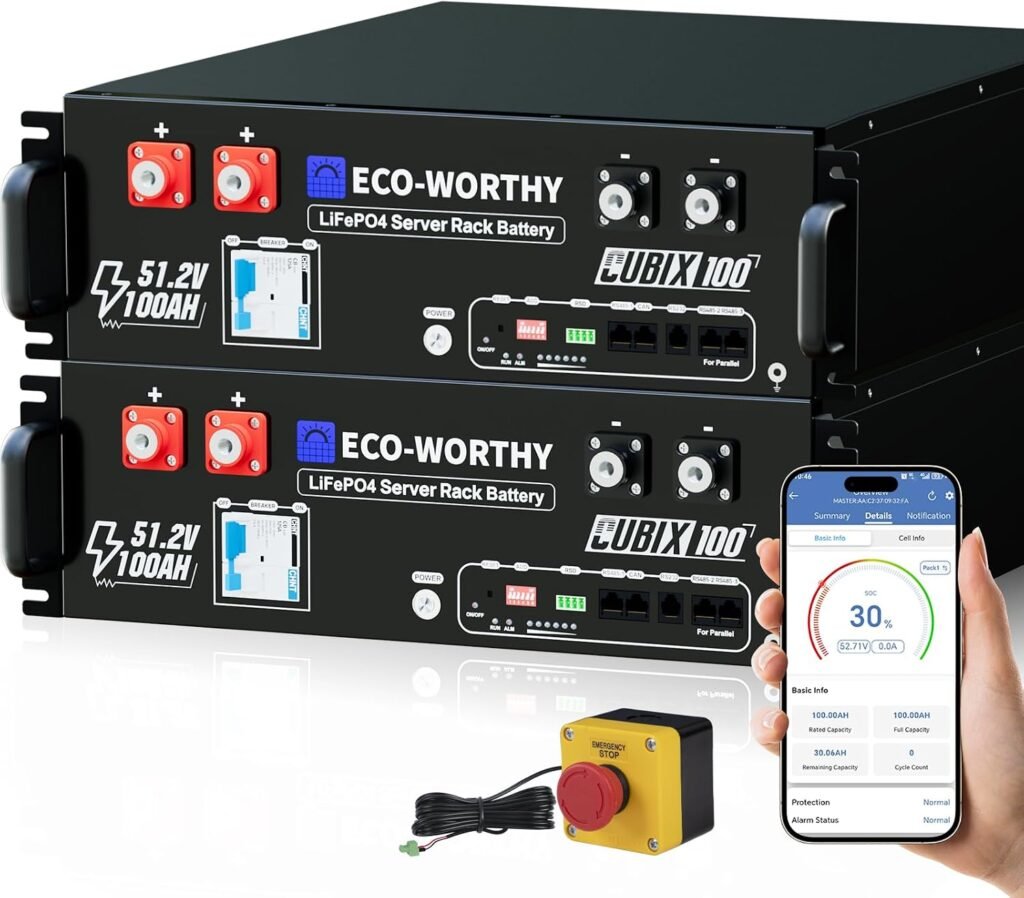
The ECO-WORTHY Cubix100 battery listing contains two separate 48V 100Ah LiFePO4 units. Connected as a parallel bank, they form a nominal 48V 200Ah system with stated energy storage of 10.24kWh. That distinction matters: the product name can make this look like one 200Ah battery, but the package is actually a two-pack of individual 100Ah batteries.
At the time of writing, the ECO-WORTHY Cubix100 battery is listed in stock at $1,679.99, reduced from $1,999.99. Its strongest selling points are UL9540, UL1973, and CEC listings, a server-rack enclosure, Bluetooth and WiFi monitoring, CAN/RS485 inverter communication, and expansion of up to individual units. We still need to assess rack compatibility, wiring, communications setup, inverter integration, and the fact that no inverter, solar panels, or charging equipment is supplied.

ECO-WORTHY Cubix100 Battery Specifications and Included Hardware
The ECO-WORTHY Cubix100 battery uses a 48V-class architecture, although the stated battery voltage is 51.2V. That is common for LiFePO4 systems because four nominal 3.2V cells connected in series produce a 12.8V module, while cells in series produce a 51.2V battery commonly marketed for 48V equipment.
| Specification | Stated detail |
|---|---|
| Nominal system | 48V |
| Battery voltage | 51.2V |
| Combined capacity | 200Ah |
| Total stated energy | 10.24kWh |
| Chemistry | LiFePO4 |
| Package configuration | Two battery units |
The 10.24kWh figure follows directly from 51.2V multiplied by 200Ah. It is a nominal calculation, not a promise that every watt-hour will be available to the load. The batteries use Grade A LiFePO4 cells, a chemistry generally valued for thermal stability, durability, and repeated charge-discharge use; the supplied information does not provide a cycle count or maximum output-current rating, so we won’t invent either.
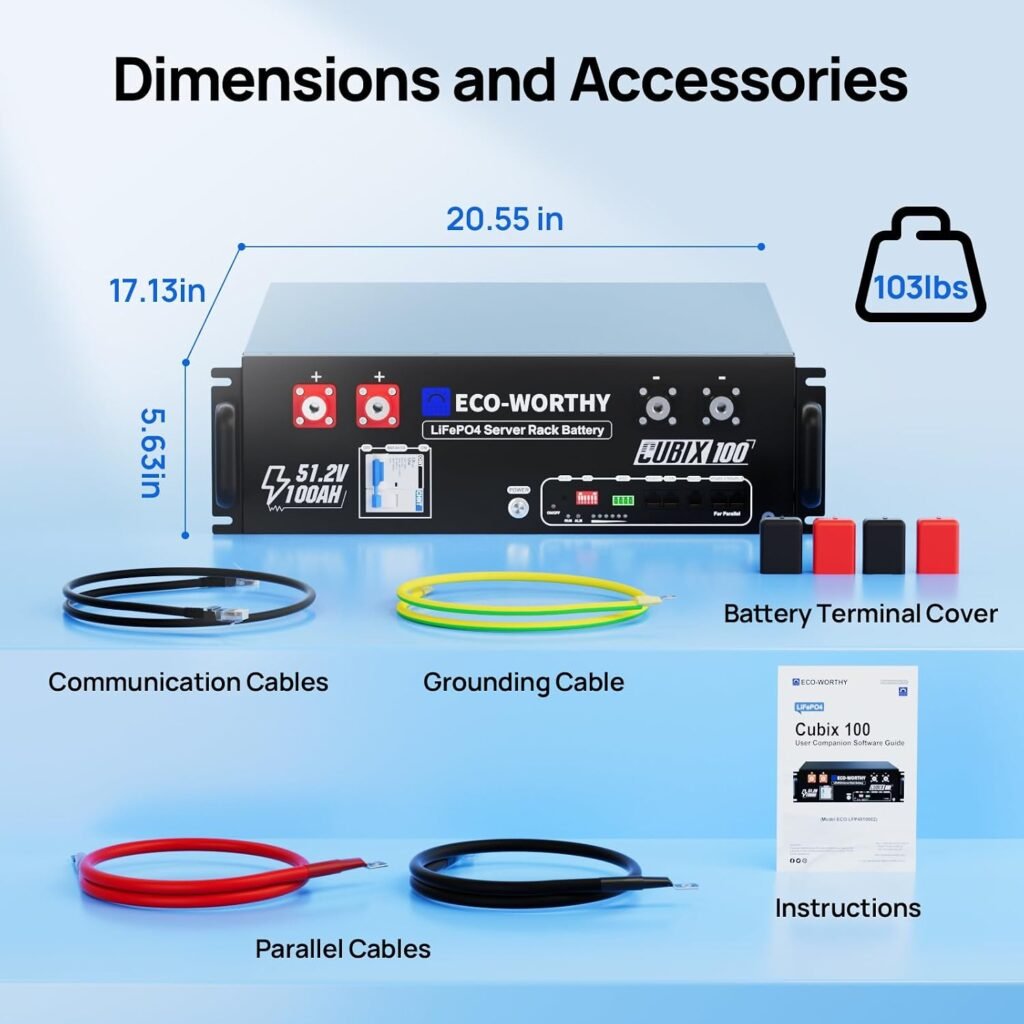
Included hardware is described as parallel cables, communication cables, grounding wires, protective terminal covers, mounting screws, and a user manual. Although the package is marketed as plug-and-play, we would still need a compatible inverter, suitable charging settings, rack or vertical mounting space, and safe high-current installation. Orders may arrive in multiple packages, so we should check tracking and the packing list before assuming the second battery or accessories are missing.
Safety Certifications, Battery Management, and LiFePO4 Design
The ECO-WORTHY Cubix100 battery carries three useful North American listings, each relevant to a different part of the purchase decision. UL9540 is associated with energy-storage systems, UL1973 addresses stationary battery safety, and the CEC listing relates to eligibility under California Energy Commission requirements. The product description says comprehensive testing was completed by Intertek.
These credentials provide more confidence than an unlisted battery, particularly for a permanent garage, utility-room, or home-backup installation. The description also refers to electrical-safety testing and thermal-runaway management. Those are reassuring design targets, but certification doesn’t make an incorrectly wired system safe and doesn’t replace local permitting, inspection, ventilation requirements, grounding, overcurrent protection, or correct inverter programming.
LiFePO4 is widely selected for stationary storage because it is generally more thermally stable than several other lithium chemistries and suits frequent cycling. The ECO-WORTHY Cubix100 battery should still be treated as high-energy electrical equipment, not as a casual plug-in appliance.
- Confirm local code, permit, and inspection requirements.
- Check that the inverter accepts the battery’s voltage range and communications method.
- Inspect both units for shipping damage before connecting them.
- Fit the supplied terminal covers and establish the grounding arrangement.
- Have a qualified electrician complete high-current connections and protective-device installation.
Following that sequence reduces avoidable risk. The ECO-WORTHY Cubix100 battery can offer a well-documented starting point, but the quality of the finished installation remains part of the safety equation.
Communication, Bluetooth, WiFi, and Inverter Compatibility
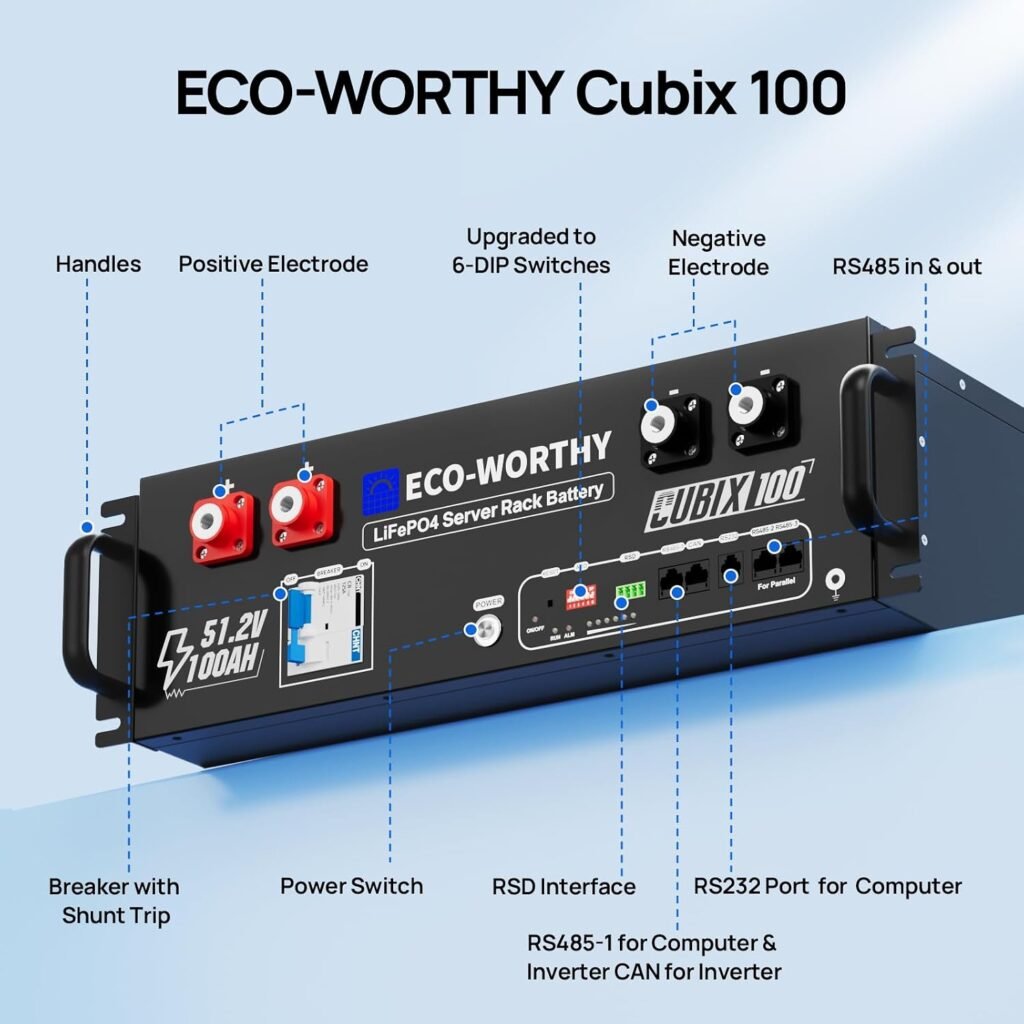
The ECO-WORTHY Cubix100 battery supports a closed-loop communication approach through CAN and RS485 interfaces. Instead of relying only on generic voltage settings, a compatible inverter can exchange operating information with the battery, potentially improving coordination of charging, discharge limits, and state-of-charge reporting.
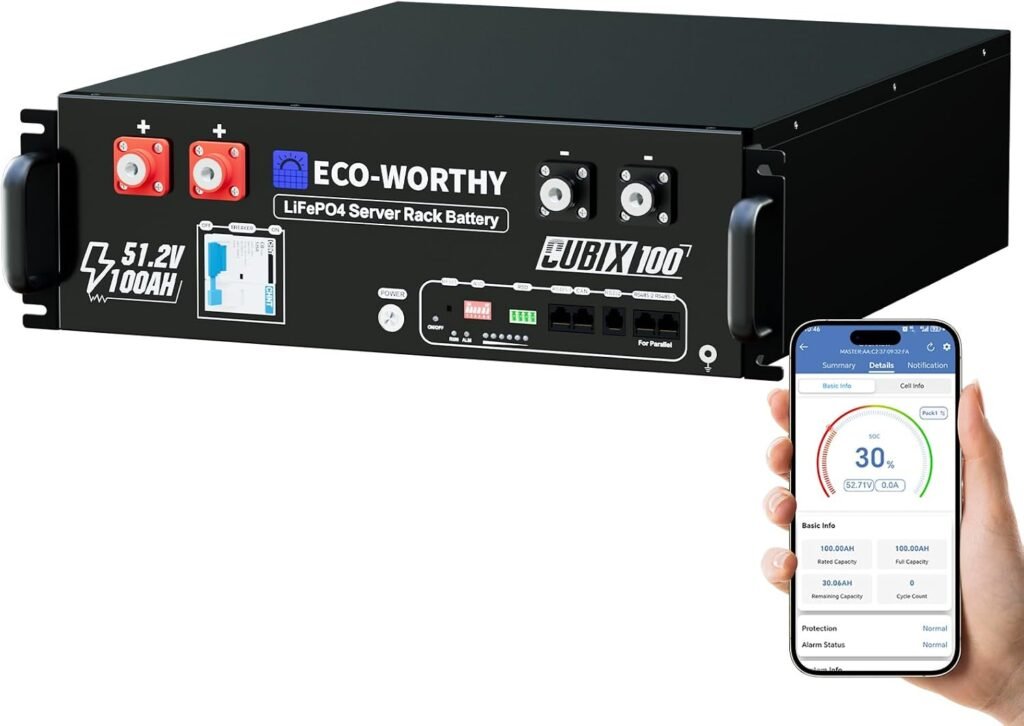
Integrated Bluetooth and WiFi add a practical monitoring layer. Through the ECO-WORTHY app, we should be able to check battery status and system information without standing beside the rack. That convenience is valuable during commissioning, although the supplied product information does not include an app rating, a communications pinout, an exact supported-inverter list, or maximum continuous charge and discharge current.
Before buying, we should compare the inverter manual with the battery documentation for supported brands, CAN or RS485 protocol, pinout, baud rate, firmware requirements, and approved cable arrangement. An RJ-style plug that fits physically does not prove that the protocol is compatible. The ECO-WORTHY Cubix100 battery needs confirmation from the manufacturer or the inverter documentation before we commit.
- Install the app and create the required account.
- Pair one battery at a time and confirm that readings appear correctly.
- Configure the parallel units according to the manual.
- Test inverter communication before applying full charging or discharge loads.
- Verify charging, discharge, and state-of-charge limits during a controlled trial.
This process is more reliable than assuming every 48V inverter will communicate automatically. The ECO-WORTHY Cubix100 battery has the right interface concept, but protocol detail is the purchase checkpoint.

Server-Rack Installation and 32-Unit Expansion
The ECO-WORTHY Cubix100 battery is designed around a server-rack format, with vertical mounting support for a fixed solar-storage wall, equipment rack, utility room, or garage installation. Standardized rack-style packaging can use space more efficiently than separate floor-standing battery boxes and may make a growing battery bank easier to organize.
We should not, however, assume that every rack or cabinet will accept these units. The supplied data does not state cabinet dimensions, rail requirements, battery weight, or clearance requirements. Before ordering, we should obtain those measurements and confirm that the supporting structure, ventilation, service access, and cable routes are suitable.
The listing advertises parallel expansion to up to units, with capacity reaching 163.8kWh. The two-pack’s 10.24kWh is based on two 48V 100Ah batteries; the 32-unit claim refers to individual 48V 100Ah batteries, not two-packs. That distinction prevents a major capacity misunderstanding.
- Start with the two included units and commission them as a matched pair.
- Use matching batteries and keep firmware and installation conditions consistent.
- Plan the communication network, addressing, grounding, and protective devices before expansion.
- Add units in stages and test the bank after each addition.
Large parallel banks need correctly sized busbars, fuses, cable-length matching, battery addressing, grounding, and inverter-current limits. Adding more units is not simply a matter of plugging in extra cables. The ECO-WORTHY Cubix100 battery supports an ambitious expansion path, but the electrical design must grow with it.
Real Customer Feedback: What Buyers Should Look For
The ECO-WORTHY Cubix100 battery listing supplied for this review does not show a customer rating or review count at publication time. We therefore can’t honestly claim that buyers consistently praise its capacity, app, delivery, output, or support, and we won’t manufacture a review trend to fill the gap. Shoppers should check the live review area for detailed accounts before placing an order.
The most useful customer comments will separate the two-package delivery experience from product performance. We would look for reports about whether both batteries arrived, the condition of the packaging, missing cables, rack installation, app pairing, inverter communication, usable capacity, and the time taken to receive support. Because the seller explicitly warns that shipments may arrive separately, a partial delivery should be checked against tracking before being treated as a defect.
Reviews describing a genuinely plug-and-play installation deserve context. Did the owner use the same inverter brand, need custom CAN settings, buy rack hardware separately, or use an electrician? A successful pairing on one inverter doesn’t prove universal compatibility, while one failed setup may reflect a pinout or firmware mismatch rather than a defective battery.
For the ECO-WORTHY Cubix100 battery, we would prioritize verified-purchase reviews with installation details over short comments that only say “works” or “bad.” We would also compare comments posted at different times, watching for repeated complaints about unclear manuals, wireless connectivity, state-of-charge accuracy, packaging, compatibility, or delayed support. Until a visible body of detailed reviews exists, the ECO-WORTHY Cubix100 battery should be judged primarily on its published specifications and our compatibility checks, not assumed customer consensus.
How the ECO-WORTHY Cubix100 Battery Compares With Alternatives
The ECO-WORTHY Cubix100 battery occupies a different category from the EVE LiFePO4 Cell 3.2V 100Ah Grade A Deep Cycle Battery. EVE cells are component-level building blocks for someone designing a custom pack, adding a BMS, busbars, enclosure, wiring, and protection. The Cubix100 is a packaged 48V-class server-rack storage system with its own battery management, communication interfaces, wireless monitoring, accessories, and a defined parallel-expansion path.
The comparison with the ECO-WORTHY 12V 100Ah LiFePO4 Battery is also about use case rather than a simple capacity contest. A 12V Group 31-style battery is more naturally suited to RV, marine, small off-grid, and other lower-voltage applications. The ECO-WORTHY Cubix100 battery is aimed at stationary solar storage and home backup, where a 48V-class architecture can fit the design of a compatible inverter.
We should compare complete-system cost rather than battery price alone. The final budget may include an inverter, rack or cabinet hardware, busbars, cables, fusing, disconnects, monitoring, installation labor, and permits. The Cubix100’s comparative strengths are the stated 10.24kWh supplied two-pack, UL9540, UL1973 and CEC listings, CAN/RS485 interfaces, Bluetooth and WiFi, and up to parallel units.
For the ECO-WORTHY Cubix100 battery, alternatives may be better when we need a portable vehicle battery, individual cells for a custom build, or a rack product with clearer inverter compatibility documentation. The ECO-WORTHY Cubix100 battery makes the most sense when packaged integration matters more than maximum design flexibility.
Who Should Buy the ECO-WORTHY Cubix100 Battery?
The ECO-WORTHY Cubix100 battery is best suited to homeowners who already have, or are selecting, a compatible 48V-class solar inverter and want a sizable fixed battery bank. Its intended roles include load shifting, outage backup, and off-grid energy storage. The two-unit package is a sensible middle ground for someone who needs more than a small 12V battery but doesn’t yet need the advertised 163.8kWh maximum expansion.
We would especially consider it if app-based monitoring, closed-loop inverter communication, rack-style organization, and recognized safety listings are priorities. The format can suit a planned equipment room or garage system better than a collection of unrelated portable batteries.
The ECO-WORTHY Cubix100 battery is less suitable for an RV owner who needs a portable 12V solution, a shopper expecting panels and an inverter in the box, or a renter who lacks authority to install permanent high-energy equipment. It is also a poor fit for anyone unwilling to verify CAN/RS485 protocol compatibility before purchase.
Our pre-purchase sequence would be:
- Identify the exact inverter model.
- Confirm supported CAN or RS485 communication.
- Verify voltage and current limits.
- Check rack space, access, support, and clearances.
- Review local electrical and permitting requirements.
- Budget for protective equipment and professional installation.
The stated 10.24kWh is nominal storage. Actual usable energy will vary with battery-management limits, inverter settings, temperature, loads, and overall system efficiency. That makes the ECO-WORTHY Cubix100 battery a planning component, not a guaranteed delivered-energy figure.
Pros and Cons
Pros
- Two-battery package provides a stated 10.24kWh of nominal storage.
- UL9540, UL1973, and CEC listings are stated, with testing attributed to Intertek.
- Built-in Bluetooth and WiFi enable app-based monitoring.
- CAN and RS485 interfaces support closed-loop communication with compatible inverters.
- Server-rack format and advertised parallel expansion to individual units support future growth.
- Included accessories cover parallel connection, communications, grounding, terminal protection, and mounting.
Cons
- No inverter, solar panels, or complete charging system is included.
- The supplied data does not provide an exact supported-inverter list, communications pinout, app rating, cycle count, or maximum continuous current.
- Rack dimensions, weight, rail requirements, and clearances are not stated and must be verified.
- Actual usable energy will be lower or different than nominal capacity depending on system limits and efficiency.
- Large parallel installations require careful electrical design and qualified installation.
- The review evidence supplied does not include a visible rating or review count, so customer consensus cannot be established.
Final Verdict
Key Takeaways
- The two-pack contains two 48V 100Ah batteries forming a nominal 48V 200Ah, 10.24kWh bank; it is not one standalone 200Ah unit.
- UL9540, UL1973, and CEC listings add confidence, but they don’t replace compliant wiring, protection, permitting, or professional installation.
- CAN/RS485 compatibility must be confirmed with the exact inverter model; a physically matching connector doesn’t guarantee communication.
- The $1,679.99 price is attractive at approximately $164.06 per nominal kWh before installation and balance-of-system costs.
- This is best for fixed solar or home-backup projects, not RV users, renters, or shoppers seeking a complete panel-and-inverter kit.
Frequently Asked Questions
Are ECO-WORTHY LiFePO4 batteries any good?
They can be a good fit when the voltage, inverter communication, installation method, and safety requirements match the project. For this model, the published advantages include LiFePO4 chemistry, UL9540, UL1973, and CEC listings, plus CAN/RS485 and wireless monitoring; however, the supplied information does not establish a customer rating, cycle count, or universal inverter compatibility.
Which Amazon LiFePO4 battery is the best?
There isn’t one best LiFePO4 battery for every application. We should choose by voltage, usable capacity, BMS limits, inverter compatibility, certifications, warranty, physical format, and complete installed cost rather than brand name alone.
Which LiFePO4 battery is best for an RV?
An RV usually benefits from a lower-voltage 12V LiFePO4 battery designed for vehicle or marine layouts, suitable charging equipment, and the available battery compartment. A 48V server-rack system such as this one is intended for stationary solar storage and home backup, not portable RV use.
What are the downsides of LiFePO4 batteries?
Common drawbacks include higher upfront cost than some lead-acid options, the need for compatible charging and protection equipment, sensitivity to unsuitable charging conditions, and added installation complexity for larger banks. Their energy capacity is also nominal, so usable output depends on BMS limits, temperature, inverter efficiency, and operating settings.
Disclosure: As an Amazon Associate, I earn from qualifying purchases.