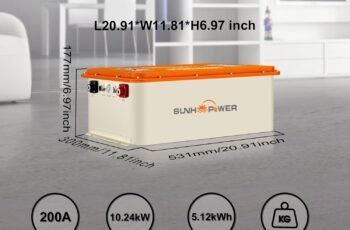
Can the ECO-WORTHY 12V 314Ah LiFePO4 battery deliver practical off-grid capacity without creating installation trade-offs? We’ll examine its 4,019Wh rating, 200A BMS, monitoring features, and expandable configurations, then weigh them against its 60.4-pound weight, dimensions, M8 terminals, and current limits. The charging cutoff below -7°C and three-year warranty also affect suitability, but the purchased model’s capacity and system compatibility may prove just as important.
Key Takeaways
- The 12.8V, 314Ah battery stores 4,019.2Wh, making it suitable for RV, solar, off-grid, and backup systems.
- Its 200A BMS, Bluetooth monitoring, LED indicators, buzzer, and voltage and temperature protections support safer operation.
- Charging stops below -7°C; the manufacturer claims Grade A cells can deliver up to 15,000 deep cycles.
- It weighs 60.4 pounds, measures 16.3 inches long, and uses M8 terminals, so plan mounting and cable connections carefully.
- Expansion is supported up to 32.15kWh, but check system voltage, inverter current demands, wiring compatibility, and the three-year warranty before buying.
314Ah Capacity and Configuration
The ECO-WORTHY’s 12.8V, 314Ah configuration stores 4,019.2Wh of energy, providing a substantial capacity for 12V systems. We can assess this rating against your system’s energy demand: divide usable watt-hours by average load to estimate runtime, allowing for conversion losses and reserve capacity.
The 314Ah specification reflects an upgrade from the previous 300Ah version, effective April 16, 2026, so confirm which capacity ratings apply to the unit you’re buying. For larger banks, expansion options support configurations up to 4P2S or 2P4S, with a stated maximum total capacity of 32.15kWh. We should match the arrangement to system voltage and required storage.
Detailed features
Beyond capacity, this battery’s Bluetooth connection lets us monitor state of charge and operating status in the ECO-WORTHY app, while onboard LEDs provide a quick local check. Bluetooth monitoring also supports fault checks; a built-in buzzer signals alerts.
| Feature | Specification | Function |
|---|---|---|
| BMS | 200A | Manages protection |
| Voltage safeguards | High and low | Limits voltage faults |
| Temperature safeguards | High and low | Includes low temperature protection |
| Charging cutoff | Below -7°C | Stops charging |
| Terminals | M8 | Connects system cables |
The BMS also guards against overloads. Grade A cells support up to 15,000 deep cycles, while the manufacturer states lifespan exceeds three times that of lead-acid batteries. We can use the battery in RV, solar, off-grid, or home-backup systems.
Pros and Cons
We’ll weigh the battery’s 4,019.2Wh capacity, app monitoring, and protective BMS against its 60.4 lb weight and three-year warranty.
We’ll also assess how its expansion options and cycle-life claims affect practical value. This comparison will help you decide whether its strengths outweigh its limitations for your setup.
Pros
With 4,019.2Wh of capacity and a 200A BMS, the ECO-WORTHY 12V 314Ah battery offers substantial energy storage alongside protection against voltage, overload, and temperature faults.
| Advantage | Specification | Reader benefit |
|---|---|---|
| Expandability | Up to 32.15kWh | Scales with demand |
| Monitoring | Bluetooth monitoring | Checks status remotely |
| Cold protection | Charging stops below -7°C | Protects cells |
| Cycle life | Up to 15,000 cycles | Supports long service |
We also value its lightweight construction: at 60.4 pounds, it’s described as one-third lighter than lead-acid batteries. Grade A cells and a three-year warranty add confidence. For RVs, solar systems, or backup, we can configure multiple batteries to increase capacity.
Cons
Despite its high capacity, the ECO-WORTHY battery has trade-offs: its 60.4-pound weight and 16.3-inch length may limit installation options, and its 200A BMS caps continuous current. We should verify that our inverter and loads stay within this limit, especially during startup surges.
Installation complexity can increase when we connect multiple batteries, since supported series-parallel configurations require careful wiring and compatible equipment. The M8 terminals also need correctly sized cables and secure connections.
At 12.8 volts, the battery may not suit systems designed for higher-voltage banks without additional units. Warranty limitations matter, too: the manufacturer provides three years of coverage, which may be short for long-term installations.
Concluding thoughts
For RVs, off-grid systems, solar setups, and home backup, the ECO-WORTHY 12V 314Ah LiFePO4 battery combines 4,019.2Wh of capacity with Bluetooth monitoring and a 200A BMS. We’d consider its app-based status checks, fault alerts, and low-temperature charging cutoff useful for monitoring and protection.
Its 60.4-pound weight and 16.3-inch length matter when planning installation, while expansion support allows larger configurations. ECO-WORTHY states that Grade A cells can deliver up to 15,000 deep cycles and a three-year warranty.
For Long term value and everyday reliability, we’d weigh those claims against our power needs, installation constraints, and budget before choosing this battery.
Frequently Asked Questions
What Charger Voltage Is Recommended for This Battery?
We can’t confirm a Recommended charging voltage from the available specifications; they don’t state one. For Safe charger settings, consult ECO-WORTHY’s manual or support before charging, and use a LiFePO4-compatible charger with the battery’s BMS.
Can This Battery Be Connected in Parallel With Other Brands?
Yes, we can connect it in parallel with other brands, but treat compatibility as a narrow bridge: match voltage, chemistry, capacity, and charge settings. Check Brand Compatibility and Parallel Limits with both manufacturers before connecting.
Is a Separate Fuse or Circuit Breaker Required?
Yes, we recommend separate Overcurrent protection; the battery’s 200A BMS doesn’t replace a fuse or breaker. We’d install one near the positive terminal and follow manufacturer guidance for fuse sizing, cable capacity, and connected equipment.
Can the Battery Power a 12V Trolling Motor?
Yes, we can power a 12V trolling motor if its current draw stays within the battery’s 200A BMS limit. Confirm motor compatibility, wiring, and fuse sizing; trolling motor runtime depends on load and conditions.
What Should I Do Before Storing the Battery Long-Term?
Before long-term storage, we should fully charge the battery, disconnect loads, clean battery terminals, and inspect storage area for dryness and safe temperatures. Check charge periodically, and follow ECO-WORTHY’s manual for storage-specific guidance and maintenance intervals.
Conclusion
We see the ECO-WORTHY 12V 314Ah LiFePO4 as a substantial 4,019Wh option for RVs, solar systems, and off-grid backup. Bluetooth monitoring, status LEDs, a buzzer, and a 200A BMS add useful oversight, while the below-freezing charging cutoff helps protect the battery. Need more capacity? Expandable configurations are rated up to 32.15kWh. Before buying, check your system’s current requirements, terminal fit, and available space: can it accommodate a 60.4-pound battery measuring 16.3 inches long? Confirm the model and warranty, too.