TalentCell 12V 6Ah Battery Review: Quick Product Overview
Finding a compact rechargeable backup for 12V electronics is harder than it sounds. Lead-acid batteries are familiar, but they can be bulky and inconvenient for a router, camera, light, or small display. The TalentCell 12V 6Ah battery takes a more portable approach: it is a 12.8V nominal LiFePO4 pack with 6,000mAh capacity and 76.8Wh of stored energy.
Listed at $35.99 and shown as in stock, it looks attractive for shoppers who need modest DC backup without buying a full power station. The capacity and chemistry point toward low-to-moderate power equipment rather than heating devices, large motors, or other demanding loads. For a compatible LED light, CCTV camera, router, telescope, fish finder, or small monitor, this pack is worth considering; the main condition is that the equipment must accept the battery’s voltage range and DC5521 connector polarity.
Our assessment looks at the published specifications, charging and protection features, practical compatibility, customer-review evidence available at publication time, alternatives, and ownership value. The early conclusion is straightforward: this is a focused 12V battery pack, not a universal power station, and its usefulness depends more on matching the connected device correctly than on the low purchase price alone.

TalentCell 12V 6Ah Battery Specifications and Included Capabilities
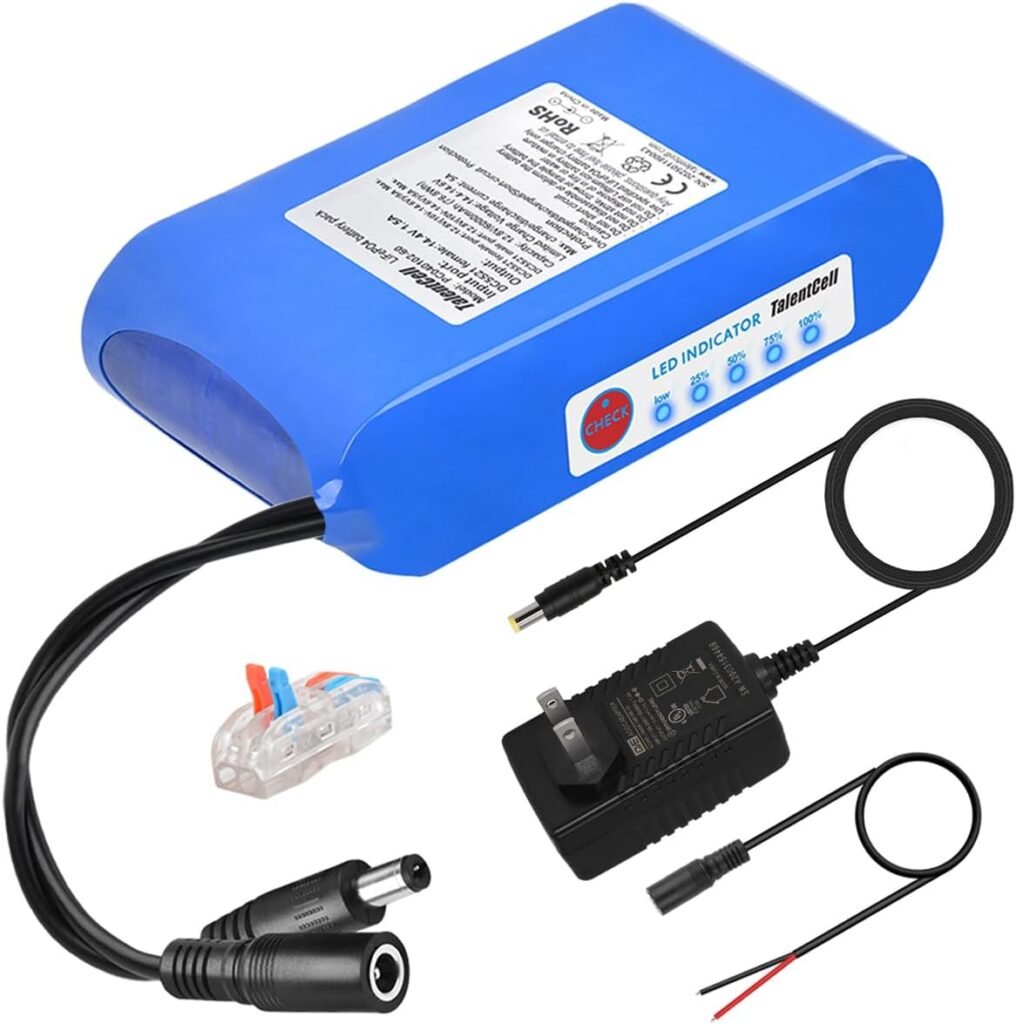
The published specification set is compact, but it answers the most important pre-purchase questions. Here is what the TalentCell 12V 6Ah battery provides through its main DC output:
| Specification | Published detail |
|---|---|
| Nominal voltage | 12.8V |
| Capacity | 6,000mAh |
| Stored energy | 76.8Wh |
| DC5521 maximum output | 5A |
| Stated output range | 9V to 14.6V |
Nominal voltage is an average reference rather than a promise that the port will deliver exactly 12.8V at every moment. The listing says the output remains approximately between 12V and 13V for more than 90% of a discharge cycle, while the stated overall range is 9V to 14.6V. That distinction matters for equipment that expects tightly regulated power.
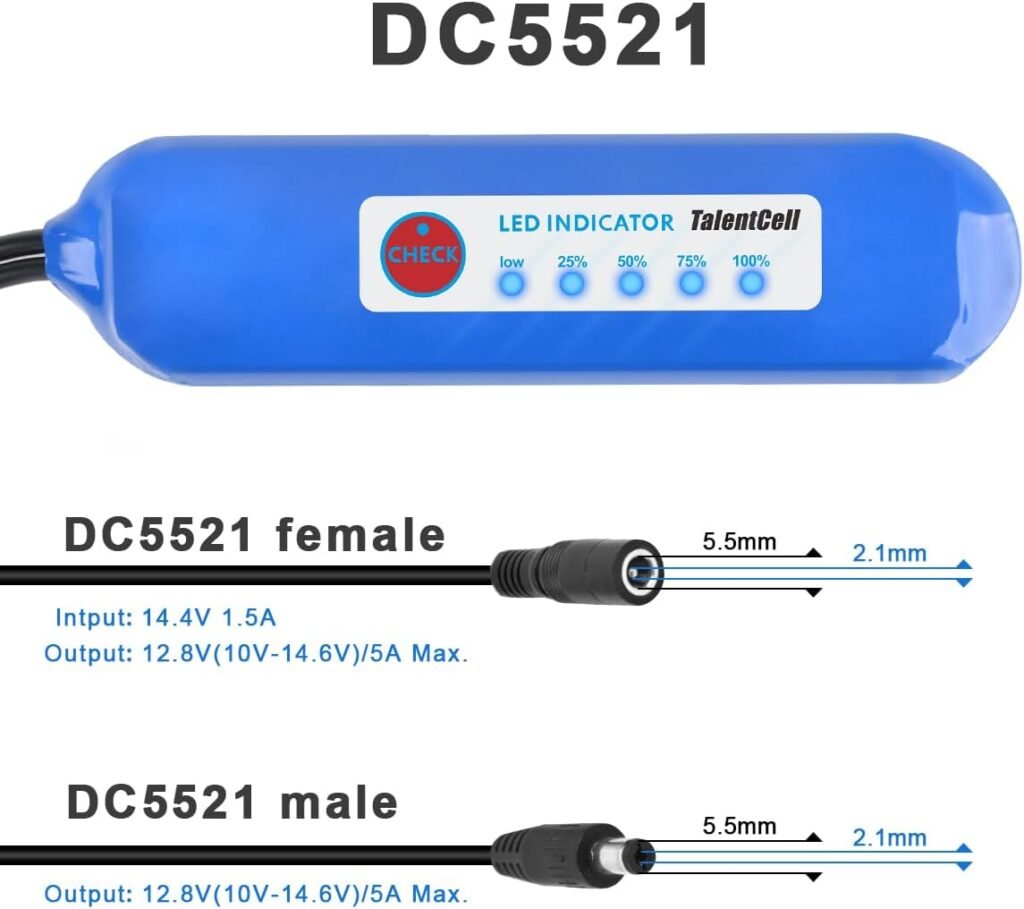
The DC5521 port uses inner positive and outer negative wiring. Connector dimensions, polarity, voltage tolerance, and current requirements all need to match before connection. A plug that fits physically can still be electrically wrong, so we would never rely on appearance alone.
This is a rechargeable battery pack, not a complete power station, AC inverter, or universal charger. To estimate runtime, divide usable watt-hours by device wattage: runtime in hours = usable watt-hours ÷ device wattage. Actual results will be lower or otherwise different because of battery cutoff, conversion losses, changing load behaviour, and the difference between a device’s rated and real consumption.
LiFePO4 Chemistry, Cycle Life, and Protection Features
Lithium iron phosphate chemistry suits people who expect to recharge a backup pack repeatedly. The listing claims 3,000-plus cycles and describes the battery as lighter and smaller than a customary lead-acid equivalent. That combination is appealing for portable lighting, field equipment, and backup projects where carrying and cycling convenience matter more than maximum stored energy.
A cycle-life claim should be treated as a testing or marketing reference, not a guaranteed service-life promise. How long the pack lasts depends on discharge depth, charging method, storage conditions, temperature, and the load connected to it. Shallow, moderate use may be kinder than repeatedly running the battery to cutoff, but the supplied information does not specify a guaranteed number of years or a particular test standard.
Listed protection functions include over-charge protection, over-discharge protection, and short-circuit protection. These features can help manage specified electrical faults, but they don’t make incorrect wiring safe. They also don’t replace a suitable charger, properly rated cables, sensible ventilation, or careful inspection.
For charging, we recommend the following procedure:
- Use a charger designed for a 12.8V LiFePO4 battery rather than assuming a lead-acid charger is appropriate.
- Confirm the charger connector and polarity before plugging it in.
- Inspect the cable, plug, and battery port for damage or looseness.
- Charge in a suitable location and monitor the pack during its first few charging sessions.
- Stop using it if the case becomes swollen, unusually hot, damaged, or develops an odor.
The protection circuitry is a useful safeguard, but it should be considered a secondary layer of protection rather than permission to experiment with incompatible accessories.
How the TalentCell 12V 6Ah Battery Performs With 12V Devices
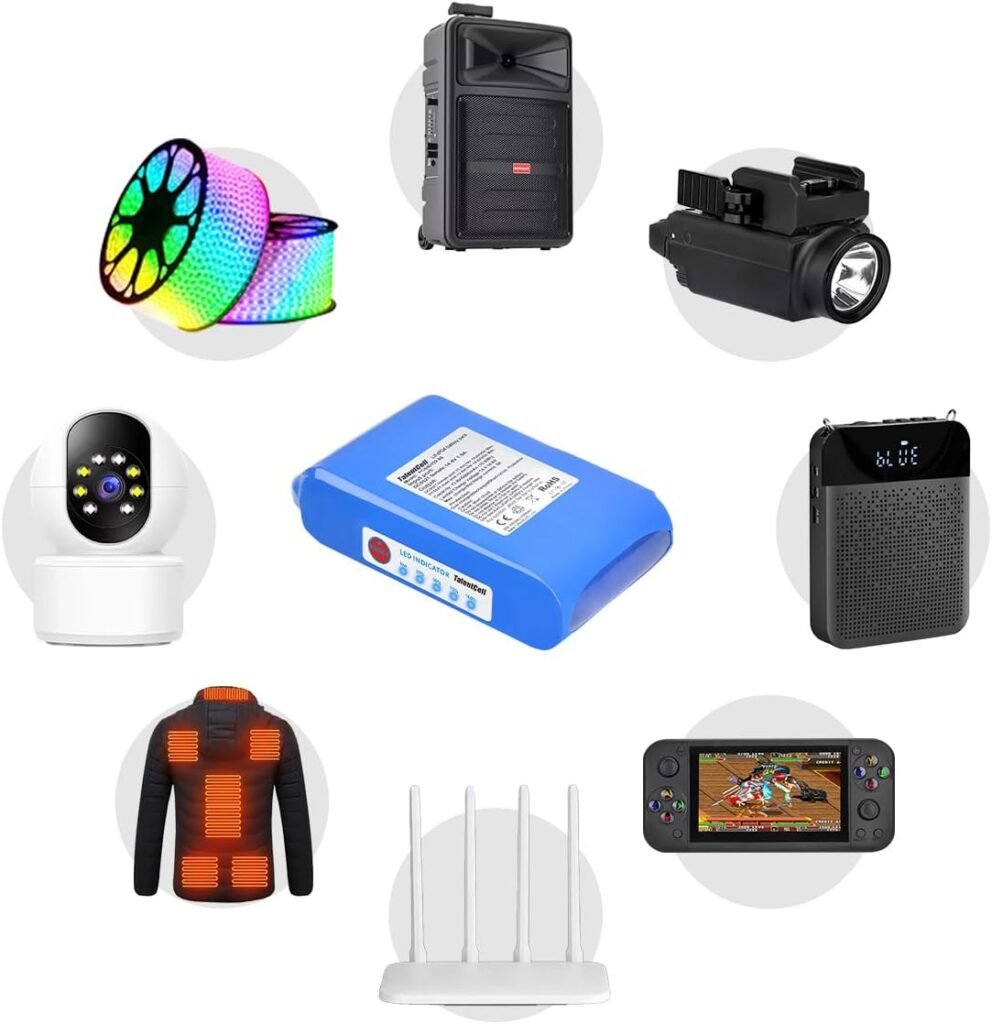
The intended applications cover a broad group of relatively modest DC electronics. LED strips and panels, CCTV cameras and DVR equipment, routers and modems, small televisions or monitors, telescopes, fish finders, pumps, slide and film viewers, and other 12V devices are all listed as potential uses. Its most sensible role is portable or temporary backup where direct DC power is preferable to converting battery energy into AC and then back into DC.
The 5A maximum output needs careful interpretation. It does not mean every connected product can safely draw 5A continuously, and it does not guarantee that a motor or pump will start successfully. Check the equipment label for voltage, current, connector size, and polarity, then consider whether the device has a brief startup surge beyond its running figure.
The stated 9V-to-14.6V range is another reason to check the equipment manufacturer’s requirements. A device designed for a broad 12V DC range may be comfortable with it, while sensitive electronics requiring regulated 12V may not be. The battery’s claim that most of a discharge cycle sits around 12V to 13V is helpful context, but it is not a substitute for the device specification.
Our recommended setup sequence is simple:
- Read the device label and record its voltage and current requirements.
- Verify that the plug is a compatible DC5521 size and that its polarity is correct.
- Estimate the load in watts from voltage multiplied by current.
- Connect the battery while the equipment is switched off.
- Monitor the first operating period for abnormal heat, flickering, resets, or connector heating.
- Disconnect the setup if the battery, cable, or plug becomes excessively warm.
That process is especially valuable for DIY projects, where a connector can be physically compatible even though the electrical requirements are not.

What Customers Are Saying About the TalentCell Battery
The supplied product information does not include an Amazon star rating or review total, so we cannot honestly report a figure such as 4.5 out of or attribute a specific number of reviews to this pack. It also does not provide a verified-buyer dataset from which to claim repeated experiences about runtime, charging time, connector fit, capacity loss, or long-term durability. That limitation matters: a credible review should distinguish documented customer evidence from expectations based on the specification.
For this model, the most useful review themes to investigate are device-specific runtime, whether routers and cameras remain stable during discharge, charging behaviour, plug fit, portability, output stability, and performance after repeated cycles. A comment saying a low-power light worked for several hours is useful practical evidence, but it should not be treated as proof that a pump, monitor, or camera recorder will behave the same way.
We would also separate successful low-power use from problems caused by mismatched voltage, reversed polarity, unsuitable chargers, loose adapters, or equipment exceeding the output limit. Those complaints may identify a compatibility issue rather than a battery defect, although repeated reports involving the same condition would deserve close attention.
When reading the live listing, we recommend this method:
- Prioritize recent verified-purchase comments over old, undated impressions.
- Compare several reports instead of allowing one unusually positive or negative anecdote to decide the purchase.
- Look for the exact connected device, its wattage, and the duration of testing.
- Pay attention to repeated reports about charging, connector looseness, shutdowns, or capacity loss.
- Treat isolated failures differently from a consistent pattern across multiple buyers.
Until a rating, review count, and identifiable customer pattern are supplied, the responsible conclusion is that the published specifications support certain uses, while real-world review evidence still needs to be checked on the current listing.
Best Uses and Who Should Buy This 12V LiFePO4 Pack
We would recommend this pack to shoppers who need a compact rechargeable source for LED lighting, CCTV equipment, routers, small monitors, telescopes, fish finders, and other modest 12V loads. It also makes sense for DIY users who want a ready-made battery with a DC5521 output and built-in protection functions rather than assembling cells and a protection board themselves.
A short interruption is a particularly sensible use case. A low-power router or camera may continue operating during a brief outage, provided its measured consumption is within the pack’s capability and the expected runtime is acceptable. For portable field work, the same arrangement can supply a display, viewer, or other small DC device without the weight and maintenance demands commonly associated with lead-acid batteries.
We would look elsewhere if the project requires large solar-storage capacity, an integrated AC inverter, a high-current motor-starting source, several simultaneous output ports, or a complete solar charging system. This product is best understood as one battery output for one carefully matched load, not as a replacement for a feature-rich power station.
Before ordering, check these points against the equipment you already own:
- Required operating voltage and acceptable voltage range
- Normal current draw and possible startup demand
- DC plug dimensions and polarity
- Expected operating time
- Suitable charging method
- Whether a direct battery connection is allowed by the device maker
The right buyer is therefore someone with a defined 12V DC application, not someone seeking a general-purpose emergency electricity box.
TalentCell 12V 6Ah Battery vs. Amazon Alternatives
The closest same-brand comparison is the TalentCell 12V 12Ah LiFePO4 battery. Its larger capacity should provide greater runtime potential than the 6Ah pack, making it more suitable for longer backup periods. The trade-off is predictable: shoppers should expect a higher listed price when available, along with potentially greater size and weight. We would choose the 6Ah model when portability and a shorter backup duty are more useful than extra reserve capacity.
A different category option is the Bioenno Power 12V LiFePO4 battery, which typically appeals to hobbyists and field users who want portable 12V operation. However, the exact Bioenno listing must be checked before comparison. Capacity, output connector, charger compatibility, maximum current, warranty, current price, rating, and review count can vary by model, so a brand name alone does not establish superior runtime or compatibility.
Lead-acid replacement batteries may have a lower entry price in some listings, but they are usually less convenient for frequent cycling because of their weight and different discharge characteristics. A larger lithium battery may offer more energy yet cost more, so the sensible comparison is not simply the lowest price.
We would compare alternatives using this framework:
- Energy in watt-hours, not only amp-hours
- Maximum continuous and startup current
- Battery chemistry and stated cycle-life claim
- Protection system and charging requirements
- Connector type and included accessories
- Warranty, current rating, and review count
Choose the TalentCell 12V 6Ah battery because its capacity and output match the equipment—not merely because its listed price is lower than a larger alternative.
Price, Value, and Ownership Considerations
At the listed $35.99, the pack offers a relatively inexpensive way to obtain a rechargeable LiFePO4 battery for a defined DC project. Using the stated energy figure, the simple purchase-price calculation is $35.99 ÷ 76.8Wh, or approximately $0.47 per watt-hour. That is a basic comparison only; it excludes a compatible charger, cables, adapters, and any replacement equipment required by an incompatible setup.
The value case is strongest for people who will cycle the pack regularly. The claimed 3,000-plus cycle life could make a rechargeable lithium pack more appealing over time than a disposable solution or a battery used only once. We would not convert that claim into a guaranteed lifespan, because actual results depend on charging, storage, temperature, discharge depth, and load conditions.
Ownership costs can appear after purchase. A buyer may need a LiFePO4-specific charger, a correctly wired DC5521 adapter, or a replacement cable. The more serious risk is discovering that the connected device draws too much current or cannot tolerate the battery’s changing output. In that case, the low initial price does not represent good value because the pack cannot perform the intended job safely.
Our value test is therefore practical: buy this pack when the equipment is a compatible low-power 12V load and the calculated operating time meets expectations. Consider the larger TalentCell model or a power station when the runtime, output type, or number of connections falls short. The $35.99 price is appealing, but correct electrical matching remains the deciding factor.
How to Check Compatibility Before Ordering
Compatibility can be checked before the battery arrives. We suggest photographing the equipment label and following this verification process:
- Record the device’s required voltage and current, including any startup information in its manual.
- Calculate approximate wattage by multiplying voltage by current.
- Inspect the connector and confirm that the dimensions match the intended DC output.
- Check polarity rather than assuming a centre-positive plug is suitable.
- Compare the device’s requirements with the battery’s published voltage range and maximum output.
- Confirm that the planned charger is intended for a 12.8V LiFePO4 battery.
For a simple estimate, divide 76.8Wh by the device’s wattage. A 6W load would theoretically use about 12.8 hours before real-world losses, voltage behaviour, and cutoff reduce that figure. Treat this as a planning estimate rather than a promised runtime, especially if the device cycles on and off or includes a display, motor, compressor, or recorder.
Also determine whether the equipment requires regulated 12V, accepts a broader DC range, or includes its own voltage regulator. Motors and pumps deserve extra caution because they can draw more current briefly than their running rating, making the 5A maximum particularly relevant.
For a first test, switch the equipment off before connecting it, place the setup where it can be observed, and monitor the battery, plug, and cable during initial operation. If anything heats excessively, flickers, resets, smells unusual, or behaves unpredictably, disconnect it. Use only a compatible LiFePO4 charging solution; do not assume a lead-acid charger is suitable simply because both batteries are marketed for 12V systems.
Pros and Cons
Pros
- LiFePO4 chemistry with a stated 3,000-plus cycle-life claim
- Compact 76.8Wh energy capacity for portable 12V backup projects
- DC5521 output with inner-positive and outer-negative wiring
- Listed over-charge, over-discharge, and short-circuit protection
- Low listed price of $35.99 for a rechargeable lithium battery pack
Cons
- The 5A maximum output limits suitability for high-demand or startup-heavy equipment
- The stated 9V-to-14.6V output range may not suit devices requiring tightly regulated 12V
- A compatible charger, cable, or adapter may need to be purchased separately
- No rating or review count was supplied in the available product data, limiting customer-evidence analysis
- It has one focused DC output and no integrated AC inverter or complete solar charging system
Final Verdict
Key Takeaways
- The TalentCell 12V 6Ah battery is best suited to compatible low-power 12V DC equipment, not high-demand appliances or a full home-backup system.
- Its LiFePO4 chemistry, stated 3,000-plus cycle life, and listed protection functions make it attractive for repeated portable or backup use.
- Check voltage tolerance, connector size, polarity, current draw, and startup demand before connecting any device.
- At $35.99, the simple purchase cost is approximately $0.47 per watt-hour, excluding a suitable charger and accessories.
- Choose a larger battery or power station if the required runtime, current, AC output, or number of ports exceeds this pack’s focused design.
Frequently Asked Questions
What is the TalentCell 12V 6Ah battery designed for?
It is intended for compatible low-to-moderate power 12V DC equipment such as LED lighting, CCTV devices, routers, small monitors, telescopes, fish finders, and DIY electronics. It is not a complete power station or AC inverter.
Can this battery power a router during an outage?
It may, provided the router accepts the battery’s DC voltage range, uses a compatible connector and polarity, and stays within the pack’s output capability. Check the router label and estimate runtime from the device wattage before connecting it.
Does it include a charger?
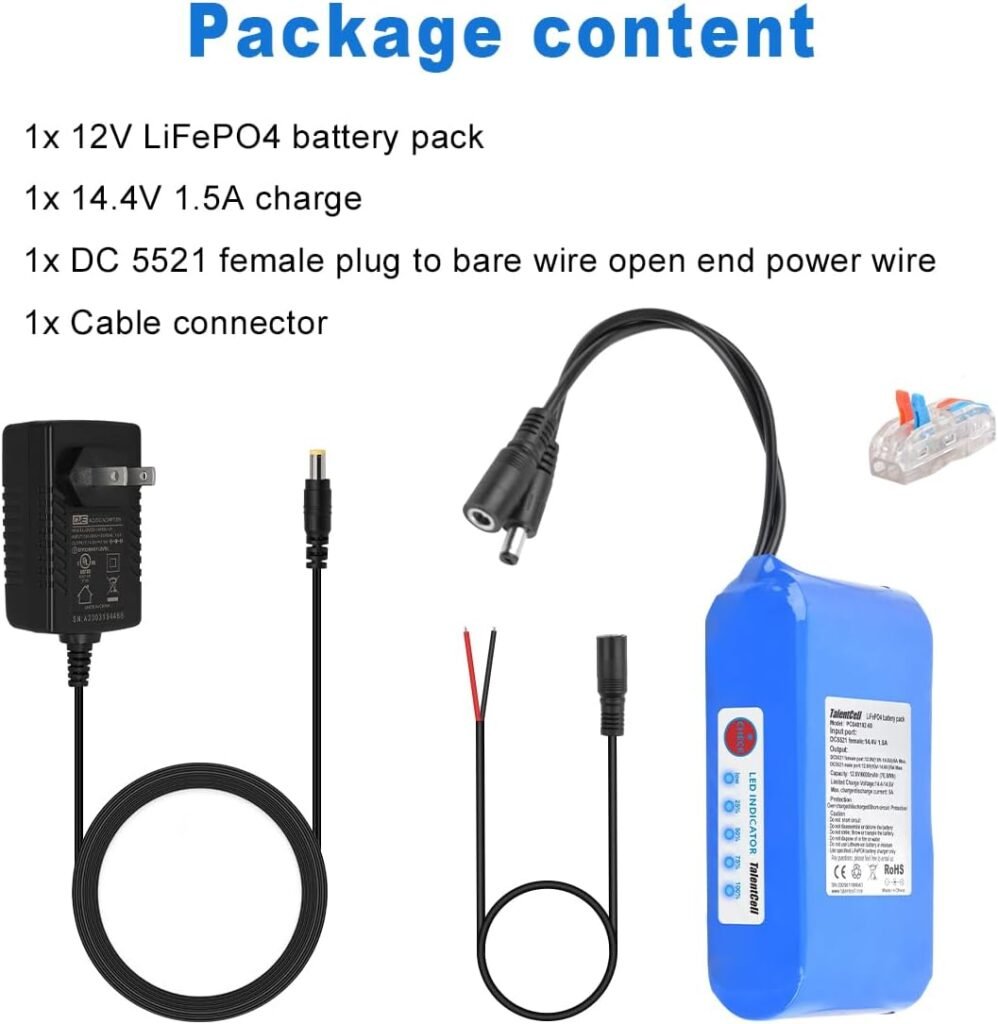
The supplied product information describes a rechargeable battery pack but does not state that a charger is included. Confirm the current listing contents before ordering and use a charger designed for a 12.8V LiFePO4 battery.
Is the battery suitable for a pump or motor?
It may work with a suitably rated small 12V device, but motors and pumps can have startup surges above their running current. Check both running and startup requirements against the 5A maximum output before use.
How do we estimate its runtime?
Divide the battery’s 76.8Wh energy figure by the device’s wattage for a theoretical estimate. A 6W load calculates to about 12.8 hours, but actual runtime will be reduced or altered by losses, device behaviour, and battery cutoff.
Disclosure: As an Amazon Associate, I earn from qualifying purchases.