ECO-WORTHY Powermega 48V 314Ah: Quick Product Overview
Can a $3,999.99 battery-and-inverter package provide meaningful whole-home backup or is it simply more equipment than most households need? The ECO-WORTHY Powermega makes a strong case for buyers who need substantial fixed storage and 240V capability, but it isn’t a plug-in power station. We get one Liber 10KP 10kW hybrid inverter and one 48V 314Ah LiFePO4 battery, with the battery shipped by truck freight.
The stated usable energy is 16.1kWh. That is a sizeable reserve for refrigerators, lighting, internet equipment, a pump, and selected household circuits, although runtime depends on the combined wattage and startup demands of those loads. The inverter can provide split-phase 240V or single-phase 120V output, which is more appropriate for a North American-style electrical installation than a small portable battery.
Shipping usually takes to weeks, and the order may arrive in multiple packages at different times. The battery travels on a pallet, so the address needs truck-delivery access and someone available to inspect the shipment. In our view, the ECO-WORTHY Powermega offers impressive capacity, output, monitoring, and stated battery-life claims for the package price, but compatible installation planning is essential.
Our early assessment is therefore conditional: the ECO-WORTHY Powermega is worth considering for essential-circuit backup or an off-grid property, provided we budget separately for electrical work, permits, protection equipment, and any solar integration required.

ECO-WORTHY Powermega Specifications and Package Details
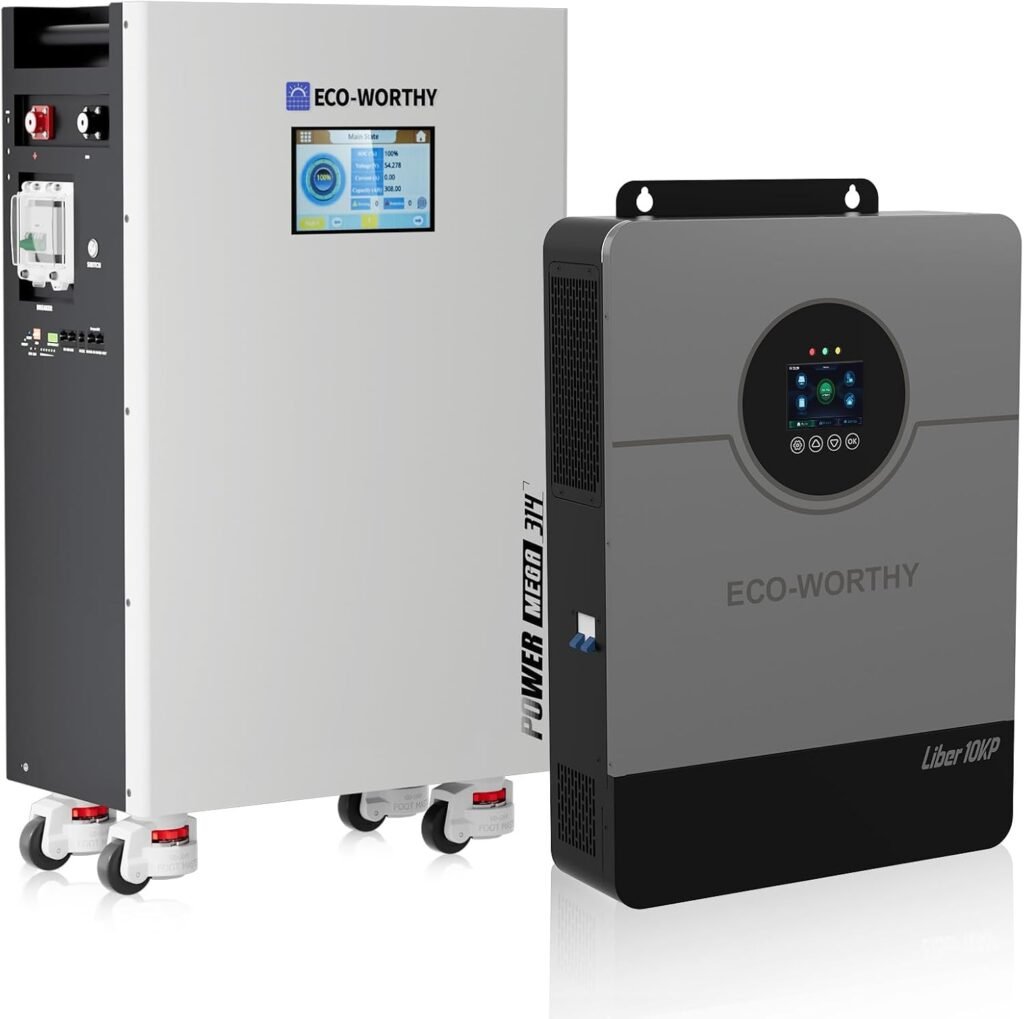
The core specification is straightforward: a high-voltage battery system paired with a substantial hybrid inverter. The table below separates the advertised package figures from the installation details that still need confirmation.
| Item | Stated specification |
|---|---|
| Battery system | 48V nominal, 314Ah |
| Usable energy | 16.1kWh |
| Battery chemistry | LiFePO4 |
| Inverter output | 10kW |
| Listed package price | $3,999.99 |
| Package contents | One inverter and one battery |
Amp-hours describe electrical charge at a particular voltage; kilowatt-hours describe stored energy. In simple terms, 48V multiplied by 314Ah gives roughly 15.1kWh nominally, while the supplied 16.1kWh usable figure is the manufacturer’s stated usable-energy value. When comparing the ECO-WORTHY Powermega with 12V products, we should compare usable watt-hours rather than amp-hours alone, because voltage changes the energy calculation.
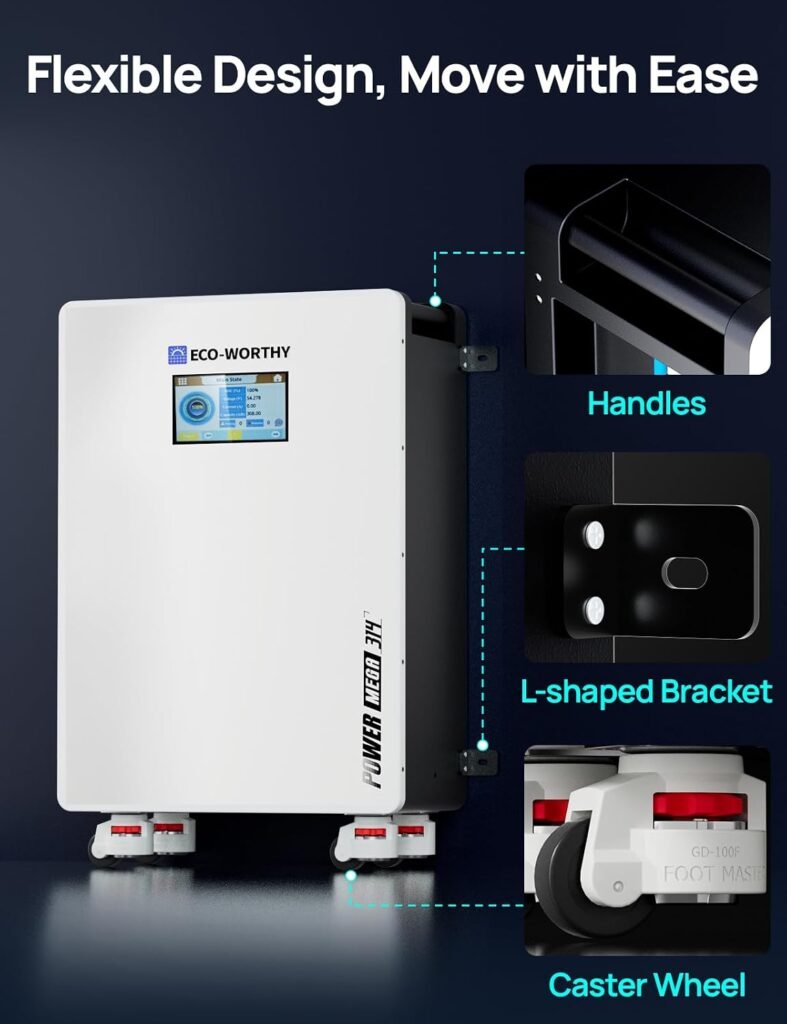
Two inverter exterior versions may be shipped randomly. The supplied information says they have identical performance, specifications, functions, and compatibility, so appearance should not affect the purchase decision. Reinforced casters may make positioning easier, but a large battery still needs suitable floor access, careful handling, and a stable final location.
The package description does not list solar panels, wiring, disconnects, mounting provisions, permits, or professional electrical work as included. Before ordering the ECO-WORTHY Powermega, we would also ask for the warranty length, certifications, dimensions, weight, maximum continuous battery current, and included cables. Those omissions matter because they affect both installation planning and the final project cost.
Key Features of the ECO-WORTHY Powermega System
The main attraction is integration. Instead of choosing a battery, then finding a compatible inverter, the ECO-WORTHY Powermega combines a 10kW hybrid inverter with a 48V 314Ah LiFePO4 battery in one defined package. That can simplify system selection, although it doesn’t eliminate the need to verify wiring, communication, solar-array sizing, and panel integration.
The inverter is advertised with up to 99.9% maximum MPPT efficiency. We should treat that as a peak specification under suitable conditions, not as a promise that every kilowatt-hour will reach the battery. Temperature, array voltage, wiring losses, conversion stages, load level, and shading can all affect real-world efficiency.
Output flexibility is another meaningful feature. Split-phase 240V can suit selected larger household loads, while single-phase 120V is useful for ordinary circuits. Our installer would need to match the chosen output arrangement with the home’s panel, transfer equipment, grounding method, and intended circuits rather than assuming both configurations can be used interchangeably.
To estimate runtime, divide usable watt-hours by average watts: 16,100Wh divided by a 500W average load equals a theoretical 32.2 hours before additional system losses and reserve limits. At 2,000W, the same calculation gives about 8.05 hours. The ECO-WORTHY Powermega can deliver up to 10kW from the inverter, but high demand drains storage much faster than modest continuous loads.
The battery claims more than 9,000 cycles at 80% depth of discharge and a service life exceeding years. Those are useful targets, not guaranteed outcomes; temperature, charge settings, cycling frequency, cell quality, and installation conditions influence longevity. The ECO-WORTHY Powermega is best viewed as a high-output storage platform, not as 10kW of energy capacity.
Battery Safety, Active Balancing BMS, and Communication
The battery uses an Active Balancing Smart BMS with stated protection against overcharge, over-discharge, over-current, short circuit, and extreme temperatures. In a multi-cell pack, active balancing helps redistribute energy between cells, supporting more consistent cell voltage and better capacity utilisation over time. That is more meaningful than simply seeing “BMS” on a specification sheet, although performance still depends on the underlying control system and correct configuration.
Several additional safety features are listed: a built-in circuit breaker, an aerosol fire-suppression module, and a buzzer alarm. These features provide extra layers of protection, but they don’t replace correctly sized conductors, external disconnects, code-compliant enclosures, suitable clearances, or an approved installation. We would never treat the ECO-WORTHY Powermega safety hardware as a substitute for an electrician’s assessment.
Communication is available through RS485, CAN, and RS232. The important question is not simply whether a port exists; the battery and inverter must use compatible protocols, pinouts, cables, baud settings, and charge parameters. Third-party energy-management equipment may require a particular CAN profile or firmware version.
- Confirm battery-to-inverter communication compatibility before installation.
- Verify cable, breaker, and disconnect ratings for the planned current.
- Install required isolation and protection equipment.
- Configure charge, discharge, and temperature limits.
- Test alarms and shutdown behaviour before relying on backup power.
For the ECO-WORTHY Powermega, the supplied data does not identify independent certification details, an ingress-protection rating, operating-temperature ranges, or fire-test documentation. We would request those documents from the manufacturer or installer, especially for an indoor installation or a property subject to permitting requirements.

Bluetooth, WiFi, LCD Monitoring, and Daily Operation
Monitoring is one of the more convenient parts of the ECO-WORTHY Powermega design. The built-in LCD is described as showing real-time battery data, while Bluetooth and WiFi allow status checks from a phone without opening the enclosure or walking to the equipment area. The supplied description doesn’t specify every screen metric, so we wouldn’t assume a particular display layout until the manual confirms it.
Useful daily checks include state of charge, charging activity, discharging activity, alarm status, and whether solar generation is reaching the battery. This can help us spot an unexpected standby load, a failed charging schedule, or a communication error before an outage exposes the problem. It is visibility, not a guarantee that the battery is healthy.
We would set up the ECO-WORTHY Powermega in this order:
- Install the relevant mobile application and confirm it is available for the intended phone.
- Pair locally over Bluetooth if the setup process requires it.
- Connect the system to a reliable WiFi network.
- Give the device a clear name and record its settings.
- Compare app readings with the physical display.
Before purchase, ask whether remote access requires an internet connection, whether the app supports 2.4GHz networks, how firmware updates work, and what privacy settings are available. We would also confirm whether local monitoring continues during an internet outage. The ECO-WORTHY Powermega still needs periodic physical inspection of terminals, cables, breakers, ventilation, moisture, and visible damage; an app cannot detect every mechanical or installation problem.
What Customers Are Saying About the ECO-WORTHY Powermega
The supplied product information does not include a verified-buyer star rating or review count, so we cannot responsibly quote an Amazon score or present a review pattern as statistically established. That limitation matters for the ECO-WORTHY Powermega, because a large battery system needs long-term evidence rather than only early delivery impressions.
When reviews are available, we would separate reports of packaging, setup, and initial inverter startup from evidence about capacity retention. A buyer posting soon after delivery can describe pallet condition, missing accessories, pairing difficulty, or whether the display turns on; that person cannot establish the advertised 9,000-plus-cycle lifespan. Similarly, one successful solar charge doesn’t prove performance across different array sizes and weather conditions.
Shipping deserves close attention because the battery is palletised truck freight and may arrive separately from the inverter. We would look for recurring reports of freight scheduling, damaged packaging, delayed packages, missing cables, and customer-service outcomes. A single damaged carton may reflect carrier handling, while repeated reports of incomplete shipments could indicate a fulfilment concern.
Customer reviews indicate that the most useful evidence would include measured loads, screenshots of app readings, installation context, ownership duration, inverter settings, and the resolution offered by support. We would also distinguish product behaviour from wiring faults, incorrect solar-array sizing, incompatible third-party equipment, or an improperly configured communication cable. Until those detailed reports and a verified rating are available, the ECO-WORTHY Powermega deserves a cautious rather than enthusiastic review score.
Installation, Compatibility, and Delivery Planning
This is a fixed energy-storage system, not a portable power station that we connect to a wall socket. Planning the ECO-WORTHY Powermega around the distribution panel, essential-load circuits, local electrical rules, and the desired backup method should happen before the order is placed.
We would begin by listing essential circuits and recording both their running wattage and startup demand. Next, we would determine whether those circuits require 120V, 240V, or both, then size the solar array around the inverter’s supported input requirements. Finally, we would confirm battery-to-inverter communication settings, including whether CAN, RS485, or RS232 is required and whether the selected inverter version, firmware, and cable are supported.
Delivery normally takes to weeks, but the order may be split across multiple packages. We would arrange truck access, check the pallet for visible damage before signing where possible, and take clear photographs of any dents, punctures, crushed corners, or wet packaging. The carrier paperwork and photographs may be important if a freight claim becomes necessary.
After delivery, we would compare every box with the order, retain the packaging until inspection and testing are complete, and avoid energising the system until the installer has checked the contents. Professional help is especially valuable for split-phase wiring, transfer equipment, service-panel integration, grounding, disconnect placement, permits, and commissioning. The ECO-WORTHY Powermega can reduce product-selection work, but it does not turn a whole-home installation into a simple DIY project.
Who Should Buy the ECO-WORTHY Powermega?
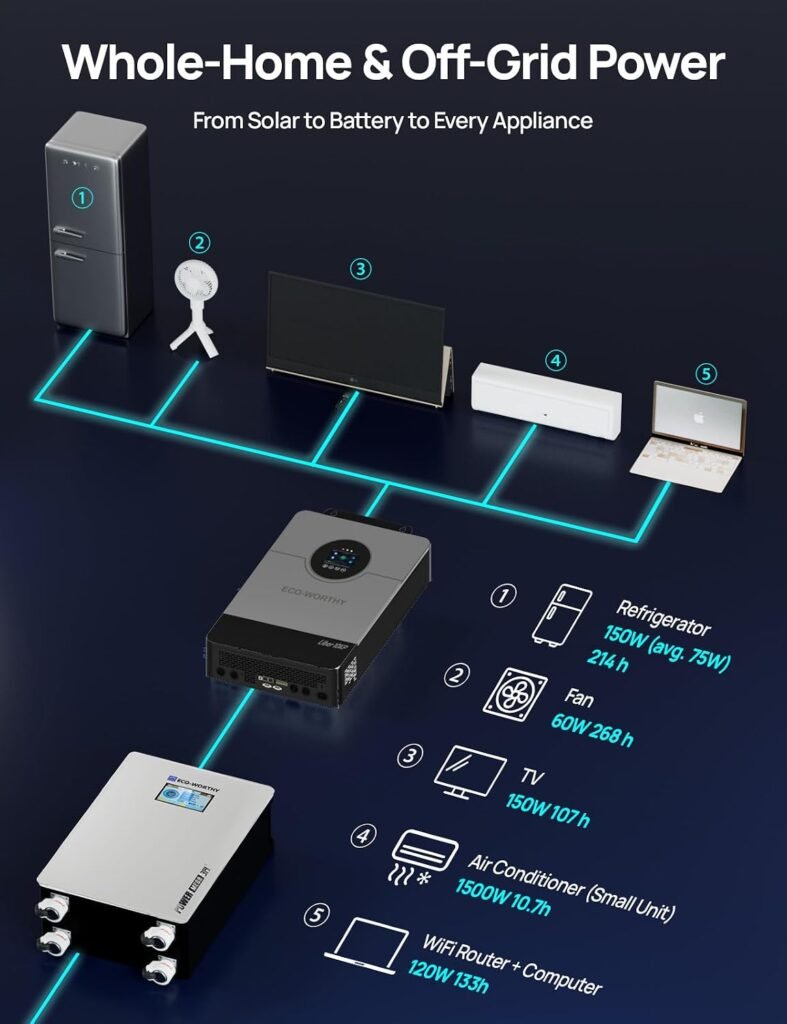
The best match is a homeowner who wants substantial emergency backup for selected circuits and values both 240V flexibility and 16.1kWh of usable storage. The ECO-WORTHY Powermega could support refrigeration, lighting, networking, pumps, and other carefully selected loads, assuming the installation and load calculations are correct.
It may also suit an off-grid cabin or remote property that needs a large battery, solar storage, mobile monitoring, and a 10kW inverter rather than a small bank intended for occasional low-power use. Solar owners may appreciate storing daytime generation for evening consumption or outages, but the array, inverter input limits, battery settings, and electrical service must all be compatible.
For an apartment, occasional camper, RV user, or shopper who only needs phones, lights, and a refrigerator for short periods, this package may be excessive. Its scale, fixed installation, freight delivery, and professional electrical requirements make it less convenient than a smaller 12V battery or portable power station.
We would choose the ECO-WORTHY Powermega when capacity, 10kW output, 240V flexibility, and long-cycle LiFePO4 storage matter more than portability, the lowest upfront cost, or simple self-installation. We would pass when the project has no protected equipment space or when the buyer cannot set aside a realistic budget for wiring, labour, permits, transfer equipment, and commissioning.
Our decision path is simple: first define the essential loads, then confirm voltage and communication compatibility, obtain an installed quote, and only afterward decide whether the package’s capacity justifies the project. The ECO-WORTHY Powermega is a specialised backup platform, not a universal battery purchase.
How the ECO-WORTHY Powermega Compares With Alternatives
The closest higher-capacity comparison is the ECO-WORTHY Cubix100 48V 600Ah Server Rack Battery. A Cubix100-style configuration is aimed at buyers planning a much larger modular battery bank, while the ECO-WORTHY Powermega is more immediately defined around one battery and one 10kW inverter. That difference affects expansion plans, rack space, wiring, and the amount of system design we must handle ourselves.
| Option | Nominal voltage | Stated energy | Inverter included | Output and monitoring | Typical role |
|---|---|---|---|---|---|
| ECO-WORTHY Powermega | 48V | 16.1kWh usable | Yes, 10kW | 120V/240V; LCD, Bluetooth, WiFi | Defined home-backup or off-grid package |
| ECO-WORTHY Cubix100 48V 600Ah | 48V | Higher-capacity modular configuration | Not assumed in the battery-only comparison | Depends on inverter and system equipment | Expandable storage banks |
| Renogy 12V 100Ah LiFePO4 | 12V | Approximately 1.2kWh nominal | No | Depends on external equipment | RV, marine, cabin, and small backup loads |
The Renogy 12V 100Ah LiFePO4 is not a direct whole-home competitor. It is much smaller and would need an inverter and potentially several batteries to approach this system’s energy and output. The ECO-WORTHY Powermega offers a more complete package, but likely involves greater installation complexity.
We would compare usable energy, continuous inverter output, surge capability, communication protocols, cycle-life test conditions, certifications, warranty, and support—not amp-hour figures alone. Total cost also includes compatible inverters, cables, breakers, racking, freight, labour, permits, and future expansion. The ECO-WORTHY Powermega is the more defined choice; the Cubix100 route may offer more growth, while the Renogy option is better suited to modest loads.
Price, Long-Term Value, and Buying Checklist
At $3,999.99, the ECO-WORTHY Powermega combines a stated 16.1kWh of usable storage, a 10kW hybrid inverter, built-in monitoring, and several battery safety features. Dividing $3,999.99 by 16.1kWh gives an indicative upfront price of about $248.45 per usable kilowatt-hour. That is only a simple package-price comparison; it excludes installation, permits, operating losses, solar equipment, and maintenance.
The advertised 9,000-plus cycles at 80% depth of discharge could improve long-term value if the claim is supported by suitable test documentation and the battery operates within its specified limits. We would not treat the figure as a guaranteed ownership outcome without knowing the test conditions, temperature range, allowable current, end-of-life definition, and warranty terms.
Before paying for the ECO-WORTHY Powermega, we would ask the seller or installer:
- What is the warranty duration and replacement process?
- Which safety certifications and test documents apply?
- What are the maximum continuous charge and discharge currents?
- What are the inverter surge rating and operating-temperature limits?
- What are the battery’s dimensions and weight?
- Which cables, connectors, and communication accessories are included?
- What app supports Bluetooth and WiFi monitoring?
- What freight, appointment, inspection, and damage-claim terms apply?
We would obtain a complete installed quote covering electrical labour, permits, transfer equipment, disconnects, solar integration, and any structural or ventilation work. The ECO-WORTHY Powermega is most compelling for buyers who need substantial fixed backup and can verify compatibility, documentation, delivery arrangements, and after-sales support before committing $3,999.99.
Pros and Cons
Pros
- Large stated 16.1kWh usable energy capacity for home backup or off-grid storage
- 10kW hybrid inverter with split-phase 240V and single-phase 120V output options
- LiFePO4 chemistry with stated 9,000-plus cycles at 80% depth of discharge
- Active balancing BMS with over-charge, over-discharge, over-current, short-circuit, and temperature protections
- Built-in LCD, Bluetooth, WiFi, RS485, CAN, and RS232 communication options
Cons
- Professional installation, permits, wiring, disconnects, and transfer equipment may add substantial cost
- Warranty, certifications, dimensions, weight, current limits, and included-cable details are not supplied in the product data
- Truck-freight delivery may require pallet access, scheduling, inspection, and multiple-package coordination
- Large fixed system is excessive for many RV, apartment, camping, and low-load applications
- The advertised cycle life and peak MPPT efficiency require confirmation under defined test conditions
Final Verdict
Key Takeaways
- The package combines one 48V 314Ah LiFePO4 battery with one 10kW hybrid inverter and states 16.1kWh of usable energy.
- Split-phase 240V and single-phase 120V output make it more suitable for fixed home-backup installations than portable power use.
- Active balancing, Bluetooth, WiFi, LCD monitoring, and RS485/CAN/RS232 communication add useful functionality, but compatibility must be verified.
- The $3,999.99 listed price excludes many potential project costs, including electrical labour, permits, disconnects, cables, and solar equipment.
- The system is most suitable for buyers with substantial backup needs, protected equipment space, freight access, and a qualified installation plan.
Frequently Asked Questions
Are ECO-WORTHY LiFePO4 batteries any good?
They can be a good fit when the stated capacity, protection features, communication protocol, warranty, and installation requirements match the project. This system lists LiFePO4 chemistry, active balancing, multiple protective functions, and more than 9,000 claimed cycles at 80% depth of discharge, but independent certification and warranty details should be confirmed before purchase.
Which Amazon LiFePO4 battery is the best?
There is no single best battery for every buyer. We would choose based on usable energy, continuous and surge output, voltage, communication compatibility, certifications, warranty, cycle-test conditions, and support rather than star rating or amp-hours alone.
Which LiFePO4 battery is best for an RV?
A compact 12V LiFePO4 battery such as the Renogy 12V 100Ah is generally more appropriate for many RV applications than a fixed 48V home-storage system. RV buyers should check compartment dimensions, weight, charging equipment, current limits, and whether the battery’s temperature protections suit the installation.
What are the downsides of LiFePO4 batteries?
The main drawbacks can include higher upfront cost, the need for compatible charging equipment and battery-management electronics, significant weight at larger capacities, and installation constraints. Cold-temperature charging limits, communication compatibility, warranty terms, and the cost of cables, breakers, labour, and permits also deserve attention.
Disclosure: As an Amazon Associate, I earn from qualifying purchases.