Like a quiet lighthouse in a storm, LiFePO4 batteries stand out for safety and longevity. We’ll present data-driven, rigorous notes on why their chemistry yields stable performance, even in tough temps, and how that translates to lower maintenance and clearer lifecycle costs. We’ll weigh safety margins, cycle life, and recycling footprints with practical charging guidance. The conversation doesn’t end here: we have to contemplate when this tech fits your project and how to optimize it for real-world use.
Key Takeaways
- LiFePO4 offers high cycle life and longevity, reducing replacement costs over many charge-discharge cycles.
- It provides improved safety with lower risk of thermal runaway and better fault tolerance in real-world use.
- The chemistry maintains stable performance across a wide temperature range, especially at moderate temperatures and charging rates.
- It has strong thermal stability and durability, contributing to reliable operation in diverse climates.
- The material supports lower energy density trade-offs for safer operation, recyclability, and cost-effective lifecycle management.
What LiFePO4 Is and How It Works
LiFePO4, or lithium iron phosphate, is a rechargeable battery chemistry known for safety, stability, and long life. We present a concise map of what LFP chemistry is and how it functions, aligned with data-driven rigor. We define the cathode as an iron phosphate framework that hosts lithium ions within a stable olivine structure, enabling selective Li+ intercalation. Anode dynamics remain graphite-based in many configurations, while the electrolyte supports ionic transport with a wide electrochemical window. We quantify performance via cycle life, thermal tolerance, and rate capability, emphasizing that battery chemistry yields predictable voltage plateaus and minimal dendrite formation. Charge-discharge curves exhibit characteristic flat regions, guiding state-of-charge estimation. Overall, LFP chemistry trades energy density for safety, reliability, and longevity in practical applications.
Why LiFePO4 Is Safer in Real Life
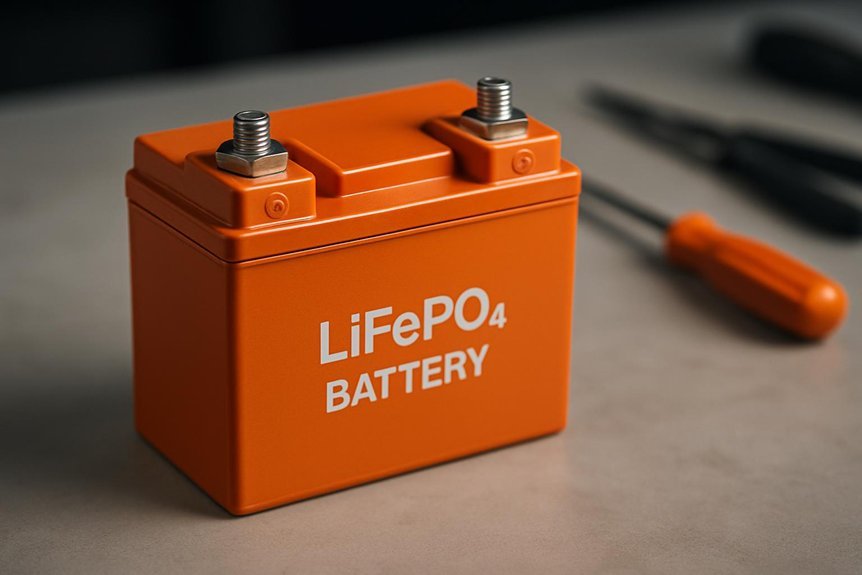
The safety profile of LiFePO4 becomes clearer when we ground it in real-world data and field experience. We synthesize observations from varied use cases to show that safer chemistries translate to fewer dramatic failures, even under stress. Our benchmark is real world safety, not lab idealizations, so the evidence weighs practical outcomes alongside theoretical safeguards.
- Safer chemistries reduce thermal runaway likelihood in routine charging and discharging
- Real world safety is reinforced by robust thermal management and protective controls
- Fault-tolerant designs limit impact during accidents or misusage
- Lower energy density reduces energy release in worst-case scenarios
- Consistent performance under diverse climates supports safer operation in practice
LiFePO4 Longevity, Temperature Stability, and Costs
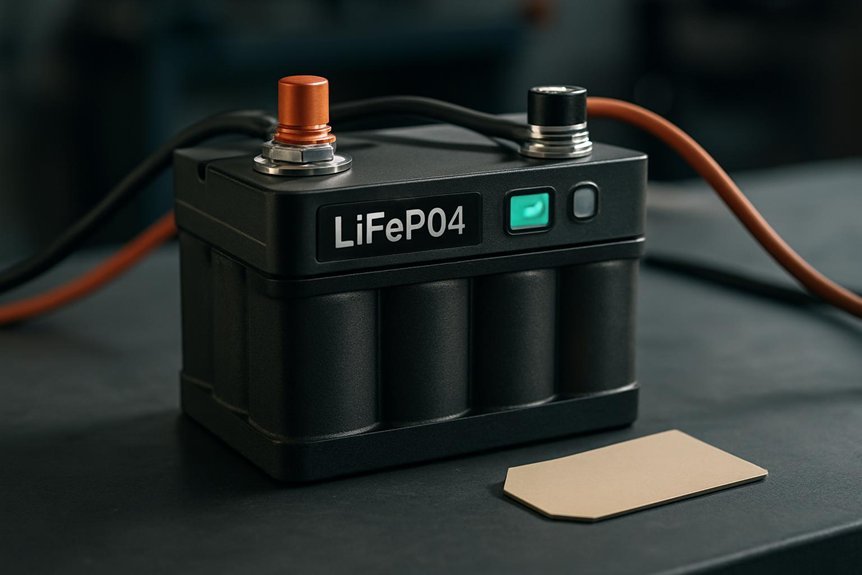
How durable is LiFePO4 across time, temperatures, and costs, really? We approach lifepo4 longevity with data-driven scrutiny, noting stable capacity over thousands of cycles and minimal degradation under moderate temps. Temperature stability stays solid up to about 45°C, with performance dip beyond that mainly in high-rate discharges. Costs remain favorable when scaled, benefiting from long cycle life and low maintenance. To illustrate, consider this compact view:
| Factor | Influence |
|---|---|
| Cycle life | High, reduces replacement costs |
| Operating temp | Stable up to ~45°C; efficiency tapers otherwise |
| Total cost of ownership | Lower over time |
Sustainability: Materials, Recycling, and Footprint
We’ve seen LiFePO4’s longevity and temperature stability push total cost of ownership lower, so sustainability now hinges on materials, recycling, and footprint. We commit to data-driven clarity: evaluating supply risk, material purity, and end-of-life pathways informs enduring value. Our assessment centers on sustainability materials quality, lifecycle inventories, and real-world degradation rates. We quantify recycling footprint impacts, processing energy, and recovery efficiency to minimize waste. By tracking supplier footprint disclosures and circular-design opportunities, we lower environmental externalities while preserving performance. Transparent metrics guide decisions and accelerate improvements. Our conclusion is evidence-based: responsible material sourcing, efficient recycling, and measured footprint reductions yield durable, scalable LiFePO4 adoption.
- Material sourcing transparency
- Recycling efficiency and energy use
- End-of-life pathways
- Circular-design opportunities
- Emissions and resource intensity
When to Use LiFePO4 and How to Charge It
When should you choose LiFePO4 and how should you charge it to maximize reliability and lifecycle value? We present a data-driven assessment for readers seeking practical guidance. When to use LiFePO4 hinges on cycle life, thermal stability, and safety margins relative to energy density needs. In high-cycle applications, its durability reduces total cost of ownership; in cold climates, performance remains acceptable with proper management. How to charge emphasizes balanced charging profiles, strict adherence to specified voltage windows, and temperature-aware routines. We advocate using dedicated BMS systems, staying within 3.6–3.65 V per cell top-of-charge, and avoiding sustained high currents. Charge rates should align with chemistry specs, not generic fast-charging promises, to preserve capacity. Overall, LiFePO4 offers predictable longevity when charging is controlled, monitored, and matched to use case.
Frequently Asked Questions
How Does Lifepo4 Perform in Extreme Cold or Heat?
We perform best in cold and hot extremes with limited degradation; cold tolerance decreases at very low temps, while high ambient temps demand robust thermal management to maintain performance and longevity. Our data show proactive thermal management essential.
Can Lifepo4 Batteries Be Fast-Charged Safely?
We can do fast charging safely with lifepo4, but it demands strict safety considerations, proper chargers, temperature control, and monitoring; we data-drive this, prioritizing safety considerations while optimizing cycles and charging rates for reliable performance.
Do Lifepo4 Cells Suffer From Capacity Decline With High-Current Use?
We answer straight: yes, LiFePO4 cells suffer some capacity decline with high-current use. Allegorically, we’re careful sailors navigating high-rate degradation, watching thermal effects and data trends. We mitigate with cooling and pacing, minimizing high rate degradation and thermal effects.
Are Lifepo4 Packs Compatible With Existing Lead-Acid Systems?
Yes, LiFePO4 packs aren’t directly compatible with lead-acid systems due to incompatibility concerns, so upgrades to charging infrastructure are required; we’ll detail voltage, current limits, and safety gaps to avoid misconfigurations and assure reliable operation.
What Are the Best Practices for Long-Term Lifepo4 Storage?
We store LiFePO4 with calm, measured care, treating it like a seed: Storage myths fade as we monitor aging indicators, maintaining charge, temperature, and cycle counts; we stay data-driven, transparent, and protective for long-term reliability.
Conclusion
We see LiFePO4 as a steady lighthouse in a storm of tech choices. Its safety shimmer, long cycles, and temperature resilience anchor our projects, while recycling and clear sourcing map the coastline for sustainable ventures. Data pinpoints lower energy density, yet predictable voltage and resilient fault tolerance keep systems reliable. When we plan, monitor, and optimize with a smart BMS, LiFePO4 quietly sustains, guiding us toward safer, cheaper, longer-lasting power, step by step.