DUMFUME 12V 100Ah LiFePO4 Battery: Quick Overview
Can a compact 12V 100Ah LiFePO4 battery provide dependable deep-cycle power for a caravan, camper, or off-grid system? The DUMFUME 12V 100Ah LiFePO4 battery makes a credible case with a 12.8V nominal output, stated 1.28kWh capacity, Group format, and integrated 100A battery management system. Its current listed price is $152.96, reduced from $168.66, and the listing shows it as in stock.
Our early view is positive but qualified. This battery appears suited to deep-cycle storage, portable power, solar systems, and moderate inverter loads, especially where reducing weight matters. It isn’t intended for engine starting, golf carts, or jacks, and its stated temperature requirement makes cold-weather charging a significant consideration.
In this review, we assess the claimed capacity, protection features, cycle-life figures, installation flexibility, casing, customer-review evidence, alternatives, and overall value. The main buying question isn’t simply whether the battery is inexpensive; it’s whether the available documentation is detailed enough for our particular electrical system.

Capacity, Size, and Weight Explained
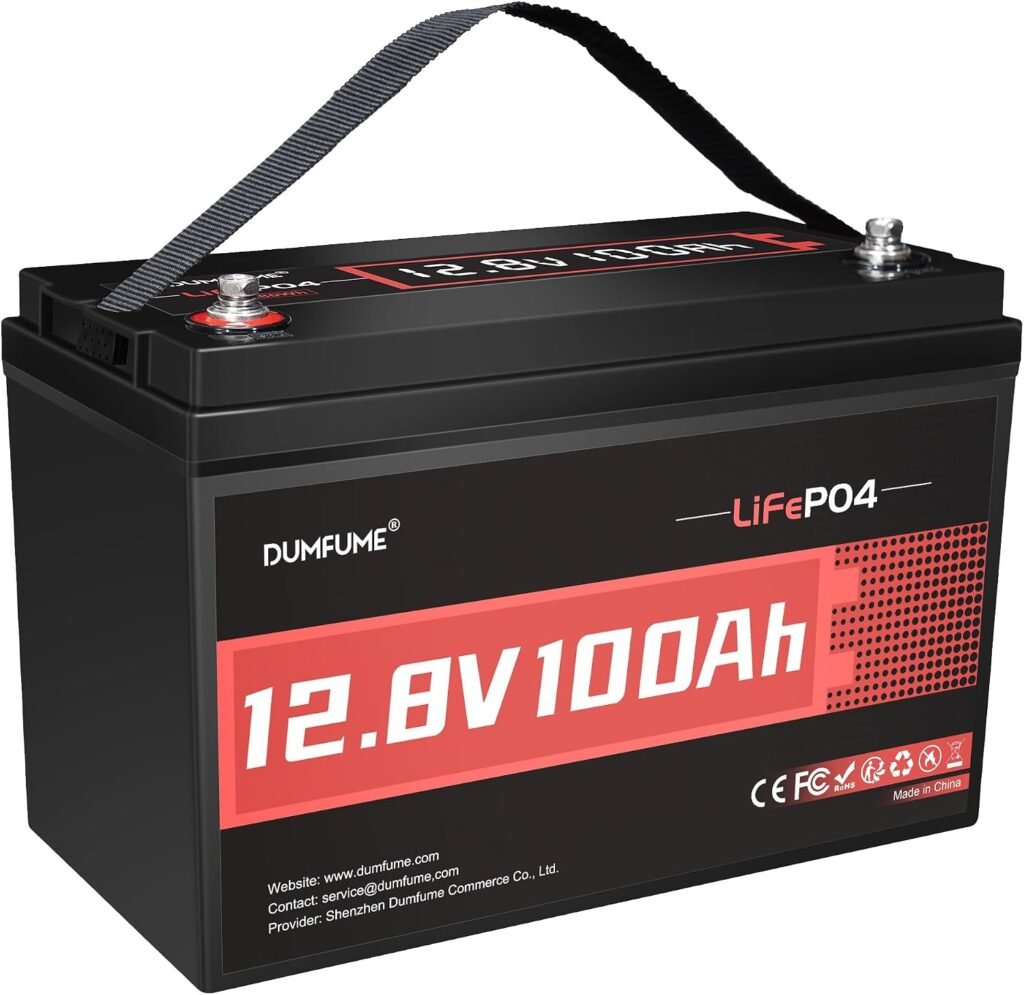
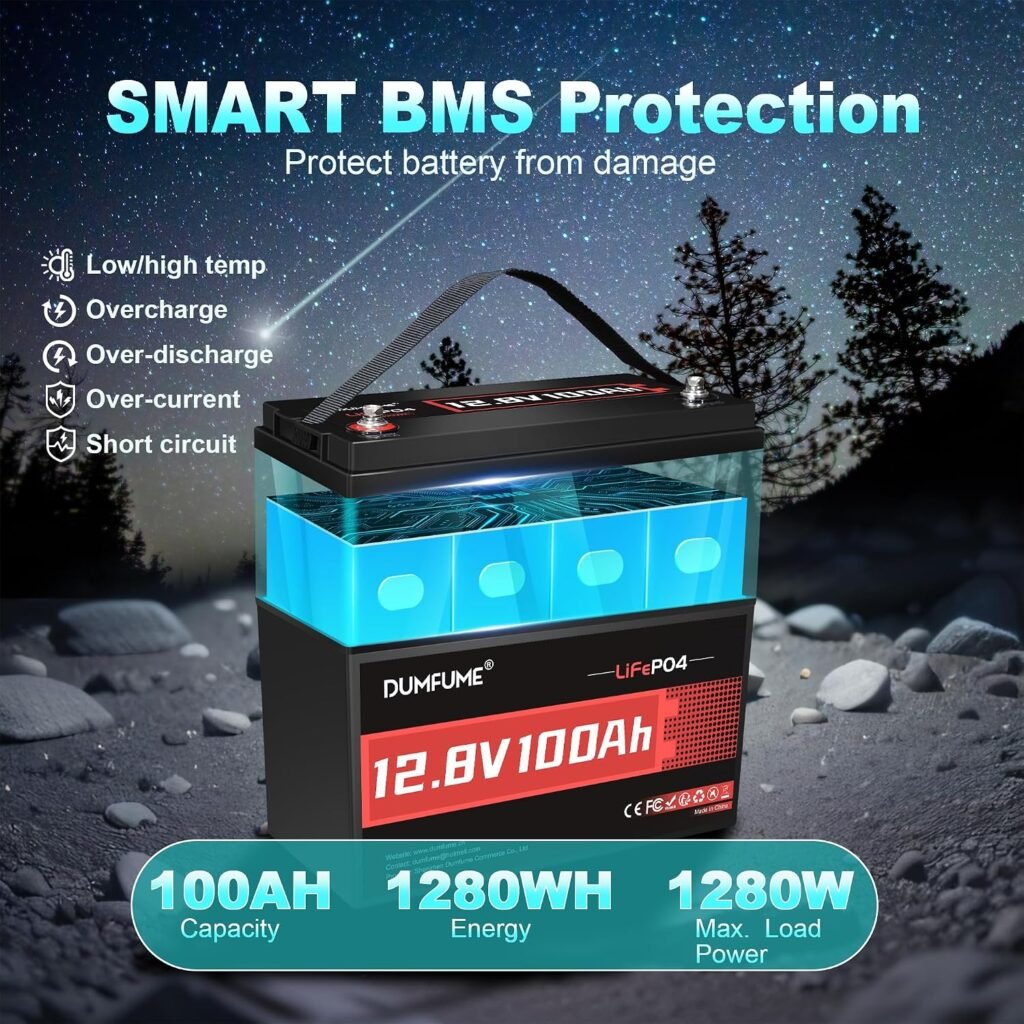
The basic capacity calculation is straightforward: 12.8 volts multiplied by amp-hours equals 1,280 watt-hours, or 1.28kWh. That is the manufacturer’s stated energy capacity, although actual usable energy depends on discharge limits, inverter losses, wiring, temperature, and the load profile.
DUMFUME claims a 25% size reduction and a 40% increase in energy density, but the supplied product information does not provide exact length, width, or height. That omission matters for a Group replacement because battery-tray dimensions and terminal placement vary between caravans, boats, campers, and storage cabinets. We should not assume that the Group label guarantees a fit in every compartment.
The listed weight is 22.05 pounds, compared with a stated 63.9-pound conventional 100Ah AGM reference. That is roughly 41.85 pounds less, a meaningful saving when a battery is lifted into a caravan locker or portable power enclosure.
Before ordering, we recommend checking the tray’s internal dimensions, terminal orientation, cable reach, charger compatibility, ventilation arrangement, and mounting points. Secure the battery against movement, particularly in a moving vehicle or marine installation.
Key Features of the 12V 100Ah LiFePO4 Battery
The DUMFUME battery uses Grade A lithium iron phosphate cells. LiFePO4 chemistry is commonly chosen for repeated deep-cycle storage because it is designed around charge-and-discharge use rather than the brief, high-surge demands of an engine starter. The product description specifically excludes starting batteries, golf carts, and jacks.
Its integrated 100A BMS is described as protecting against overcharging, over-discharging, short circuits, overheating, and overcurrent. In simple terms, a 100A limit at 12.8V represents an approximate 1,280-watt load ceiling before conversion losses. That is not the same as a guaranteed inverter rating, however. We should confirm both continuous and peak-current requirements before connecting an inverter, motor, compressor, or other surge-heavy device.
The battery supports series and parallel connections up to 4S4P. A correctly designed four-series arrangement could reach 51.2V, while four parallel strings could reach 400Ah, subject to the manufacturer’s compatibility requirements.
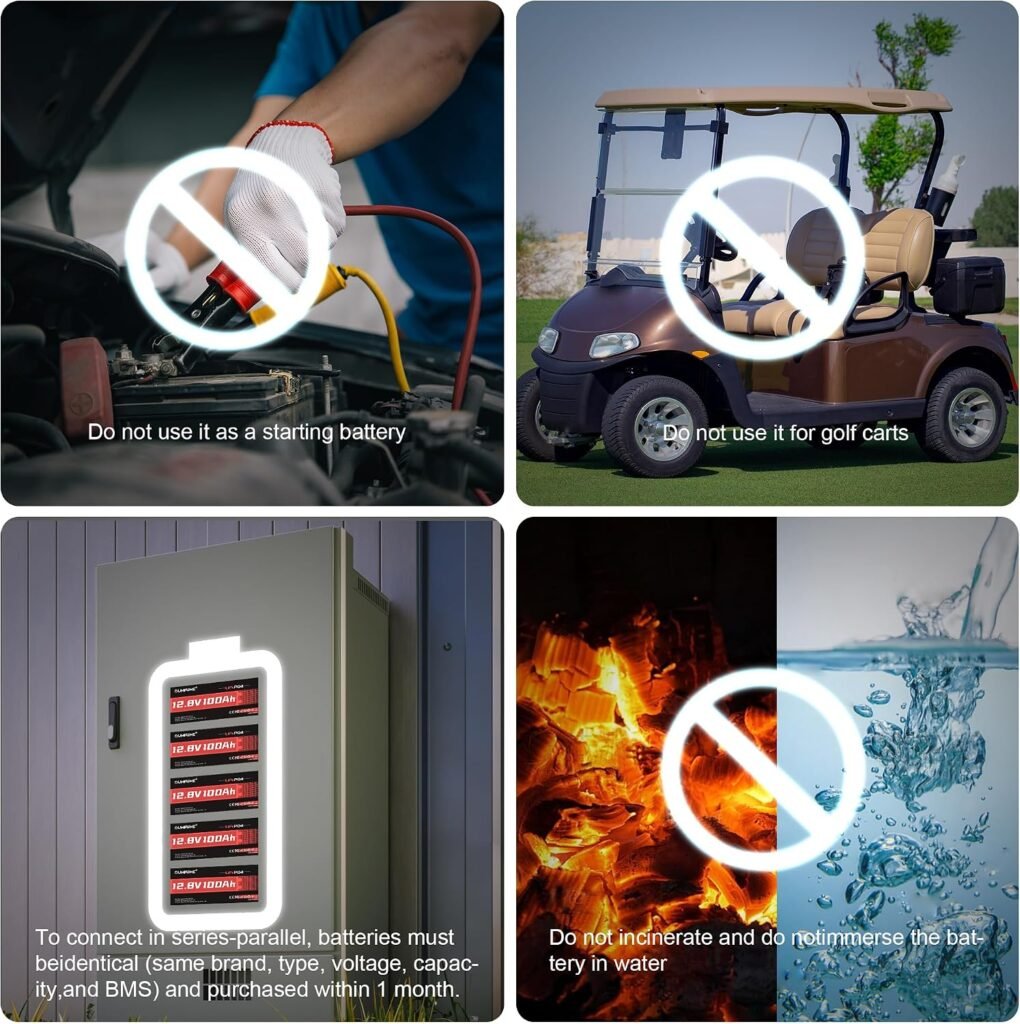
For any combined bank, use identical models with similar age and state of charge, matched cables, suitable fuses or breakers, correct balancing, and a charger designed for the resulting voltage. A larger bank increases available current, so protection and wiring must be designed as a system rather than improvised after connection.

Cycle Life, Charging, and Temperature Limits
The claimed service-life figures are ambitious: more than 4,000 cycles at 100% depth of discharge, more than 6,000 cycles at 80% depth of discharge, and more than 15,000 cycles at 60% depth of discharge. These are manufacturer claims, not results we can independently verify from the supplied material.
Depth of discharge, or DOD, describes how much of the battery’s available capacity is used before recharging. Using roughly 80% or less generally places less stress on a lithium battery than repeatedly draining it completely, which helps explain why the projected cycle count rises as DOD falls. Real-world longevity will also depend on temperature, charge settings, current, storage, and cell balancing.
The listing states that battery performance requires temperatures of 5°C or higher. Cold-weather charging deserves particular attention because the product data does not provide a complete charging-voltage profile, maximum charge-current specification, low-temperature cutoff detail, or recommended charger model. We should obtain those details before installation, especially for winter caravanning or outdoor solar storage.
During extended storage, the instructions say to charge and discharge the battery once every six months. Setting a calendar reminder is practical insurance against leaving it unused indefinitely. The description also allows for voltage and current variation of 1% to 5% depending on temperature, humidity, measurement method, and instruments.
Build Quality and Protection for Outdoor Use
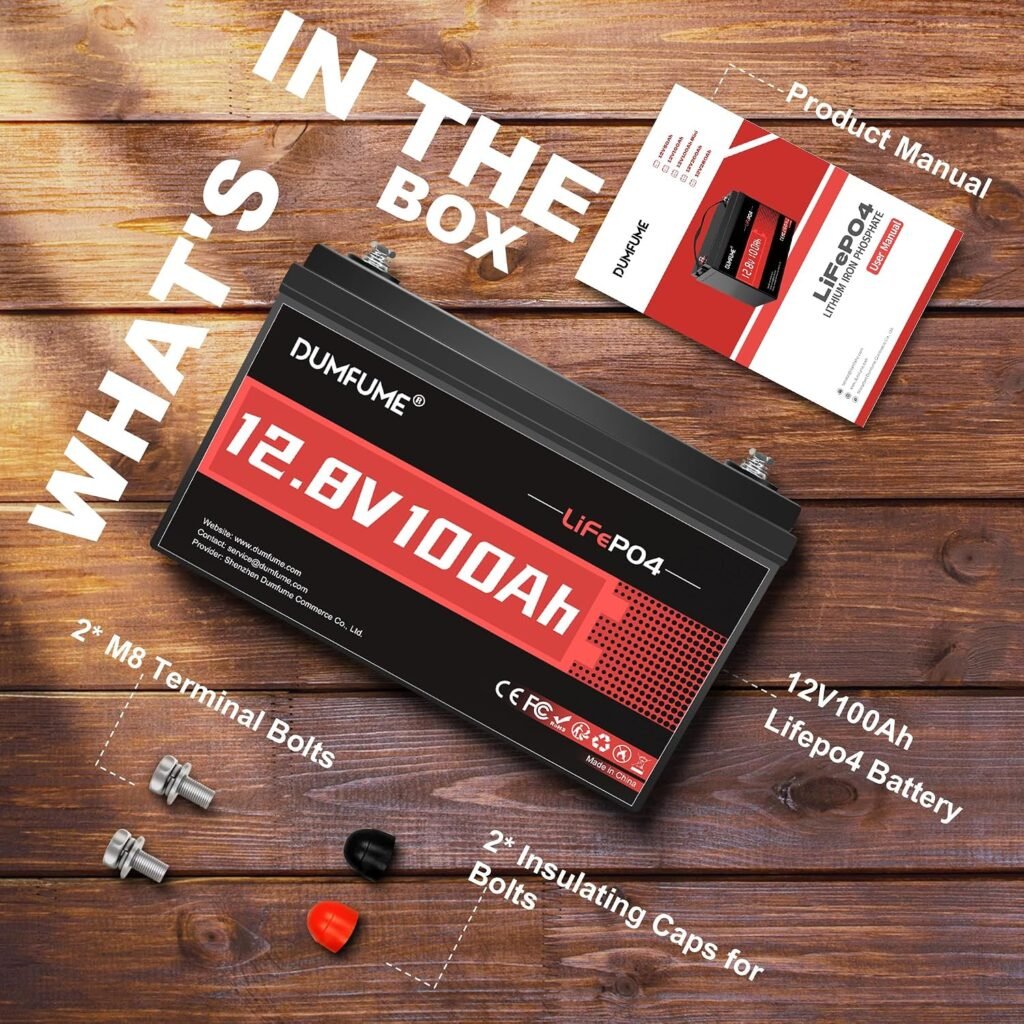
The casing is described as high-strength, impact-resistant, heat-resistant, weather-resistant, and fire-resistant ABS. That combination should be useful in caravans, campers, boats, and off-grid cabinets where equipment may encounter vibration, knocks, and changing conditions.
We should read the weather-resistance wording carefully. The battery is described as dustproof and weather-resistant, but not waterproof. It belongs in a dry, protected enclosure rather than an exposed position where rain, spray, condensation, or flooding can reach the case, terminals, or cables.
The listing says the batteries are certified, but the supplied information does not name the certification standards or provide certificate numbers. That makes it difficult to assess compliance for a particular vehicle, boat, insurance policy, or installation code. The enclosure, terminals, cable gauge, fuse placement, and physical restraint still affect safety even when the battery itself includes protective electronics.
For installation, we would follow this sequence:
- Inspect the case, terminals, and packaging for damage.
- Mount the battery securely in a dry enclosure.
- Check polarity with the wiring disconnected.
- Place the correctly rated fuse close to the battery’s positive terminal.
- Use a charger with confirmed LiFePO4 settings.
- Complete the first charge under supervision and check for abnormal heat, odor, or BMS interruption.
What Customers Are Saying
The source brief does not supply a verified Amazon star rating, review count, or customer quotations for this DUMFUME battery. We therefore cannot honestly claim that buyers rate it at a particular score, nor can we attribute specific experiences to verified purchasers. That absence is itself relevant: shoppers should inspect the current listing’s review record before making a decision.
When we assess the available customer feedback, we would look for repeated evidence rather than isolated comments. Useful patterns include whether users measured close to the stated capacity, found the battery manageable during installation, experienced normal charging, and saw predictable BMS cutoffs. Terminal quality, fit in actual Group compartments, and performance in caravans or solar systems are also more useful than general comments such as “works well.”
Short-term satisfaction cannot confirm the claimed 4,000-plus to 15,000-plus cycle range. Long-term evidence would need to show how batteries performed after sustained use, not merely after a few camping trips.
We would also watch for recurring complaints about cold-weather charging, unexpected protection shutdowns, incompatible chargers, inaccurate capacity readings, damaged packaging, or unclear instructions. Repeated patterns deserve more weight than a single faulty-unit report, and reviewers should have used the battery for an approved deep-cycle purpose rather than engine starting.
How It Compares With Other 12V LiFePO4 Batteries
Two familiar names shoppers may also investigate are the ECO-WORTHY 12V 100Ah LiFePO4 battery and the Renogy 12V 100Ah LiFePO4 battery. We cannot make a current, like-for-like ranking because the supplied brief does not include verified live prices, warranties, dimensions, ratings, BMS specifications, or accessory lists for those alternatives. Their current listings should be checked directly at the time of purchase.
The DUMFUME listing’s clearest numerical strengths are its stated 1,280Wh capacity, 100A BMS, 22.05-pound weight, and support for expansion up to 4S4P. A meaningful comparison should then examine continuous discharge capability, low-temperature charging protection, Bluetooth or display monitoring, claimed cycle testing, enclosure design, warranty length, and after-sales support.
Several purchase questions remain open for DUMFUME: exact physical dimensions, complete charging limits, warranty terms, named certification standards, and whether monitoring hardware or accessories are included. Those details may matter more than a small price difference for a permanent RV or solar installation.
We should compare 100Ah batteries at the same nominal voltage and include the cost of a compatible charger, fuse, cables, and enclosure. A lower purchase price doesn’t automatically represent better system value if extra equipment or weaker support increases the total cost.
Who Should Buy This 12V 100Ah LiFePO4 Battery?
This battery is a sensible candidate for caravan and camper owners, portable power builders, small solar-storage systems, backup loads, and off-grid users who need lightweight 12V deep-cycle storage. Suitable loads may include lights, refrigeration, electronics, communications equipment, and moderate inverter use, provided the complete wattage and surge calculation is completed first.
We would not choose it for engine starting, golf carts, jacks, or any application that expects a starting-battery surge. That restriction comes directly from the product description, so substituting it into an excluded application would be poor practice even if the nominal voltage appears compatible.
A different battery may be preferable if we need reliable charging in cold weather, app-based monitoring, a clearly documented warranty, a waterproof enclosure, higher continuous output, or a certification package with named standards and traceable documentation. Those needs are common in demanding marine, commercial, and permanent installations.
Our purchase check is simple: identify every load, calculate daily watt-hours, confirm the storage compartment and cable route, verify charger settings, plan positive-side fusing, and confirm the expected installation temperature. If any answer is unclear, we would pause the purchase and request the missing specification rather than guessing.
Price and Overall Value Assessment
The current listed price is $152.96, compared with an original price of $168.66, a stated reduction of $15.70. The listing shows the product in stock, although prices and availability can change. At the listed price, the simple cost per stated watt-hour is about $0.12 ($152.96 divided by 1,280Wh).
That calculation is only a starting point. Real value also depends on how much energy we can use, how long the battery lasts, the warranty, charger requirements, accessories, installation hardware, and whether the BMS limits suit the intended load. The substantial weight saving compared with the description’s 63.9-pound AGM reference could be especially valuable in mobile setups, where lifting and payload are genuine constraints.
The capacity, 100A protection system, and expansion claim make the DUMFUME 12V 100Ah LiFePO4 battery attractive for approved deep-cycle applications. However, unresolved details remain around exact dimensions, warranty terms, full charging limits, low-temperature protection, and named certification standards.
We would consider it when the application is a dry, properly fused deep-cycle system and the seller can confirm the missing installation information. We would be more cautious when cold-weather operation, formal documentation, monitoring, or long-term after-sales support is essential.
Pros and Cons
Pros
- Stated 1.28kWh capacity from a 12.8V, 100Ah LiFePO4 design
- Lightweight 22.05-pound format compared with the listed 63.9-pound AGM reference
- Integrated 100A BMS with multiple stated protection functions
- Supports series and parallel expansion up to 4S4P
- Reduced listed price of $152.96 while shown in stock
Cons
- Exact physical dimensions and terminal layout are not supplied
- Complete charging profile, charge-current limit, and low-temperature cutoff details are missing
- Not waterproof and requires performance temperatures of 5°C or higher
- Warranty terms and named certification standards are not provided
- Explicitly unsuitable for engine starting, golf carts, and jacks
Final Verdict
Key Takeaways
- The DUMFUME battery provides a stated 12.8V, 100Ah and 1.28kWh deep-cycle platform with a 100A BMS.
- Its 22.05-pound listed weight may make it attractive for caravans, campers, marine systems, and portable storage.
- The product is not intended for engine starting, golf carts, or jacks, and charging requires temperatures of at least 5°C according to the listing.
- Exact dimensions, complete charging specifications, warranty terms, low-temperature cutoff details, and named certification standards are not supplied in the source data.
- At $152.96, it offers an appealing entry price, provided the buyer verifies compatibility and accepts the documentation gaps.
Frequently Asked Questions
Are ECO-WORTHY LiFePO4 batteries good?
ECO-WORTHY is a named alternative worth comparing, but the supplied product data does not include its current price, rating, warranty, dimensions, or BMS details. We should judge a specific ECO-WORTHY model by its documented continuous output, cold-temperature protection, cycle claims, warranty, and total system cost rather than by brand name alone.
Which Amazon LiFePO4 battery is the best?
There is no single best battery for every installation. The right choice depends on capacity, continuous and peak current, charger compatibility, low-temperature protection, physical fit, warranty, monitoring, certification documentation, and total cost. This DUMFUME model is worth considering for lightweight 12V deep-cycle storage, but its missing charging and certification details should be resolved first.
Which LiFePO4 battery is best for an RV?
For an RV, the best battery is one that fits the compartment, supports the RV’s peak loads, works with the existing charger, and has suitable protection for the installation temperature. This DUMFUME battery may suit lights, refrigeration, electronics, communications, and moderate inverter loads, but it should be kept dry and must not be used for engine starting or other excluded applications.
What is the best lithium battery for a caravan?
The best caravan battery balances usable energy, weight, physical fit, charging protection, current capability, warranty, and service support. The DUMFUME 12V 100Ah LiFePO4 battery offers a stated 1.28kWh capacity and lightweight design, but buyers should confirm dimensions, charger settings, cold-weather limits, and installation documentation before choosing it.
Disclosure: As an Amazon Associate, I earn from qualifying purchases.


