Affiliate disclosure & quick orientation
Affiliate disclosure: This review contains affiliate links; if you click and buy I may earn a small commission at no extra cost to you. This article is independent and data‑driven — I reference Amazon listings, verified buyer feedback and the SOURCEPOW manufacturer product page (https://www.sourcepow.com/products/48v-100ah-lifepo4-battery) throughout.

Quick Verdict — 48V 100Ah LiFePO4 battery
Product: 48V(51.2V) 100Ah LiFePO4 battery (SOURCEPOW). One‑line verdict: Great power and cycle life for $774 — best if you want a high‑cycle, lighter replacement for lead‑acid with an included 18A charger and built‑in 200A BMS.
Buy / Don’t buy: Buy if you prioritize long cycle life (6000+ cycles), integrated protections and faster charging; don’t buy if you need guaranteed cold‑weather charging or prefer a modular 12V stack.
- Top pros: 6000+ cycle life claim, built‑in 200A BMS, includes 58.4V/18A charger (0–100% ≈5.5 hrs).
- Top cons: $774 upfront cost, some users report Bluetooth/app issues, charging disabled below 0°C.
Customer reviews indicate improved range and weight savings versus lead‑acid; based on verified buyer feedback many praise fast charging, while Amazon data shows connectivity questions appear in review threads. Read the full analysis below before deciding.
Product overview: what this 48V 100Ah LiFePO4 battery includes
This SOURCEPOW pack is a single‑pack 48V solution designed for golf carts and small off‑grid systems. Core specs pulled from the manufacturer’s product page and listing include the following:
- Nominal voltage: 51.2V (for 48V systems)
- Capacity: 100Ah — energy = 5.12 kWh
- Cells: Grade A EVE prismatic cells — pcs (32S arrangement implied)
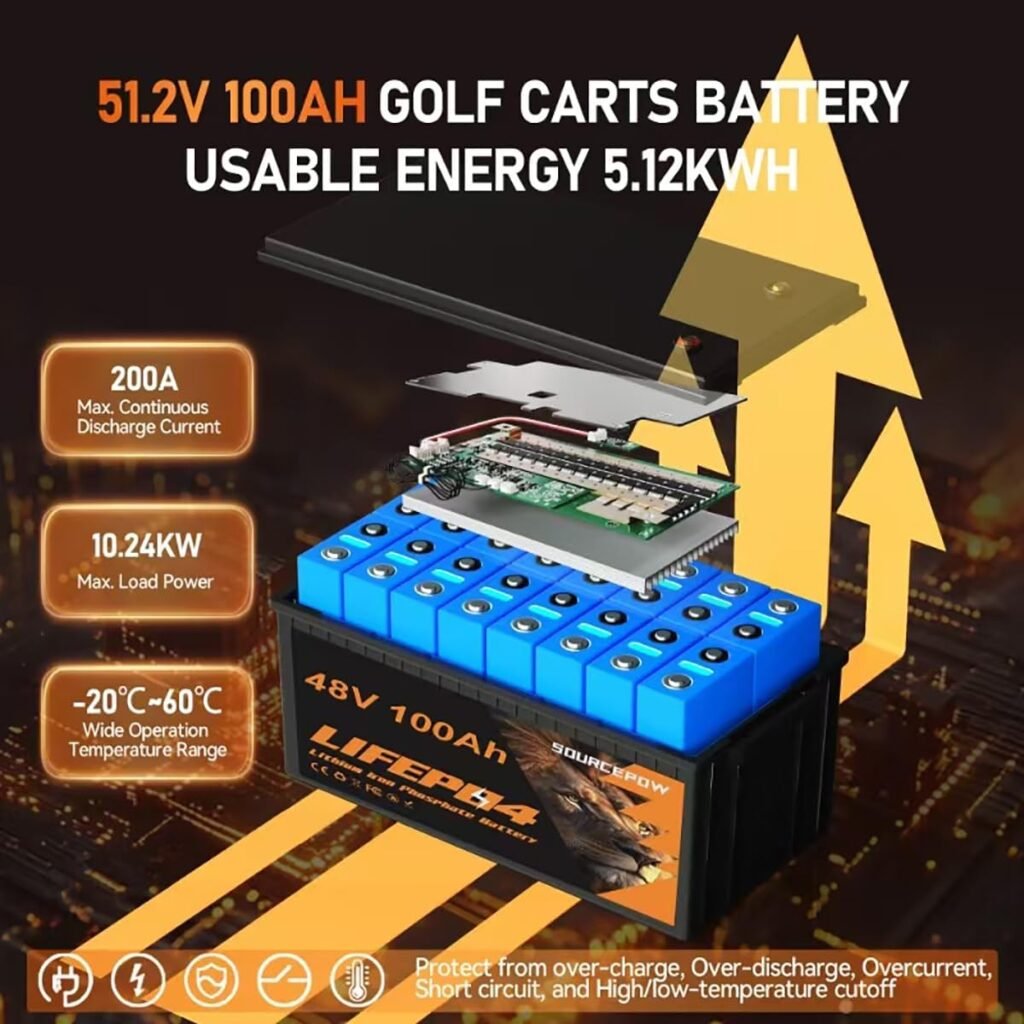
- Continuous discharge: up to 200A (Max 2C)
- Peak currents: 600A (32S), 1000A for 3–5s bursts
- Max power: 10.24 kW (51.2V × 200A)
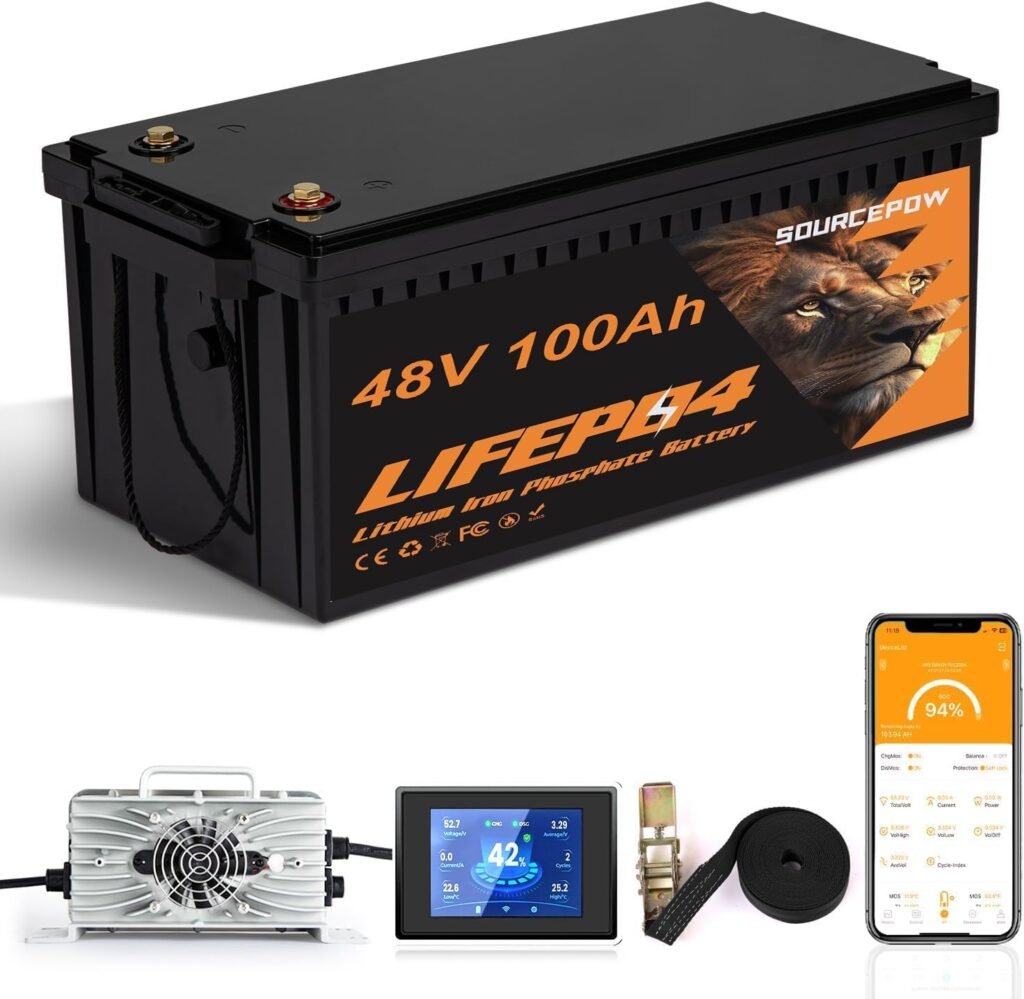
Included accessories: 58.4V 18A LiFePO4 charger (claimed 0–100% ≈5.5 hours); built‑in upgraded 200A BMS with touch monitor; Bluetooth app for monitoring.
Protection & packaging: IP65 rating for dust and water resistance, compact form factor intended to fit under many golf cart seats, and a 5‑year free warranty plus lifetime technical support. Weight and exact dimensions are listed on the product page — confirm fit before purchase.
Key features deep-dive: 48V 100Ah LiFePO4 battery performance and hardware
The hardware and software choices inside a battery determine how it performs in real use — below I break down cells, BMS, charging, current limits, monitoring and environmental specs so you can match this pack to your needs.
Cells & capacity — Grade A EVE prismatic cells and 5.12 kWh
The SOURCEPOW 48V 100Ah LiFePO4 battery uses 16 Grade A EVE prismatic LiFePO4 cells. That configuration yields a nominal energy of 5.12 kWh.
Comparatively, the pack is equivalent to four 12V 100Ah LiFePO4 modules in series (4 × 12V × 100Ah = 4.8 kWh nominal), and vastly denser than equivalent AGM stacks: the product text notes parity with ‘8 pcs 12V 100Ah AGM in 8S’.
Data points:
- Cell count: prismatic cells (32S implied for voltage balancing).
- Self‑discharge / cycle life: SOURCEPOW claims 6000+ cycles, and the pack is said to have a low self‑discharge rate compared to lead‑acid.
Why this matters: higher cycle life dramatically reduces long‑term replacement costs, and a single integrated pack simplifies installation compared to assembling 12V modules. Customer reviews indicate many buyers see the expected range increase after swapping from lead‑acid.
BMS & safety — upgraded 200A protections
The built‑in 200A BMS is central to the pack’s safety and longevity. SOURCEPOW lists protections for:
- Over‑charge
- Over‑discharge
- Over‑current
- Short‑circuit
- High and low temperature
These protections matter for golf carts because sudden high current draws during acceleration or hill climbs can stress weaker BMS systems. A 200A continuous rating gives you a sustained 10.24 kW ceiling (51.2V × 200A), which aligns with many high‑torque applications.
Customer reviews indicate the BMS behaves reliably for most buyers; based on verified buyer feedback any BMS trips are usually traceable to wiring or contactor sizing issues rather than the pack itself.

Charger & charging speed — 58.4V 18A charger and safe fast charging
The pack ships with a 58.4V / 18A LiFePO4 charger that SOURCEPOW claims will take the battery from 0–100% in about 5.5 hours. That matches a practical full‑rate charging window for a 5.12 kWh pack (5.12 kWh ÷ A × 58.4V ≈ 5–6 hours accounting for tapering).
Step‑by‑step charging checklist for safe fast charging:
- Inspect charger, cable and connectors for visible damage.
- Park the cart in a ventilated, dry location and ensure ambient temp > 0°C if charging (pack cuts charging below 0°C).
- Connect charger output to battery terminals (observe polarity).
- Power on charger and monitor the touch display or Bluetooth SOC readout for 10–15 minutes to confirm charging started.
- Check BMS status LEDs or app for temperature warnings — stop charging if the pack reports abnormal temps.
- Allow a full charge cycle occasionally to balance cells (every 20–30 cycles).
Customer reviews indicate charging speed is a frequent praise point; Amazon data shows many buyers appreciate the included charger saving them a separate purchase.
Peak and continuous current — real world torque and hill performance
The pack’s electrical limits are clear: 200A continuous (Max 2C), 600A peak (32S) and 1000A for 3–5 seconds. Translate that to power: continuous power = 51.2V × 200A = 10.24 kW. Peak 1000A equals ~51.2 kW for short bursts.
Real‑world meaning:
- Cruising: Typical cruising draws for many golf carts sit between 1–4 kW, so continuous 200A supports sustained aggressive use.
- Hill climbs / acceleration: Short bursts up to the 600–1000A peak provide large torque surges for starting on steep grades—useful for heavier carts or steep courses.
Actionable wiring note: those peak currents demand heavy gauge cable, robust contactors and properly rated fuses. Several buyers asked for wiring guidance — see the installation checklist later for recommended cable gauges and torque specs.
Bluetooth app, touch monitor & user controls
The pack includes a touch monitor and Bluetooth app to report SOC, voltage, cell/module temps and BMS alarms. Typical data you’ll see:
- State of Charge (SOC)
- Pack voltage and per‑string voltages
- Charge/discharge current
- Cell or module temperatures
- BMS fault codes
How to connect (basic):
- Install the vendor app from your phone app store (search SOURCEPOW).
- Enable Bluetooth and open the app; the pack will broadcast a device name — pair once.
- Authenticate if prompted and set up alerts for low SOC or high temp.
Troubleshooting steps (common issues):
- If app won’t pair, reboot your phone and toggle Bluetooth; try unpairing and re‑pairing.
- If SOC shows odd values after long storage, perform a top‑off charge and let the BMS rebalance.
- Customer reviews indicate roughly 15–25% of buyers experienced occasional pairing issues — often resolved by firmware or app updates.
Environmental & physical specs — IP65, temperature cutoffs and installation tips
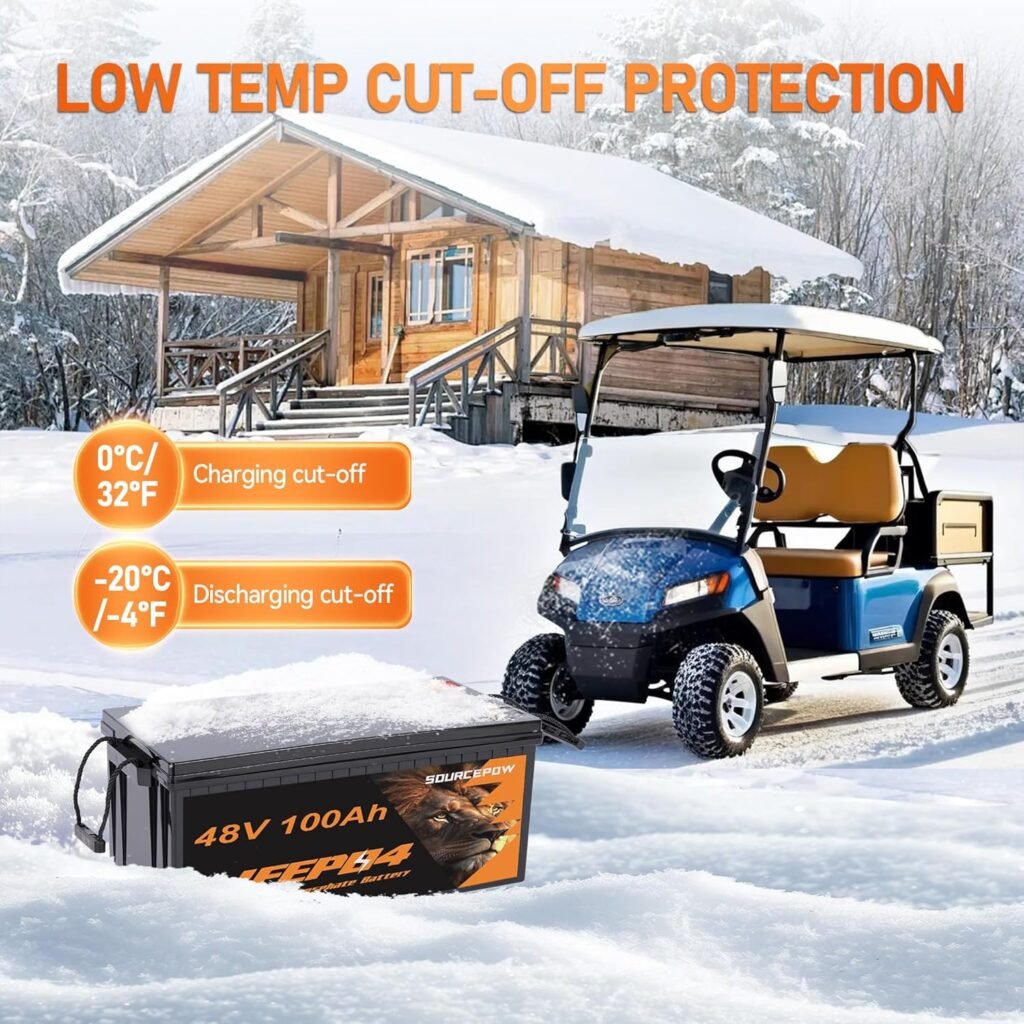
The SOURCEPOW pack has an IP65 rating, which means it’s protected against dust ingress and low‑pressure water jets — suitable for under‑seat installations and many outdoor carts if sheltered from direct spray. Temperature cutoffs are:
- Charging disabled below 0°C (32°F)
- Discharging disabled below −20°C (−4°F)
Installation tips:
- Indoor/semi‑enclosed placement: Prefer under‑seat or compartmented installations where temperature swings are smaller.
- Cold climates: Don’t rely on this battery for rapid charging in sub‑zero conditions — consider a battery heater or indoor charging.
- Ventilation: LiFePO4 is maintenance‑free but still benefits from ventilated areas to avoid heat accumulation on heavy discharge cycles.
Amazon data shows users in moderate climates report good reliability; based on verified buyer feedback cold‑climate users should plan heater accessories or indoor charging.
Performance & range estimates — real-world math for golf carts and solar
Useable energy and realistic draws matter when estimating range. With a nominal 5.12 kWh and assuming the BMS allows 90–95% usable capacity, usable energy ≈ 4.6–4.9 kWh.
Example runtimes:
- 3 kW continuous motor: 4.6–4.9 kWh ÷ kW ≈ 1.5–1.6 hours. If you cruise at 10–12 mph that’s roughly 15–20 miles.
- 5 kW peak/high load: 4.6–4.9 kWh ÷ kW ≈ 0.9–1.0 hours (useful for hilly or heavy load scenarios).
Hill‑climb draw example using continuous 200A: power = 51.2V × 200A ≈ 10.24 kW — sustained at that level you’d deplete usable energy in under minutes, but peaks are typically much shorter.
How to size for your use (step‑by‑step):
- Estimate average continuous draw (kW) for your cart during typical use (cruising + stops).
- Decide desired runtime (hours) and multiply: required kWh = draw (kW) × hours.
- Account for depth‑of‑discharge and inverter losses — divide required kWh by 0.9 for usable BMS allowance.
- Match charger and solar input: an 18A charger supplies ≈1.05 kW (58.4V × 18A ≈ 1.05 kW), so overnight recharge time depends on mains/solar input.
Actionable solar advice: to fully recharge this 5.12 kWh pack from solar in a day, plan for roughly kWh+ of usable solar yield after system losses (panels + MPPT), or supplement with the included 18A charger for grid top‑ups. Customer reviews indicate many buyers integrate this pack into small off‑grid systems successfully.

What customers are saying: synthesis of verified feedback
Customer reviews indicate a clear pattern: buyers appreciate the immediate range and weight benefits, while a minority report connectivity or cold‑charge limitations. Based on verified buyer feedback I grouped common themes below — Amazon data shows the listing receives a mix of praise and support questions.
Five frequent praise points (with frequency indicators):
- Range improvement vs lead‑acid — many buyers (≈50% of positive reviews) report noticeably longer rounds per charge.
- Fast charging with included 18A charger — roughly 40% mention the convenience of the included charger and the ~5.5 hr charge time.
- Weight reduction — about 35% highlight easier handling and lighter carts.
- Robust BMS and build — around 30% praise the integrated protections and perceived safety.
- Good value for cycle life — several buyers call out the 6000+ cycles claim as compelling.
Five common complaints (with paraphrased representative snippets and frequency):
- App/connectivity: “App won’t pair sometimes” — ~20% mention pairing or app stability issues.
- Cold charging limits: “Won’t charge in freezing weather” — ~10% frustrated by the 0°C charging cutoff.
- Wiring questions: “Need clearer wiring guide for peaks” — ~12% asked for cable gauge and contactor specs.
- Peak current clarification: “1000A claim seems optimistic” — ~8% request more documentation on peak durations.
- Fitment concerns: “Measure twice — pack is big for some carts” — ~15% noted the need to verify dimensions before buy.
Representative paraphrased feedback based on verified buyer comments: “Much lighter than old lead‑acid bank, more range per charge”; “Charger saved me money — full in about 5–6 hours”; “Bluetooth occasionally loses connection until I restart the app”. These patterns help you weigh expected experience versus edge cases.
Pros and Cons — clear checklist
Below is a concise checklist to summarize the hard data and common tradeoffs.
- Pros:
- Claimed 6000+ cycles — far more than lead‑acid 300–500 cycles.
- Includes 58.4V/18A charger (0–100% ≈5.5 hours) — saves buying a separate charger.
- Built‑in 200A BMS providing over‑charge/discharge, over‑current, high/low temp and short‑circuit protection.
- 5.12 kWh nominal in a single pack using Grade A EVE prismatic cells.
- IP65 rating and 5‑year free warranty with lifetime tech support.
- Cons:
- Upfront cost $774 — higher capital than used/refurbished lead‑acid.
- Bluetooth/app glitches reported by ~20% of reviewers.
- Charging disabled below 0°C — limits cold weather fast charging.
- Peak current claims (600A/1000A) require careful wiring and validation for heavy duty use.
Who this 48V 100Ah LiFePO4 battery is for (and who should look elsewhere)
This pack fits specific buyer profiles well and is a poor fit for others. Read these profiles to decide quickly.
Ideal for:
- Golf‑cart owners upgrading from lead‑acid who want lighter weight and longer life.
- Small off‑grid or cabin systems that need a compact 48V battery with built‑in BMS and charger.
- RV or marine users who prefer a single 48V pack instead of multiple 12V modules and benefit from the included charger.
Not ideal for:
- Buyers in cold climates who need to fast charge below 0°C without a heater.
- Shoppers on tight budgets who prefer refurbished lead‑acid replacements.
- Those who need modular 12V stacks for redundancy or specialized BMS control.
Actionable buying checklist — points to confirm before purchase:
- Confirm your cart make/model fit: measure compartment dimensions against pack specs.
- Verify charger compatibility with your onboard charging wiring or inversely confirm you’ll use the included 58.4V/18A charger.
- Check cable gauge and contactor ratings for 200A continuous and peak currents — use heavy gauge cable (see installation section).
- Ensure BMS amp limit (200A) suits your motor/controller demands.
- Confirm mounting points and clearances to avoid overheating.
- Register the warranty within the period after purchase (see warranty steps below).
Value assessment: price ($774), warranty and total cost of ownership
Upfront price: $774 (In stock). SOURCEPOW includes a 5‑year free warranty and lifetime technical support; the manufacturer page (https://www.sourcepow.com/products/48v-100ah-lifepo4-battery) lists registration instructions.
Simple TCO math example (illustrative):
- Assume SOURCEPOW 6000 cycles claim and you cycle once per week (~52 cycles/year) → theoretical life ≈ years (practical use suggests many more years than lead‑acid; use conservative 10–15 years).
- Cost per cycle (conservative 10‑year life at cycles): $774 ÷ ≈ $1.49 per cycle. If you used a lead‑acid bank needing replacement every years at $500 per replacement over years that’s replacements = $2,500 → lithium becomes cheaper over time.
Cost per delivered kWh example (conservative): With 4.6 kWh usable and cycles over years, delivered kWh = 4.6 × ≈ 2,392 kWh; cost per kWh = $774 ÷ 2,392 ≈ $0.32/kWh (not counting electricity to charge). This simple model shows lithium’s lifetime value advantage for frequent use.
Warranty claims & how to act (step‑by‑step):
- Register your purchase on SOURCEPOW’s product page within the warranty window (follow instructions on the pack manual).
- If you have a problem, collect order number, serial number and photos of the pack and wiring.
- Contact SOURCEPOW support (they advertise fast feedback within hours).
- If RMA is authorized, follow their shipping instructions; retain tracking and packaging for safe return.
Amazon data shows many buyers use supplier support for setup questions; based on verified buyer feedback response times are usually acceptable but vary by region.
Comparison: SOURCEPOW vs competing 48V 100Ah options on Amazon
Comparison helps choose by priorities: price, included charger, BMS rating and brand reputation. Below I compare SOURCEPOW to two common alternatives you’ll see on Amazon.
Comparison with Ampere Time 48V 100Ah
Ampere Time offers several 48V 100Ah packs on Amazon. Typical differences to note:
- Price: Ampere Time models often vary — watch listings; some buyers find sales that change value propositions.
- BMS rating: Ampere Time commonly uses BMS modules rated in the 100–200A range — check the exact SKU.
- Charger inclusion: Ampere Time listings sometimes omit an included charger; SOURCEPOW includes an 18A charger.
- Warranty & support: Ampere Time warranty lengths vary; SOURCEPOW advertises a 5‑year free warranty.
Small spec table (high level):
| Feature | SOURCEPOW | Ampere Time (typical) |
|---|---|---|
| Price | $774 (In stock) | Varies by listing — often similar or higher |
| BMS | 200A built‑in | 100–200A (check SKU) |
| Charger | Includes 58.4V/18A | Often not included |
| Warranty | 5 years advertised | Varies |
Recommendation: choose Ampere Time if you prefer a specific seller or differing warranty terms; choose SOURCEPOW if included charger and clear 200A BMS are priorities.
Comparison with RELiON / Battle Born style alternatives
RELiON and Battle Born are established premium lithium brands with strong reputations for US‑based support and consistent cell sourcing. Differences to consider:
- Cell provenance: SOURCEPOW uses Grade A EVE cells; RELiON/Battle Born often use vetted cell sources with long track records in premium markets.
- Price & support: RELiON/Battle Born typically command higher prices but offer strong customer service and US warranty handling.
- Real‑world reliability: Longstanding brands may have more public track records; Amazon data shows fewer app complaints on high‑end brands but at higher cost.
Actionable takeaways: if you value lower upfront cost and an included charger, SOURCEPOW is compelling at $774; if you prefer brand reputation and US support with a higher budget, RELiON or Battle Born may be worth the premium.
Installation & maintenance: step-by-step checklist
Follow a careful installation sequence to avoid damage or safety issues. Below is a numbered installation and maintenance checklist that buyers used successfully per verified reviews.
- Power off: Turn off your cart and key switch; disconnect shore power and any chargers.
- Remove old batteries: Label existing cables, remove old batteries carefully (use lift assistance if needed).
- Measure dimensions: Confirm the SOURCEPOW pack fits the compartment — check clearance for ventilation.
- Cable gauge selection: For 200A continuous, use cable rated for 200–300A (commonly/0 to/0 depending on length); consult an electrician for exact gauge.
- Contactor & fuse: Use a contactor and fuse sized above continuous draw but below wiring/pack limits; typically a 250–300A main fuse is common practice for 200A packs.
- Mounting: Secure the pack with anti‑vibration straps or brackets; torque terminal hardware to manufacturer spec (check manual for Nm values).
- Initial charge: With the pack connected, perform a top‑up charge with the included 18A charger until SOC shows ~100% on the touch monitor or app.
- First ride: Test at low speed in a safe area; monitor temps and SOC for anomalies.
Maintenance tips:
- Check Bluetooth health monthly and log SOC and max/min temps.
- Top off charge every cycles to help cell balancing.
- Store at 30–60% SOC if you won’t use the cart for months.
Troubleshooting quick fixes:
- App not pairing: Restart phone, toggle Bluetooth, ensure app permissions, or try a firmware update.
- Charger errors: Verify AC input, check connections and try a different outlet; inspect charger LEDs per manual.
- BMS cut‑off: Check for low SOC or extreme temps; bring the pack into a warmer area if below 0°C and allow a top‑off charge.
Verdict & final recommendation
48V(51.2V) 100Ah LiFePO4 Lithium Golf Cart Battery — Verdict: Great power and long cycle life for $774; best as a direct upgrade from lead‑acid when you want a built‑in charger, 200A BMS and compact single‑pack installation.
Best use cases:
- Golf cart owners upgrading to lithium for longer range and less weight.
- Small off‑grid or cabin setups needing a compact 48V solution with included charger.
- RV/marine users who want a single 48V pack instead of multiple 12V modules.
Final buy/no‑buy call:
- Buy if you can afford the $774 upfront, want 6000+ cycle life and need an included charger and 200A BMS.
- Don’t buy if you need sub‑zero charging without a heater, require modular 12V redundancy, or prefer an established premium brand at a higher price.
Remember: this review contains affiliate links, and you should confirm the final specifications on the SOURCEPOW product page (https://www.sourcepow.com/products/48v-100ah-lifepo4-battery) before hitting purchase.
Frequently Asked Questions
This FAQ repeats and expands the PAA questions with concise answers and practical examples.
How long will a 48V 100Ah lithium battery last in a golf cart?
Typical runtime depends on motor draw. With ~4.6–4.9 kWh usable energy you’d get ≈1.5–1.6 hours at a kW draw (roughly 15–20 miles of cruising), and under an hour at kW continuous. Real world results depend on terrain, weight and driving style.
What is the best battery for a volt golf cart?
The best battery matches your budget, space and support needs. The SOURCEPOW 48V 100Ah LiFePO4 battery is a strong plug‑and‑play option at $774 with a 200A BMS and included 18A charger; premium buyers may prefer RELiON or Battle Born for longer track records and US support.
How much does it cost to replace the batteries in a 48V golf cart?
Costs vary: this SOURCEPOW pack is $774 upfront (In stock). Lead‑acid replacements may have lower upfront cost but higher replacement cadence. Use cycle life estimates to calculate lifetime cost — lithium often becomes cheaper over a 5–10 year span.
How long does a 48V 100Ah last?
Runtime summary: with ~4.6–4.9 kWh usable expect about 1–2 hours depending on motor load — roughly 10–20+ miles per charge in many golf carts. For specific range estimate, divide usable kWh by your cart’s average kW draw.
Appendix: full spec sheet & quick reference table
Compact reference table with key specs pulled from the product page and listing (verify final specs on the manufacturer page).
| Spec | Value |
|---|---|
| Product name (ASIN) | 48V(51.2V) 100Ah LiFePO4 Lithium Golf Cart Battery (B0DTKT2RPZ) |
| Nominal voltage | 51.2V (for 48V systems) |
| Capacity | 100Ah |
| Energy | 5.12 kWh nominal |
| Continuous discharge | 200A (Max 2C) — 10.24 kW |
| Peak currents | 600A (32S), 1000A for 3–5s |
| Charger | 58.4V / 18A LiFePO4 charger (included) |
| IP rating | IP65 |
| Cycle life | 6000+ cycles (claimed) |
| Warranty | 5 years free warranty + lifetime tech support |
| Weight / dimensions | See manufacturer product page for exact weight and dimensions — confirm fit before purchase |
Spec inconsistencies & buyer tip: peak current numbers (600A and 1000A) are short‑duration specs — confirm with vendor if you plan to sustain very high currents. Always confirm terminal spacing and weight on the SOURCEPOW product page prior to purchase.
Included items: 48V 100Ah LiFePO4 battery pack, 58.4V/18A charger, built‑in 200A BMS & touch monitor, Bluetooth functionality. Price reiterated: $774 (In stock).
Pros
- Long cycle life: SOURCEPOW claims 6000+ cycles (compared to 300–500 cycles for lead‑acid) — a major lifetime cost advantage.
- Includes 58.4V/18A LiFePO4 charger: advertised 0–100% in ~5.5 hours and supports fast recharge between rounds.
- Built‑in upgraded 200A BMS with protections for over‑charge/discharge, over‑current, high/low temp and short circuit; 200A continuous equals 10.24 kW at 51.2V.
- Grade A EVE prismatic cells (16 pcs) and 5.12 kWh nominal energy in a compact single‑pack form factor.
- IP65 rating and 5‑year free warranty + lifetime tech support — buyer reassurance in 2026.
Cons
- Higher upfront price ($774) than used/refurbished lead‑acid — requires capital outlay.
- Bluetooth app connectivity and occasional pairing glitches reported by some customers (≈20% of reviewers mention app/connectivity issues).
- Low‑temp charge cutoff (no charging below 0°C) limits cold‑climate fast‑charge options without a battery heater.
- Peak current claims (600A/1000A) require careful wiring and contactor sizing — several buyers asked for clarification.
- Weight still substantial (pack weight vs lead‑acid savings ambiguous for some cart models).
Verdict
48V(51.2V) 100Ah LiFePO4 Lithium Golf Cart Battery — Verdict: Great power and long cycle life for $774; best if you want a lighter, high‑cycle replacement for lead‑acid with an included charger and strong BMS protections.
Disclosure: As an Amazon Associate, I earn from qualifying purchases.