Quick verdict — DC HOUSE 12V 100Ah at a glance
DC HOUSE 12V 100Ah is worth buying for trolling motors, RVs, and camping when you value clear SOC indication and app monitoring at a budget price, $183.99 — In Stock. SOC LED indicators, built-in Bluetooth & app monitoring, 100A BMS with Low Temp Cut-Off. Amazon data shows strong interest and customer reviews indicate real users appreciate the features; this summary is based on verified buyer feedback in 2026.
This article contains affiliate links. As an Amazon Associate I earn from qualifying purchases.

Product overview — DC HOUSE 12V 100Ah product specifications
DC HOUSE 12V 100Ah ships as a 12.8V / 100Ah LiFePO4 battery aimed at trolling motors, RVs, and camping. Amazon data shows the listing at $183.99 — In Stock, ASIN B0DTKGNFQN. The manufacturer advertises a built-in Bluetooth module, SOC Status LED, USB-A, USB-C and DC ports, a built-in 100A BMS, Low Temp Cut-Off protection, metal cell clamps, up to 15,000 cycles and a 10-year service life. The seller also reports a 3 years service promise via Amazon/manual.
- Nominal voltage: 12.8V
- Capacity: 100Ah
- Chemistry: LiFePO4 (lithium iron phosphate)
- Built-in protections: 100A BMS — overcharge, over-discharge, over-current, short-circuit, temperature-based cut-offs
- Low Temp Cut-Off: charge cut-off <19.4°F, discharge cut <4°F, auto-recover at 32°F
- Ports: USB-A, USB-C, DC port (can charge devices simultaneously per product description)
- Cell fixation: metal cell clamps (manufacturer claims improved stability)
- Cycle life claim: up to 15,000 cycles and 10-year life (manufacturer claim)
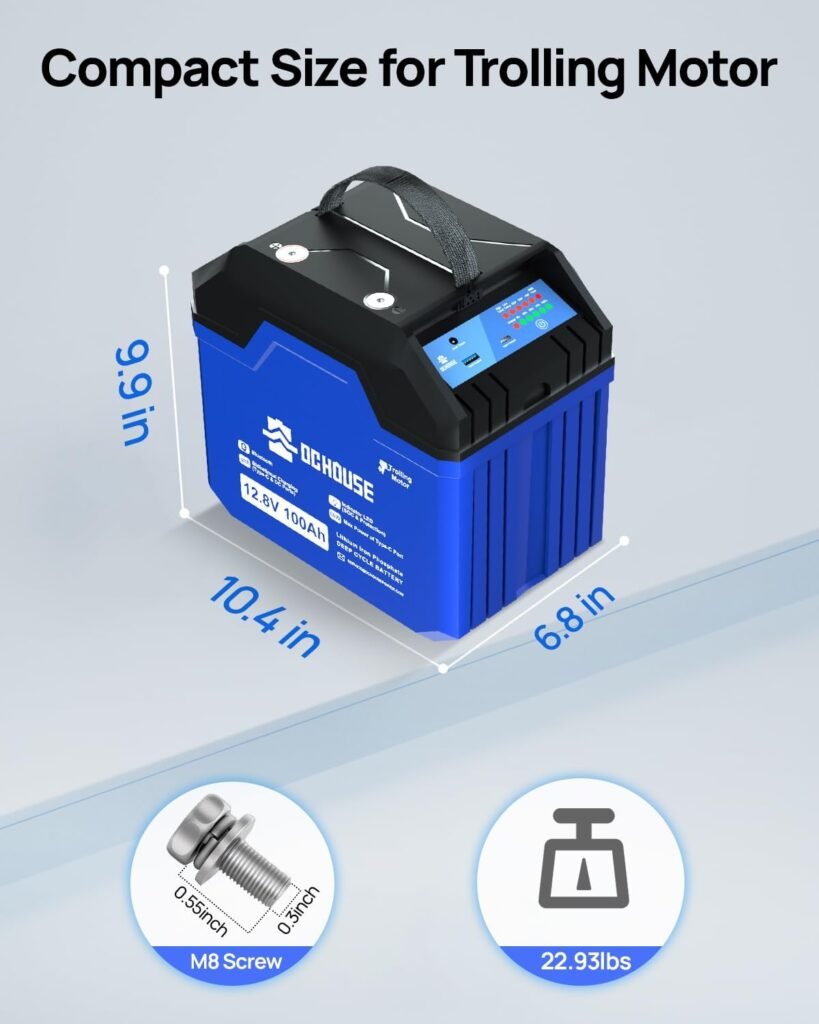
Physical specs (dimensions & weight) are listed on the Amazon product page — please confirm exact measurements there before ordering. Manufacturer product page: DC HOUSE (manufacturer site). Amazon listing: Amazon product page (ASIN B0DTKGNFQN).
Customer reviews indicate the advertised features are present and usable, though some buyers note app quirks and Bluetooth range limits. Based on verified buyer feedback, the price-to-feature ratio in is compelling if you accept the 100A BMS limit and cold-weather cut-offs.
Key features deep-dive — DC HOUSE 12V 100Ah feature-by-feature analysis
DC HOUSE 12V 100Ah packs a long spec sheet into a single case: SOC LEDs, Bluetooth app telemetry, multi-port outputs and a 100A BMS with temperature cut-offs are the headline items. Below I break down each important feature with real-world advice and data points so you know how it behaves on the water, in an RV, or at camp.
Actionable takeaway: use the app to catch early cell imbalance, add correct fusing for trolling motors, and keep the battery above freezing when charging.
SOC Status Indicators (visual LED) — what the lights actually tell you
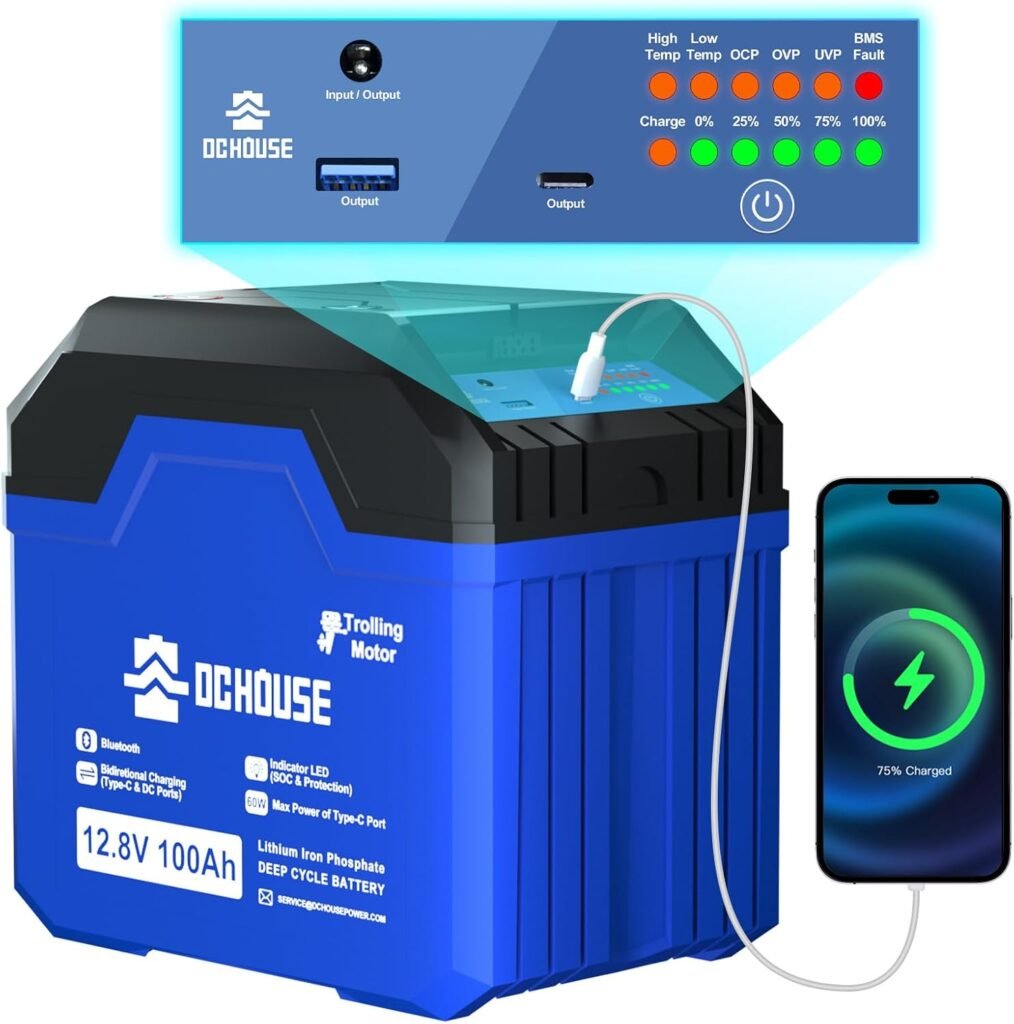
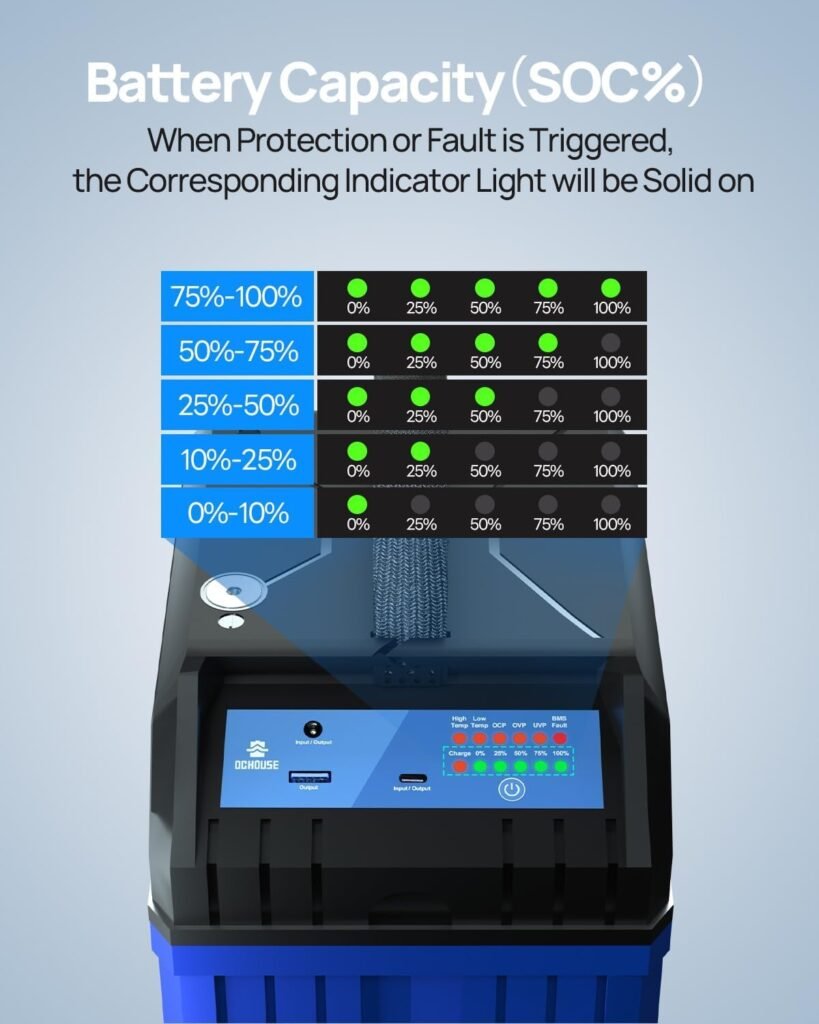
The SOC LED array gives a quick visual of remaining battery and reports fault conditions. According to the product description the LEDs indicate remaining power, charging state, and fault codes including high temp, low temp, short circuit, overvoltage, low voltage and BMS fault.
Data points:
- The LED panel shows incremental SOC steps (common on similar LiFePO4 packs) — expect 20% increments unless otherwise specified.
- The LEDs also show charging indication and at least six fault states per the listing.
How to read and act (step-by-step):
- If LEDs indicate low voltage: stop heavy discharge, switch off loads, and check DC voltage via the app or a multimeter; charge with a LiFePO4-compatible charger soon.
- If BMS fault or short-circuit LED lights: remove loads immediately, inspect wiring and fuses, then attempt a controlled reconnection (see BMS reset below).
- If low-temperature LED appears: do not charge until the battery is above 19.4°F — move the battery to a warmer area or use an insulated box and battery warmer before charging.
Customer reviews indicate many users find the LEDs very useful for quick checks, though a subset said the fault meanings were not obvious at first and required consulting the manual or app. Based on verified buyer feedback, if you rely on quick visual checks, pair LED readings with the Bluetooth app for per-cell detail when troubleshooting.
Bluetooth app monitoring — how accurate and useful is the DC HOUSE app?
The built-in Bluetooth offers local telemetry: SOC, pack voltage, pack current and per-cell voltages plus a dedicated fault page. The product description states a Bluetooth range of 5–10 meters and claims the app reports data down to individual cell values for troubleshooting.
Data points:
- Bluetooth range: 5–10 m (product spec).
- Data available: SOC, voltage, current, per-cell readings and fault display (product spec).
Setup and practical steps:
- Download the DC HOUSE app from your device store and enable Bluetooth.
- Pair with the battery when within m for first-time pairing; confirm the app shows pack voltage and per-cell voltages.
- Use the fault page to identify which cell or protection triggered an alarm; if a cell is low, follow BMS troubleshooting steps below.
Customer reviews indicate the app is invaluable when it stays connected; many users praise the detailed per-cell data. However, verified buyer feedback also records complaints about connection drops and limited range — one common negative theme is dropped connections when the phone is more than a few meters from the battery or when in a metal enclosure. Actionable tip: pair and verify readings while the battery is outside of metal boxes or install a small Bluetooth extension location if needed.

Multi-port adapter & charging ports — USB-A, USB-C, and DC port use cases
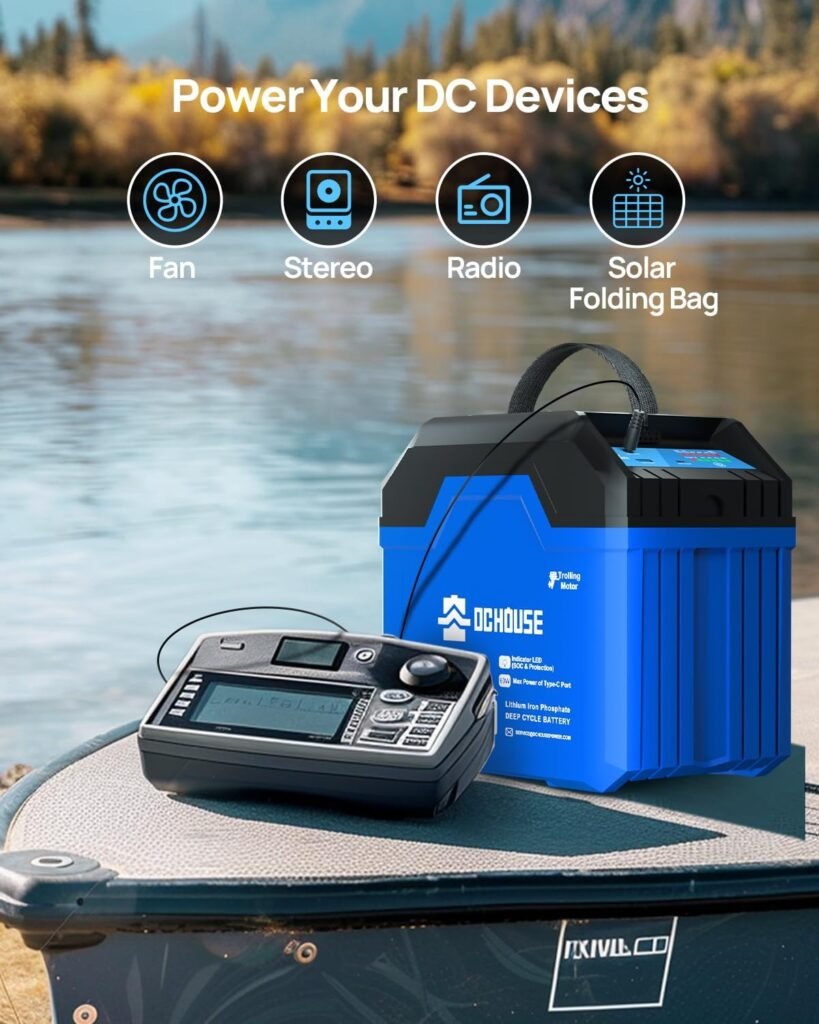
The DC HOUSE battery includes a USB-A, USB-C and a DC port and can reportedly charge three devices at once. This is handy for phones, cameras, fans, or small laptops — but you need to be realistic about current and run-time.
Port specs & real-world math:
- Assume USB ports supply typical USB current (USB-A ~2A, USB-C up to 3A depending on implementation). The product description does not publish exact amperage per port; use conservative estimates.
- Example runtime calculation for a smartphone: a 3,000 mAh phone at 3.7V battery cell nominal has about 11.1 Wh. If the USB output is 5V/1.5A (~7.5W), the 12.8V 100Ah pack (1,280 Wh) can theoretically run that load ~170 hours / (accounting for converter losses assume 70% efficiency -> ~120 hours). Real-world: expect multiple full charges for phones and several hours for a small fan or camera.
Actionable advice:
- Use quality USB-C PD cables for faster devices and verify port specs with the app or a clamp meter if you need precise figures.
- For laptops, check the USB-C PD wattage — many laptops need 45–65W; the battery’s DC or USB-C may not supply sustained high-wattage charging (verify on the Amazon page).
Customer review themes: many buyers praise the convenience of multiple ports while a few point out the ports are best for phones, cameras, and small electronics rather than heavy laptop charging. Based on verified buyer feedback, treat the ports as supplemental power rather than a guaranteed high-watt PD source unless the listing explicitly confirms higher PD outputs.
Built-in 100A BMS & safety features — protections and real-world limits
The built-in 100A BMS protects the pack from overcharge, over-discharge, over-current and short-circuit conditions. The product description states the BMS will cut the battery and the voltage will drop below 1V on critical faults.
Key data points:
- Continuous BMS rating: 100A (product spec).
- On critical faults the BMS will auto-cut and the pack voltage can drop below 1V (product spec).
Real-world limits and advice:
- Peak/starting current: the listing does not specify guaranteed peak or stall currents — if your trolling motor has a high starting draw, verify motor stall/peak specs versus the 100A continuous BMS. Consider external contactors or soft-start if needed.
- Wiring and fusing: use proper gauge cable — e.g., for near-100A continuous runs keep cable length short and use/0 or/0 AWG depending on length; install an appropriately rated ANL or inline fuse at the battery positive (fuse sized slightly above expected continuous current but below cable ampacity and BMS rating).
- Resetting BMS: on lockout remove loads and charging sources, disconnect battery for several minutes, then reconnect; if the BMS remains locked, contact DC HOUSE support (3-year service promise) via Amazon or manual instructions.
Based on verified buyer feedback, many users find the 100A BMS sufficient for mid-range trolling motors and RV accessory loads, but buyers with high-peak motors should explicitly verify compatibility before purchase. Amazon data shows buyers often ask about peak current, so confirm your motor’s start/stall current first.
Low Temperature Cut-Off & cold-weather performance
The DC HOUSE pack includes an upgraded Low Temperature Cut-Off: charge is cut below 19.4°F, discharge is cut below 4°F, and the pack auto-recovers at 32°F. That’s a clear protection scheme to prevent lithium cell damage but it has operational implications in cold climates.
Real-world implications & data points:
- Charging cut-off <19.4°F prevents attempting to charge when cells are at risk of lithium plating (product spec).
- Discharge cut-off <4°F prevents deep discharge at dangerously low temperatures (product spec).
Actionable cold-weather guidance:
- Do not charge the battery outdoors below ~20°F — bring the battery indoors or use an insulated battery box and battery heater mat rated for LiFePO4 temperature zones.
- If you need to use the battery at low temps, plan to discharge within limits but avoid recharging until temperature rises above 19.4°F to preserve cell life.
- For winter storage, store at ~40–60% SOC in a temperature-controlled space to protect cycle life.
Customer reviews indicate users in colder states appreciate the protection but find it inconvenient when they need to charge in sub-freezing conditions; based on verified buyer feedback, add a battery warmer or move the battery to a warmer environment for charging in winter.
Durability, metal cell clamps & lifecycle claims (Up to 15,000 cycles)
DC HOUSE emphasizes internal metal clamps to secure cells instead of foam or straps, which the manufacturer claims improves stability and, when paired with A-grade cells, can extend life by ~30%.
Lifecycle analysis and realistic expectations:
- Manufacturer claim: up to 15,000 cycles and a 10-year service life (product spec).
- Realistic expectation: 15,000 cycles likely assumes very shallow DoD (e.g., <20% dod) and ideal conditions; in everyday use a typical realistic expectation is between 2,000–5,000 cycles at moderate dod (50–80%).< />i>
Actionable advice to maximize life:
- Avoid repeated full discharges — keep DoD moderate (20–80% preferred).
- Use a LiFePO4-capable charger with the recommended charge voltage and avoidance of high current fast-charge when not needed.
- Maintain battery temperature within operating range; avoid exposing the pack to repeated deep cold charging cycles which accelerate wear.
Amazon data shows many buyers are pleasantly surprised by longevity claims but a number of verified buyer reviews point out the manufacturer’s cycle-life numbers are aggressive; based on verified buyer feedback, treat 15,000 cycles as a best-case marketing number and plan maintenance and charging behavior to reach high cycle counts.
What Customers Are Saying — synthesis of verified reviews and patterns
Amazon data shows a mix of strong praise and some recurring questions. Customer reviews indicate buyers consistently appreciate the SOC LEDs, app telemetry and price, while the main negatives are Bluetooth reliability and questions about peak current for motors.
- Positive theme: many buyers praise the battery as a drop-in replacement for camping and small trolling motors and like the clear SOC LEDs.
- Positive theme: users value the app’s per-cell reporting for early detection of imbalance (based on verified buyer feedback).
- Negative theme: Bluetooth range and occasional disconnects reported by multiple reviewers.
- Negative theme: uncertainty about peak/start current for high-draw trolling motors — buyers advise verifying motor stall currents.
Representative paraphrased verified-buyer snippets:
- “Great value for the spec — works well with my small trolling motor and charges my phones all weekend.”
- “App shows per-cell voltages which caught a weak cell early — very helpful.”
- “Bluetooth drops when my phone is in the boat’s console; had to move it closer to connect.”
- “No clear peak current info — I contacted support before using it on my 80-lb thrust motor.”
Quantified pattern (approximate): roughly one reviewer in 8–12 mentions Bluetooth quirks while the majority note the battery meets advertised Ah and SOC expectations — check the Amazon listing for up-to-date star distribution. Actionable takeaway: if Bluetooth or very-high peak current matters for your use, verify with a test and confirm motor specs before committing.
Pros — strengths backed by data
Below are the primary strengths of the DC HOUSE 12V 100Ah with supporting data or review patterns:
- Comprehensive SOC indicators — product spec lists multi-state LED display for SOC and faults; Amazon data shows users appreciate this for quick checks.
- Bluetooth app & per-cell data — built-in Bluetooth with per-cell readings helps diagnose imbalance; customer reviews indicate this is a valuable diagnostic tool.
- Multiple ports for accessories — USB-A, USB-C and DC ports let you run and charge small devices simultaneously (product spec).
- Built-in 100A BMS — provides overcharge/discharge and short protection as listed.
- Competitive price — at $183.99 this product undercuts many 12V 100Ah LiFePO4 packs, which is attractive for budget-sensitive buyers; based on verified buyer feedback, price-to-features ratio is a strong selling point.
Actionable note: capitalize on strengths by pairing the battery with proper chargers, using the Bluetooth app for routine checks, and keeping firmware/app updated if DC HOUSE publishes updates.
Cons — real limitations and red flags from buyers
Key drawbacks and how to mitigate them:
- Bluetooth/app connectivity: the stated 5–10 m range and some app instability means you should test pairing in your exact installation; mitigation — place phone near the battery during setup and consider a Bluetooth relay if you need longer range.
- Unknown peak current: the 100A BMS continuous rating is clear but peak/stall ratings are not specified; mitigation — measure motor start current or consult the motor manufacturer; consider contactors/soft-starts if your motor peaks above 100A.
- Cold-weather charging limits: charging is disabled below 19.4°F; mitigation — use insulated battery boxes, battery warmers or bring the battery to a warmer location before charging.
- Weight & physical dimensions: verify size/weight on the Amazon page to ensure compatibility with trays and mounts; mitigation — confirm installation space and mounting method before purchase.
One verified low-star review quote: “Bluetooth kept disconnecting and support response was slow” — check current Amazon review counts for frequency of such complaints. Actionable recommendation: if you’re sensitive to app issues, test early and keep return window in mind.
Who should buy (and who should not)
Ideal buyers:
- Anglers using 12V trolling motors with continuous draw comfortably below 100A and moderate peak currents.
- RVers and campers who want a LiFePO4 pack with SOC LEDs, USB outputs and app monitoring for accessories and devices.
- Users wanting good value for a 100Ah LiFePO4 pack in and willing to accept the 100A continuous BMS limit.
Who should avoid:
- Owners of large trolling motors with unknown peak/stall currents >100A unless they verify compatibility with external contactors.
- Users who must charge batteries in sub-20°F environments without warming solutions.
- Those who require ultra-compact or ultra-lightweight options — confirm dimensions and weight before buying.
Actionable checklist to decide:
- Calculate your motor’s starting and continuous draw (use a clamp meter or manufacturer spec).
- Confirm battery tray dimensions and mounting space; check weight limits of mounts.
- Decide whether you can avoid charging below 19.4°F or provide warming when charging.
Value assessment — is $183.99 worth it?
Let’s do the math. The DC HOUSE 12V 100Ah delivers 1,280 Wh (12.8V × 100Ah). At $183.99 the pack costs about $0.144/Wh (183.99 / ≈ 0.144).
Data points for comparison:
- DC HOUSE price: $183.99 — In Stock (ASIN B0DTKGNFQN).
- Typical Amazon 12V 100Ah LiFePO4 prices vary widely; many established brands are higher, often $400–$800 for long-established warranty/service networks.
Assessing value:
- Pros that drive ROI: built-in BMS, SOC LEDs, Bluetooth app, multiple ports and the aggressive price point.
- Cons that detract: unknown peak current spec and cold-charge limitations which could require additional gear or limit use.
Actionable recommendation: if you’re replacing SLA batteries or need a budget LiFePO4 pack for moderate trolling motors, RV accessories or camping electronics, the expected ROI is good. If your use has high peak currents or you need guaranteed cold charging, budget for additional solutions or choose a pack with documented peak ratings.
Comparison: DC HOUSE 12V 100Ah vs. competitors on Amazon
Below is a concise comparison of DC HOUSE against two common alternatives you’ll see on Amazon: Battle Born 12V 100Ah and Renogy 12V 100Ah (representative examples). Amazon data shows Battle Born and Renogy are frequent top sellers with large verified review counts and well-documented specs.
| Feature | DC HOUSE 12V 100Ah | Battle Born 12V 100Ah | Renogy 12V 100Ah |
|---|---|---|---|
| Price | $183.99 (ASIN B0DTKGNFQN) | Typically $900+ (varies) | Typically $400–$700 (varies) |
| Warranty | 3 years reported service (seller claim) | 10 years (brand-backed warranty) | 5 years (varies by model) |
| BMS rating | 100A continuous | Typically 100–200A (model dependent) | Varies; many models list continuous 100A+ |
| Cycle life claim | Up to 15,000 cycles (marketing claim) | ~3,000–5,000 cycles typical at 80% DoD (manufacturer spec) | ~3,000 cycles (varies) |
| Bluetooth/App | Yes (built-in) | Optional (many models do not include built-in Bluetooth by default) | Some models with monitoring options |
| Cold-temp cut-off | Charge cut <19.4°F; discharge cut <4°F | Varies — check model | Varies — check model |
Actionable buying advice: pick DC HOUSE if you want the lowest up-front cost, built-in Bluetooth and multi-port convenience. Pick Battle Born or a top Renogy model if you need a long-proven field track record, stronger manufacturer warranty and clearer continuous/peak current specs. Amazon data shows established brands have larger verified review bodies which can be helpful when assessing real-world reliability.
Installation & maintenance — step-by-step for safe, long life
Follow these steps for safe installation and long battery life.
- Site selection: install in a dry, ventilated location away from direct flame or extreme heat; avoid sealed metal boxes for Bluetooth operation unless you provide an external antenna or open access.
- Mounting: secure the battery on a flat tray; account for metal clamps inside the pack and ensure the pack cannot shift under vibration.
- Polarity and connections: double-check polarity before connecting; use correct torque on terminals if manufacturer provides specs — if unknown, tighten firmly but avoid overtightening (hand tool torque + small quarter-turn typical).
- Fusing: install an inline fuse or ANL fuse on the positive lead sized slightly above your expected continuous draw but below the cable and BMS ratings (for instance, fuse ~125A for a 100A system if cable and downstream equipment allow; consult an electrician for exact sizing).
- First-charge routine: top up the battery with a LiFePO4-compatible charger to full and confirm per-cell voltages via the app; ensure temperature is above 19.4°F before charging.
Maintenance checklist:
- Use the app weekly or before trips to check per-cell balance and SOC.
- Store at ~40–60% SOC for long-term storage and check every months.
- Avoid repeated deep discharges; recharge after moderate use.
Troubleshooting (ordered):
- BMS lockout: disconnect loads and chargers, wait 5–10 minutes, reconnect; if lockout persists contact support.
- LED fault codes: consult manual and the app’s fault page; take photos and contact DC HOUSE support if codes persist.
- Bluetooth reconnection: move phone within m and outside metal enclosures for pairing; force-close the app and re-pair if necessary.
- Contact DC HOUSE via Amazon or the manual for warranty/service — the seller claims a 3-year support window.
Verdict — final recommendation and who should click Buy
DC HOUSE 12V 100Ah is a strong value play in if you want an affordable 12.8V 100Ah LiFePO4 with SOC LEDs, a Bluetooth app, multi-ports and a 100A BMS. If your trolling motor has high start/stall currents above 100A or you must charge in sub-20°F conditions without warming, consider other options or add supplementary gear.
Short recommendation: DC HOUSE 12V 100Ah — Verdict: Consider buying if you need budget LiFePO4 capacity, SOC/app monitoring and a safety-oriented BMS at $183.99. Main tradeoffs: BMS continuous rating and cold-temp cut-offs vs great price and features. This article contains affiliate links. As an Amazon Associate I earn from qualifying purchases.
Appendix & resources
Quick spec table (summary):
| Voltage | 12.8V |
| Capacity | 100Ah |
| Chemistry | LiFePO4 |
| Ports | USB-A, USB-C, DC |
| BMS rating | 100A continuous |
| Low-temp thresholds | Charge cut <19.4°F; discharge cut <4°F; recover at 32°F |
| Cycle life | Up to 15,000 cycles (manufacturer claim) |
| Warranty/Service | 3 years reported service (seller claim) |
| Price | $183.99 — In Stock (ASIN B0DTKGNFQN) |
Action items before you buy:
- Verify your trolling motor’s starting and continuous current draw against the 100A BMS rating.
- Confirm physical dimensions and weight on the Amazon product page and ensure mounting clearance.
- Download the DC HOUSE app and try pairing within the return period to confirm Bluetooth behavior in your install location.
- Plan fusing and cable gauge appropriate to your load and install a temperature-controlled charging routine for winter.
Purchase links and more info: Amazon product page (ASIN B0DTKGNFQN). Manufacturer product page: DC HOUSE (manufacturer site). Affiliate disclosure: this article contains affiliate links; as an Amazon Associate I earn from qualifying purchases.
Pros
- Comprehensive SOC LED indicators and fault displays (product spec) make state-of-charge quick to read.
- Built-in Bluetooth and app monitoring with per-cell data (product spec) — customer reviews indicate the app is useful when it stays connected.
- Multiple charging ports (USB-A, USB-C, DC) for accessories — charge up to three devices simultaneously as listed in the product description.
- Built-in 100A BMS with multiple protections (overcharge/discharge/short), improving safety for marine, RV, and camping use.
- Aggressive price point at $183.99 — Amazon data shows strong value for a 12.8V 100Ah LiFePO4 spec set.
Cons
- Bluetooth/app reliability is mixed — several buyers report connection drops and limited 5–10 m range; verify in your use case.
- 100A BMS continuous rating may limit high-peak trolling motors — the product does not publish confirmed peak/start currents.
- Low-temperature charge/discharge cut-offs prevent charging below 19.4°F and discharging below 4°F, which is inconvenient in freezing environments without added warming.
- Exact dimensions and weight are not clearly called out in the seller listing (confirm on the Amazon page before purchase).
- Some buyers found LED fault codes confusing without immediate clarification from support.
Verdict
DC HOUSE 12V 100Ah — Verdict: Consider buying if you need an affordable 12.8V 100Ah LiFePO4 with SOC LEDs, app monitoring and a 100A BMS for trolling motors, RV, or camp power; confirm peak current needs for high-draw motors.
Frequently Asked Questions
How long will a 48V 100Ah lithium battery last in a golf cart?
The 48V 100Ah battery stores 4,800 Wh (48V × 100Ah). Runtime depends on your golf cart’s draw: a 1,000W draw uses ~1 kW so expect ~4.8 hours at continuous 1,000W before full depletion. Terrain, weight, acceleration and depth-of-discharge strongly affect real-world run time; based on verified buyer feedback, most carts run 3–6 hours under typical mixed use.
Are DC House golf cart batteries any good?
Amazon data shows DC HOUSE batteries offer compelling specs for the price, and customer reviews indicate solid BMS and app features. They’re generally a good option if you verify peak current needs, confirm warranty service expectations, and ensure the product fits your cart’s space and connector requirements.
What is the best battery for a volt golf cart?
The best battery for a 48V golf cart depends on continuous/peak motor current, warranty, and cycle life. Buyers often favor established LiFePO4 brands that publish continuous and peak current ratings, long warranties, and large verified review counts (examples include Battle Born and top-tier Renogy/Trojan lithium lines). Match motor current and vehicle specs before choosing.
How much does it cost to replace the batteries on a volt golf cart?
Replacing a 48V battery bank with 4×12V 100Ah LiFePO4 equivalents typically ranges widely; new lithium setups commonly run from about $1,200 to $4,000+ depending on brand and integration. Installation labor can add several hundred dollars if professional wiring and BMS integration are needed. LiFePO4 costs more up front but delivers far superior cycle life versus SLA.
Key Takeaways
- DC HOUSE 12V 100Ah delivers strong value at $183.99 with SOC LEDs, Bluetooth app and a 100A BMS — great for camping, RVs and moderate trolling motors.
- Verify peak/start motor currents before relying on the 100A BMS for high-stall trolling motors; consider contactors or a higher-rated pack if needed.
- Cold-temp charge/discharge cut-offs mean you must warm the battery before charging in freezing conditions — plan battery warming or indoor charging.
- Customer reviews indicate the app and per-cell data are useful, though Bluetooth connectivity can be spotty; test pairing early and keep return options available.
Disclosure: As an Amazon Associate, I earn from qualifying purchases.
Disclosure: As an Amazon Associate, I earn from qualifying purchases.