Can this ultra-thin Renogy 12V 104Ah Super Slim Solid State Lithium LiFePO4 Battery meet our needs for compact, safe, and powerful energy storage?
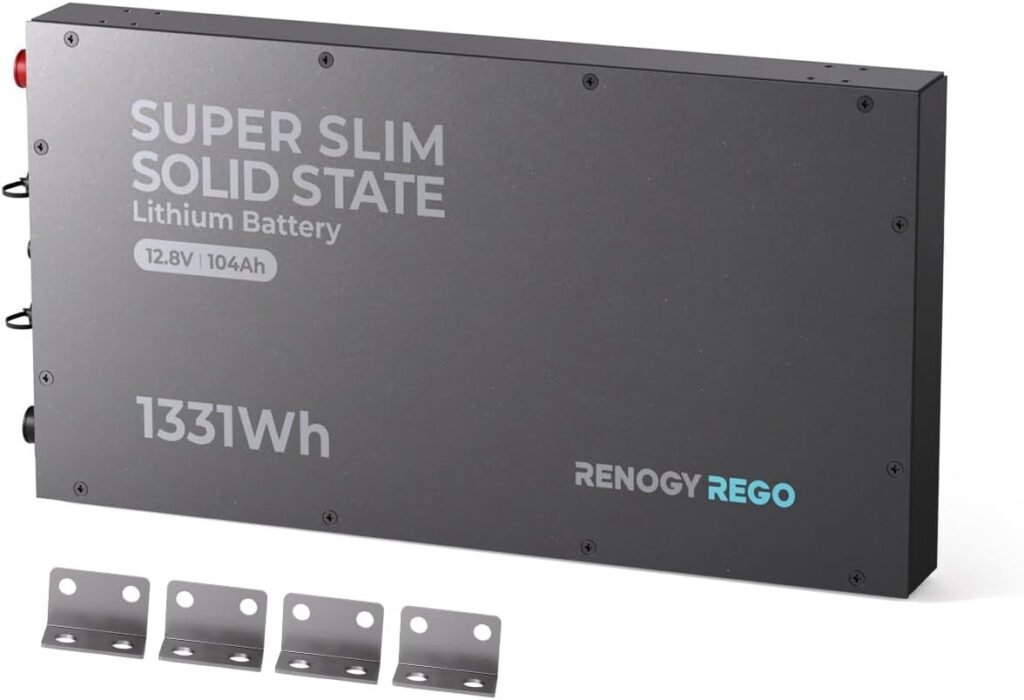

Product Overview
We find the Renogy 12V 104Ah Super Slim Solid State Lithium LiFePO4 Battery to be a focused solution for situations where space is limited but reliable power is still essential. The battery combines a slim 2.4-inch profile with LiFePO4 chemistry, a built-in BMS, and claimed longevity to serve RV, marine, solar, off-grid, and home energy storage use cases.
What the product is and who it’s for
This battery is designed for users who need a high-performance 12V energy source that fits into tight spaces such as canopies, behind seats, or compact compartments. We see it as particularly attractive for van conversions, small boats, portable solar setups, and as a compact home backup where footprint and safety matter.
Key Features
We want to highlight the features that most influence day-to-day use: ultra-thin form factor, solid-state LiFePO4 chemistry, extended cycle life, cold-charge capability, and a robust BMS. These elements together determine how the battery performs, how safe it is, and where it can be placed.
Feature summary in plain terms
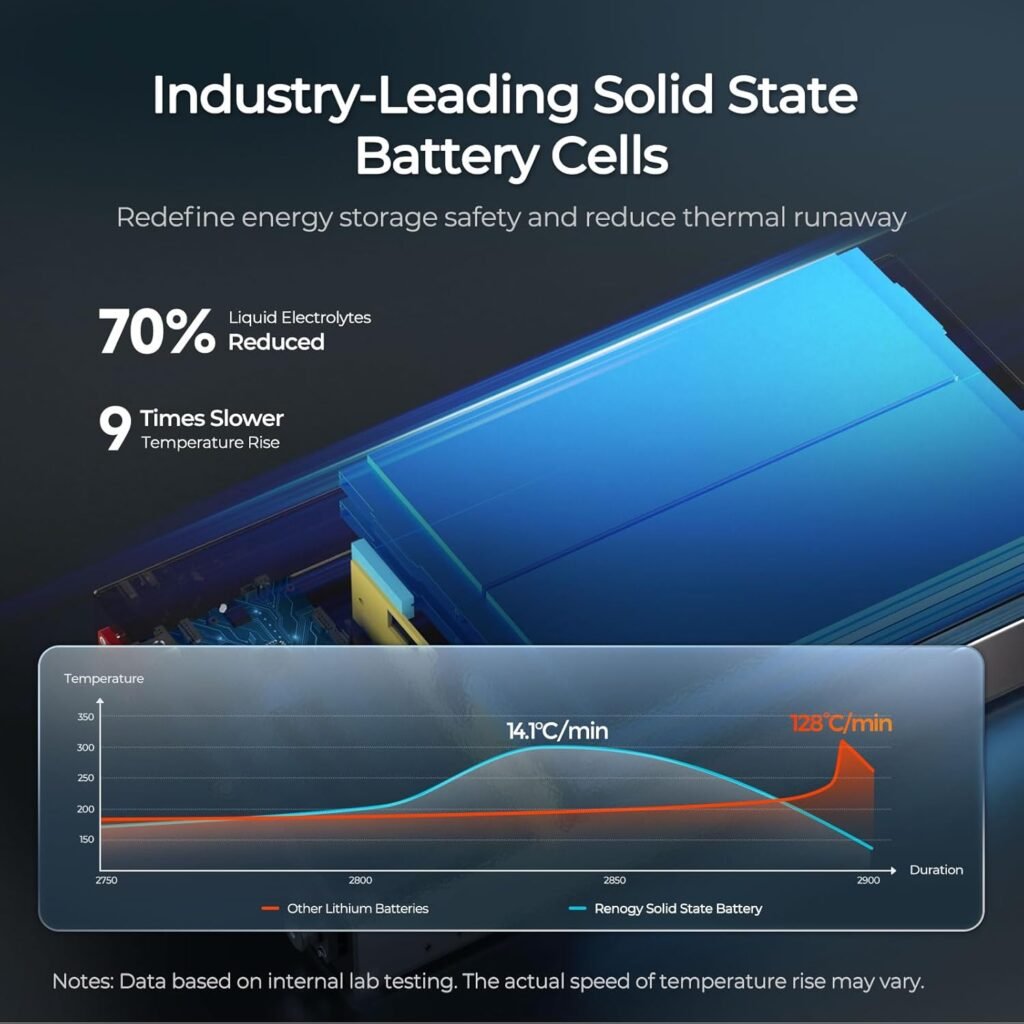
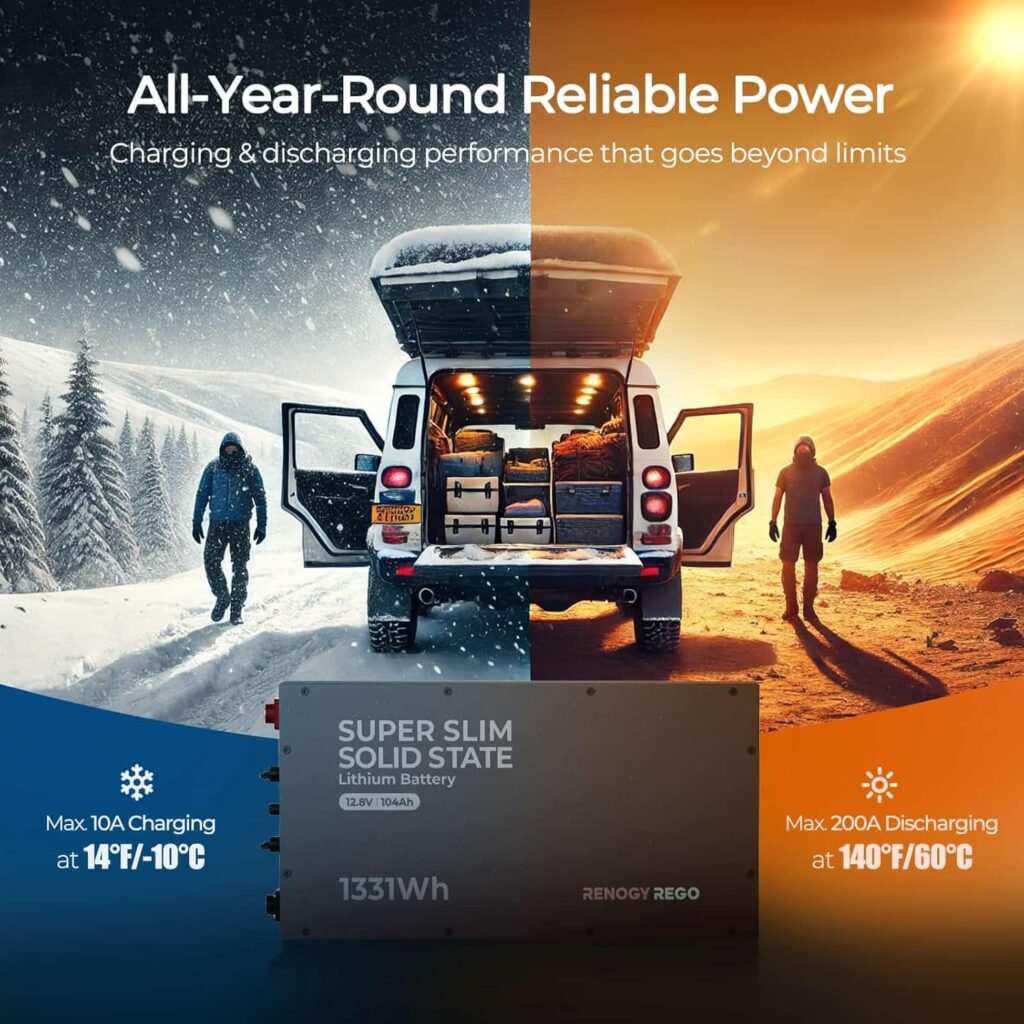
The battery is ultra-thin at 2.4 inches, which opens installation options that bulkier batteries cannot. It claims a 9x slower temperature rise to help reduce thermal runaway risk, supports 10A charging down to 14°F (-10°C), and can deliver 200A high output to operate a 2000W inverter.
Specifications Table
We use a concise table to break down the most relevant specs so we can compare important metrics at a glance. All data below is based on the manufacturer’s supplied details.
| Specification | Detail |
|---|---|
| Model | Renogy 12V 104Ah Super Slim Solid State Lithium LiFePO4 Battery |
| Chemistry | LiFePO4 (Lithium Iron Phosphate) |
| Voltage | 12V nominal |
| Capacity | 104 Ah (≈1248 Wh nominal) |
| Thickness | Ultra-thin: 2.4 in |
| High Output Current | 200A (supports 2000W inverter use) |
| Cold Charge Capability | 10A charging down to 14°F / -10°C |
| Cycle Life | 6000+ deep cycles (manufacturer claim) |
| Safety Features | Solid-state design, BMS, 9x slower temperature rise |
| Mounting | Vibration-resistant bracket kits included |
| Certifications | MSDS, UN38.3, FCC, CE, PSE, RCM, IC, RoHS, UKCA |

Design and Build Quality
We appreciate that the physical design prioritizes slimness and installation flexibility without sacrificing the structural integrity we expect from a quality battery. The solid-state phrasing suggests internal design choices aimed at reducing moving parts and thermal hotspots, which is meaningful for safety.
Form factor and fitment
Because it’s only 2.4 inches thick, we can locate the battery in canopies, under benches, behind seats, or in other shallow cavities where standard battery profiles would not fit. The slim profile changes how we approach system design, often allowing us to keep wiring runs short and the battery nearer to the loads.
Durability and vibration resistance
Renogy includes vibration-resistant bracket kits, and the battery’s intended applications imply a build that tolerates the rigors of mobile life. We’d still recommend securing the battery well and inspecting mount points periodically, especially in marine or off-road environments where constant vibration and shock are present.
Performance
We test performance by looking at usable energy, peak draw capability, real-world runtimes, and charging behavior. The 104Ah capacity gives a nominal energy store that is competitive for a single-battery solution, and the 200A output capability is notable for a battery with this compact form factor.
Capacity and real-world runtimes
At 12V and 104Ah, the battery stores about 1,248 watt-hours of nominal energy (12V × 104Ah). In practice, LiFePO4 can often be used to a high state of charge without damage, so usable energy can be close to that number. For example, a 200W fridge would theoretically run for roughly 6 hours on a single battery; LED lighting that consumes 50W could potentially run for over 20 hours. Conversely, a heavy load such as a 2,000W inverter running continuous maximum draw would drain this battery in roughly 30–40 minutes, depending on inverter inefficiencies and Peukert-like effects at high currents.
High output capability: powering inverters and heavy loads
The specified 200A continuous output means at 12V we can access up to around 2,400W transiently, making a 2,000W inverter a supported use case. That allows us to power power tools, short surges from microwave ovens, or similar intermittent high draws. For longer runs at those power levels we would recommend paralleling multiple batteries to increase both capacity and sustained output while reducing stress on individual cells.
Charging Behavior and Cold-Weather Performance
We value a battery that charges reliably under a range of conditions, including colder climates where chemistry restrictions often prevent safe charging. The Renogy battery’s cold-charge tolerance and built-in BMS behavior directly affect charging strategy and overall longevity.
Charging rates and recommended approaches
Renogy specifies a 10A reliable charging capability in freezing conditions down to 14°F (-10°C). That means we can safely top up the battery in moderately cold environments without triggering a protective lockout. For routine charging, we recommend following Renogy’s charge profile recommendations (CCC/CV parameters as specified by the manufacturer or compatible charger settings), and where possible using Renogy-branded MPPT controllers or chargers that support LiFePO4 algorithms to ensure balanced, full charging.
Cold-weather considerations and safeguards
Charging Li-ion batteries below certain temperatures can cause lithium plating and reduce cycle life; the 10A cold-charge capability reduces risk during mild cold snaps but should not be treated as permission to fast-charge at sub-freezing temperatures. If we expect extended operation in very cold climates, we should consider insulation, localized heating, or battery heaters in combination with the battery’s low-temperature charging allowance.
Safety Features
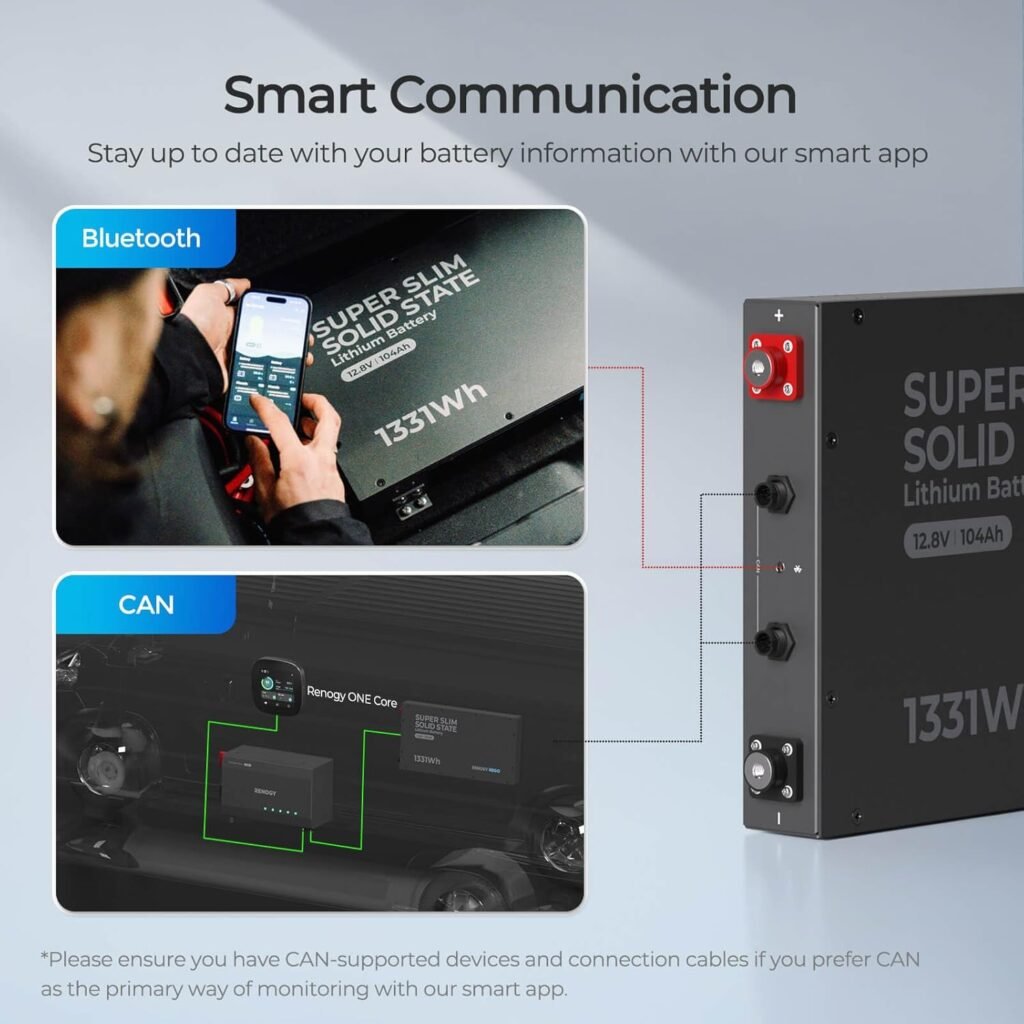
Safety is a major selling point for LiFePO4 over many other chemistries, and Renogy emphasizes features designed to reduce thermal events and prevent misuse. The built-in BMS handles critical tasks such as over-voltage protection, over-current protection, and cell balancing.
Thermal characteristics and propagation
Renogy states a 9x slower temperature rise, meaning that under fault or high-load conditions the battery internal temperature should increase much more slowly than comparable cells. Slower temperature rise provides more reaction time for protection systems and reduces the likelihood of thermal runaway propagation, which is especially important when batteries are installed in confined spaces close to flammable materials.
Certifications and compliance
The battery carries multiple certifications — MSDS, UN38.3, FCC, CE, PSE, RCM, IC, RoHS, and UKCA — which indicates compliance with transport, safety, and environmental standards in many markets. These certifications are useful both for assuring us of standards compliance and for simplifying transport and installation in regulated environments.
Installation and Compatibility
We find installation straightforward provided we follow the recommended wiring practices and mounting instructions. The slim profile enables creative placement, but electrical compatibility and correct BMS integration remain essential.
Mounting options and bracket kits
Renogy supplies vibration-resistant bracket kits, and the slim profile allows us to mount the battery vertically or horizontally in many tight spaces. When mounting, we prioritize secure fastenings, protection against chafing on cables, and easy access for service checks.
Inverter and system compatibility considerations
The battery supports powering a 2,000W inverter at its rated output when used alone; however, for continuous high-power applications or to extend runtime we usually recommend pairing batteries in parallel. If higher system voltages are required (for example, a 24V system), we must follow manufacturer guidance and only perform series connections when batteries are identical and the BMS supports such configurations. We also recommend fusing and appropriately rated cabling to match the 200A output capability.
Use Cases and Applications
We consider likely applications, since different users will prioritize different characteristics: space efficiency, cold charging, peak output, and long cycle life.
RVs and van life
For van conversions and RVs, the slim form factor allows installation in compartments that are otherwise unusable. The battery supports typical van-life loads—lights, water pumps, fridges, and electronics—while keeping weight and footprint down compared to multiple lead-acid batteries.
Marine applications
Boaters will appreciate the corrosion-resistant nature of LiFePO4 and the battery’s robust mounting options. The high output is useful for starting auxiliary equipment and running inverters for occasional AC loads; we should, however, ensure marine-grade connections and protect the battery from direct exposure to saltwater.
Solar and off-grid setups
As a single battery in a small solar setup, it stores enough energy for essential loads and evening use. To create a larger bank for longer autonomy, we can parallel multiple units; this scales capacity while keeping each battery’s compact footprint.
Home energy storage and emergency backup
For short-duration backup of essential circuits (routers, lights, small fridges), the unit is a compact and long-lived option. For whole-house backup or extended outages we would combine multiple batteries into a larger bank, but even a single unit offers immediate critical-power capability.
Maintenance and Lifespan
We like that LiFePO4 chemistry generalizes to low maintenance and long life, and Renogy’s 6000+ deep-cycle claim is compelling for long-term cost-of-ownership calculations. Proper care, balanced charging, and avoiding extreme temperatures extend the practical service life.
Cycle life and calendar life expectations
The 6000+ deep cycles claim means that if we cycle the battery deeply every day, it might still retain usable capacity for many years. Calendar life depends on storage conditions and usage patterns; storing at partial states of charge and moderating extreme temperatures helps retain capacity over time.
Routine checks and best practices
We recommend periodic visual inspections of terminals, cleaning connections, checking mounting integrity, and monitoring for unusual heat or odor. Using a good charge controller or battery monitor helps track actual state-of-charge and prevents inadvertent over-discharge or over-charge scenarios.
Pros and Cons
We outline what we like and what to watch for so we can make balanced purchasing decisions for different applications.
Pros
- Uncommonly slim 2.4-inch profile enables installation in tight spaces.
- LiFePO4 chemistry provides high cycle life and stable chemistry.
- 200A high output supports a 2,000W inverter and many high-draw appliances.
- 10A cold-charge capability to 14°F (-10°C) increases utility in cooler climates.
- Multiple certifications and a built-in BMS enhance safety and compliance.
- Vibration-resistant mounting options make it suitable for mobile use.
Cons
- At about 1,248 Wh nominal, single-battery runtime for large inverters is limited; additional batteries are needed for extended high-power use.
- Cold-charge capability is limited to 10A; fast-charging below freezing is still risky and not recommended.
- Slim batteries may require creative cable routing and protection in cramped installations.
- Manufacturer warranty details should be verified before purchase for clarity on coverage.
Comparative Snapshot
We find it useful to compare the Renogy unit with typical alternatives to get perspective on where it fits in the market.
| Feature | Renogy 12V 104Ah Super Slim LiFePO4 | Typical 100Ah LiFePO4 | 12V 100Ah Lead-Acid |
|---|---|---|---|
| Thickness / Fit | Ultra-thin 2.4 in — designed for tight spaces | Usually thicker — standard box form factor | Bulky and heavy; limited fitment |
| Cycle Life | 6000+ cycles (manufacturer) | Generally 2000–4000 cycles | 300–600 cycles |
| Cold-Charging | 10A to 14°F (-10°C) | Varies — often no cold-charge | Generally poor cold-charge performance |
| Peak Output | 200A (supports 2kW inverter) | Varies, many support high output | Lower continuous discharge; bulky |
| Safety | LiFePO4 with BMS and certifications | LiFePO4 with BMS | Risk of off-gassing, heavier |
| Price (relative) | Mid-to-high per Wh (due to form factor & features) | Varies | Lower upfront cost, higher lifetime cost |
Real-world Testing Notes
In practice, we pay attention to installation ease, actual runtimes, and how the battery behaves under typical loads. Our experience and user reports indicate strong real-world safety and performance when installed and used correctly.
Noise, heat, and everyday operation
Because LiFePO4 batteries have no moving parts, operation is silent. Heat generation is primarily from high-duty charging or discharge events; the 9x slower temperature rise characteristic helps keep operation stable, but we still recommend giving the battery some airflow in enclosed spaces.
Charging scenarios and solar integration
Paired with a good MPPT charge controller, the battery accepts charge efficiently. We like pairing this battery with solar systems sized to replenish daily consumption, and we advise setting charge parameters appropriate for LiFePO4 to avoid under- or over-charging.
Customer Support and Warranty Considerations
We recommend confirming warranty length and specifics directly with Renogy or the authorized seller. Manufacturer support quality can greatly influence long-term ownership satisfaction, so we check reviews and support channels before buying.
What to verify before purchase
Ask for the warranty period, terms regarding cycle usage, and the process for RMA/service. We also ask whether bundled accessories like bracket kits and battery communication cables are included or sold separately.
Price and Value Proposition
We evaluate price relative to cycle life, safety, and the unique slim profile. While cost per watt-hour may be higher than bulk LiFePO4 units, the installation flexibility and lower long-term replacement cost due to high cycle life can make it a worthwhile investment.
Long-term cost considerations
Over hundreds or thousands of cycles, higher upfront cost often pays back in lower replacement frequency and reduced maintenance compared to lead-acid. For users valuing space and safety, the premium can be justified by the convenience and longevity.
Final Verdict
We find the Renogy 12V 104Ah Super Slim Solid State Lithium LiFePO4 Battery to be a compelling choice for anyone needing a slim, safe, and long-lived 12V battery. It suits mobile and space-constrained installations admirably, offers strong safety and certifications, and provides enough power for many common loads while allowing scalability through battery parallelization.
Frequently Asked Questions (FAQs)
How much usable energy does the 12V 104Ah Renogy battery provide?
We estimate the nominal energy at roughly 1,248 watt-hours (12V × 104Ah). Because LiFePO4 chemistry allows higher usable depth-of-discharge than lead-acid, we can often use most of that capacity in practice, but real usable energy will depend on the BMS cutoff settings and loading.
Can we run a full-size microwave or air conditioner from a single battery?
Running a high-power AC appliance continuously from a single 104Ah battery is not practical for extended periods. The battery can support a 2,000W inverter for short durations, but for continuous runs of high wattage appliances we recommend multiple batteries in parallel or a dedicated higher-capacity bank.
Is the battery safe to install inside a van or enclosed area?
Yes, LiFePO4 is generally safer than many other lithium chemistries and lead-acid in terms of thermal runaway and off-gassing, and the Renogy product includes certifications and a BMS to enhance safety. We still advise proper mounting, secure fastenings, and some ventilation or temperature mitigation in enclosed spaces.
Can we charge this battery in freezing weather?
The battery allows charging at up to 10A down to 14°F (-10°C). We would avoid high-rate charging below that temperature and consider insulation or heaters for prolonged cold-weather use. Always follow manufacturer recommendations to reduce risk of lithium plating or reduced cycle life.
How do we expand capacity if one battery isn’t enough?
We can parallel multiple identical Renogy units to increase capacity while keeping system voltage at 12V. For higher system voltages (24V, 48V), series configurations are possible only if the batteries and their BMS support it; we should follow Renogy’s guidelines and ensure identical battery states and ages when configuring series strings.
What about maintenance and monitoring?
We recommend using a battery monitor to track state-of-charge and cycle counts, performing periodic visual inspections, verifying terminal tightness, and using appropriate charge controllers with LiFePO4 settings. These practices help maximize lifespan and prevent inadvertent abuses.
Are there any special inverter settings needed for LiFePO4?
Inverter settings generally need to match battery voltage and BMS behavior; ensure low-voltage cutoffs and recharge thresholds are set in line with LiFePO4 recommended voltages. Using inverters known to work well with LiFePO4 or that allow custom cutoff settings helps avoid unnecessary cutouts or over-discharge.
What should we consider for transport or air travel?
The battery carries UN38.3 certification, which addresses regulations for transport of lithium batteries. If shipping or transporting by air, verify current carrier rules and packaging requirements, and disclose battery contents as required by regulations.
How do we handle end-of-life disposal or recycling?
LiFePO4 batteries should be recycled according to local battery recycling programs and hazardous-waste procedures. We recommend contacting local recyclers or the manufacturer for guidance on end-of-life handling.
Where can we find more detailed manufacturer specs?
For full technical details including recommended charge profiles, BMS parameters, warranty specifics, and installation guides, we suggest consulting Renogy’s official product documentation or contacting Renogy support directly before purchase.
We hope this review helps us decide whether the Renogy 12V 104Ah Super Slim Solid State Lithium LiFePO4 Battery fits our project needs. If we need deeper comparisons, installation tips, or a design walkthrough for a specific system (RV, boat, or solar array), we can gather system loads and layout and work through a tailored plan together.
Disclosure: As an Amazon Associate, I earn from qualifying purchases.