12V 320Ah LiFePO4 Battery: Quick Product Overview
Can a compact 59-pound battery deliver enough stored energy to replace a much heavier lead-acid bank? The 12V 320Ah LiFePO4 battery makes a credible case in 2026, particularly for RV owners, off-grid users, and solar-storage projects that value capacity without excessive weight. At the listed price of $369, reduced from an original $399, it combines a built-in smart 200A battery management system, Bluetooth monitoring, IP65 protection, and a stated five-year warranty.
There is one calculation shoppers should understand immediately. A 12V battery multiplied by 320Ah equals approximately 3,840Wh of nominal capacity, while the product listing advertises up to 4,096Wh. Those figures should not be treated as identical: voltage under operating conditions, cell configuration, and the seller’s stated measurement can produce different headline numbers. Actual usable energy will also depend on discharge limits and conversion losses.
Our early view is positive but conditional. The battery looks most attractive where lower weight, substantial storage, and app monitoring matter. However, we still need to verify charger compatibility, cold-weather charging behavior, practical capacity, installation requirements, and what equipment is included. The supplied product information does not identify an inverter or charger, so buyers should budget for those separately.

Key Specifications and Energy Capacity
The 12V 320Ah configuration is best understood as a large low-voltage energy reservoir rather than a plug-and-play power station. To estimate runtime, multiply the appliance load by the number of hours needed, then compare that figure with available watt-hours. For AC equipment, allow for inverter losses; a 1,000W load, for example, demands roughly 1,000W from the inverter plus its own operating overhead, and the battery-side current can become substantial at 12V.
Using the advertised 4,096Wh figure only as a rough comparison, a 100W refrigerator load could theoretically run for about 40.96 hours before conversion losses and compressor cycling are considered. A 500W appliance would have a theoretical run time of about 8.2 hours, while a continuous 1,000W inverter load would be around 4.1 hours. These are estimates, not guaranteed results: usable capacity, inverter efficiency, temperature, wiring, and the appliance’s duty cycle all matter.
The listed weight is pounds, described as roughly one-third the weight of an equivalent lead-acid battery. Its claimed energy density is nearly twice that of ordinary lead-acid technology, which can free valuable space in an RV, boat, trailer, or compact solar installation. Before ordering, we would check the battery compartment, access route, mounting surface, terminal position, and ventilation requirements against the manufacturer’s full installation instructions.
The 200A BMS rating also needs careful interpretation. It does not mean every inverter can draw 200A continuously. We must match the inverter’s continuous and surge demand with the battery’s output capability, cable gauge, fuse rating, terminal hardware, and the manufacturer’s stated limits.
LiFePO4 Cycle Life and Long-Term Durability
The advertised cycle-life figures are unusually broad: more than 4,000 cycles at 100% depth of discharge, 6,000 cycles at 80%, and 15,000 cycles at 60%. Depth of discharge, or DOD, describes how much of the stored energy we use before recharging. A 100% DOD cycle uses essentially the full available range, whereas a 60% DOD cycle uses less energy per day but may reduce stress on the cells.
That trade-off is practical. A user who regularly consumes only 60% of the battery may obtain more total cycles than someone who fully drains it every day, but the smaller daily energy window could require additional capacity. We would treat all three figures as laboratory-style claims rather than a service-life guarantee. Temperature, charging voltage, storage habits, current levels, cell balancing, and actual cell quality can materially change longevity.
The manufacturer describes the cells as automotive-grade Grade A+, but the supplied information does not independently verify that grading. When examining customer feedback, we would give more weight to repeated reports about capacity consistency, balancing, long-term output, and warranty handling than to a single claim that the battery performed well on one trip.
The impact-resistant ABS casing is described as resistant to heat, weather, and flame. That describes the housing claim, not formal fireproof certification or permission to install the unit beside an engine or heater. IP65 indicates dust protection and resistance to low-pressure water jets; it does not make the battery submersible. Our maintenance routine would include secure mounting, clean terminals, periodic state-of-charge checks, and storage at the charge level specified by the manufacturer.
Built-In 200A BMS and Temperature Protection
The built-in smart BMS is designed to protect against overcharge, over-discharge, overcurrent, short circuit, and abnormal temperature conditions. In practice, a BMS can disconnect the battery when a monitored limit is exceeded. That safeguard is valuable, but it cannot substitute for correctly sized external protection, suitable conductors, a compatible charger, or careful installation.
The low-temperature charging cutoff is listed as 32°F (0°C). This matters for winter camping, unheated RV compartments, boats, garages, and outdoor solar cabinets because a solar controller may continue trying to charge even when the cells are too cold. The stated high-temperature charging cutoff is 158°F (70°C), but we would still keep the battery away from engines, heaters, direct heat sources, and poorly ventilated equipment.
Our setup sequence would be straightforward:
- Confirm that the charger or solar controller uses a suitable LiFePO4 charging profile and is within the battery’s permitted voltage and current range.
- Install a properly rated fuse as close as practical to the positive terminal.
- Select cables for the expected continuous and surge current, then secure every connection against movement.
- Mount the battery firmly in a dry, protected location.
- Test charging and a modest load before connecting a high-demand inverter or appliance.
The product information does not answer whether every BMS cutoff resets automatically, how accurately the state-of-charge estimate behaves, or whether protection events can cause nuisance shutdowns. Those are the specific questions we would seek in verified buyer reports before committing to a demanding installation.
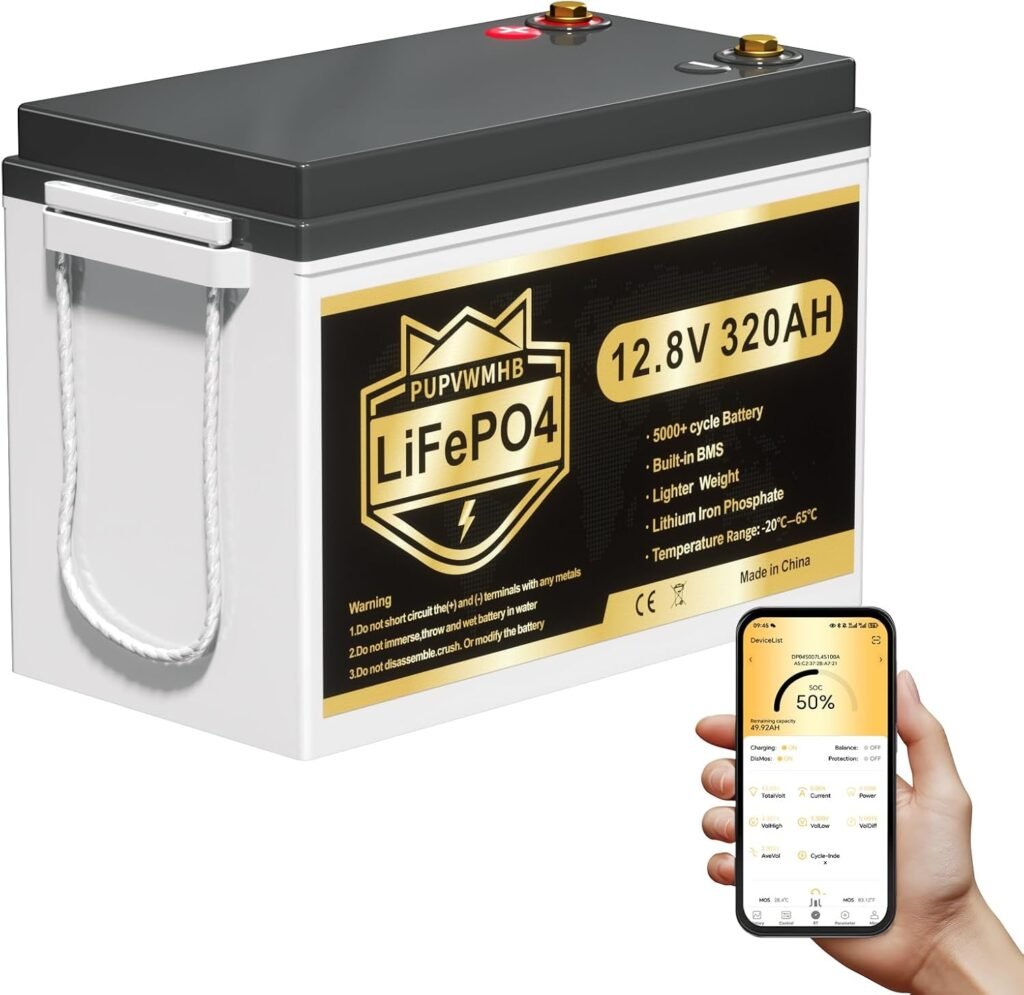

Bluetooth App Monitoring and Series or Parallel Expansion
The Bluetooth function is intended to let us view state of charge, voltage, current, capacity, and other operating information from a mobile-phone app. That can be useful when the battery is inside an RV compartment or solar cabinet, since we can inspect its condition without opening the enclosure or relying only on an inverter display.
App convenience depends on details that are not supplied here, including Bluetooth range, the app’s name, phone compatibility, update support, and the accuracy of its readings. We would pair the phone close to the battery, record the initial voltage and state of charge, check charging current during daylight, and compare those figures with the solar controller or inverter. Large discrepancies would justify contacting support before expanding the system.
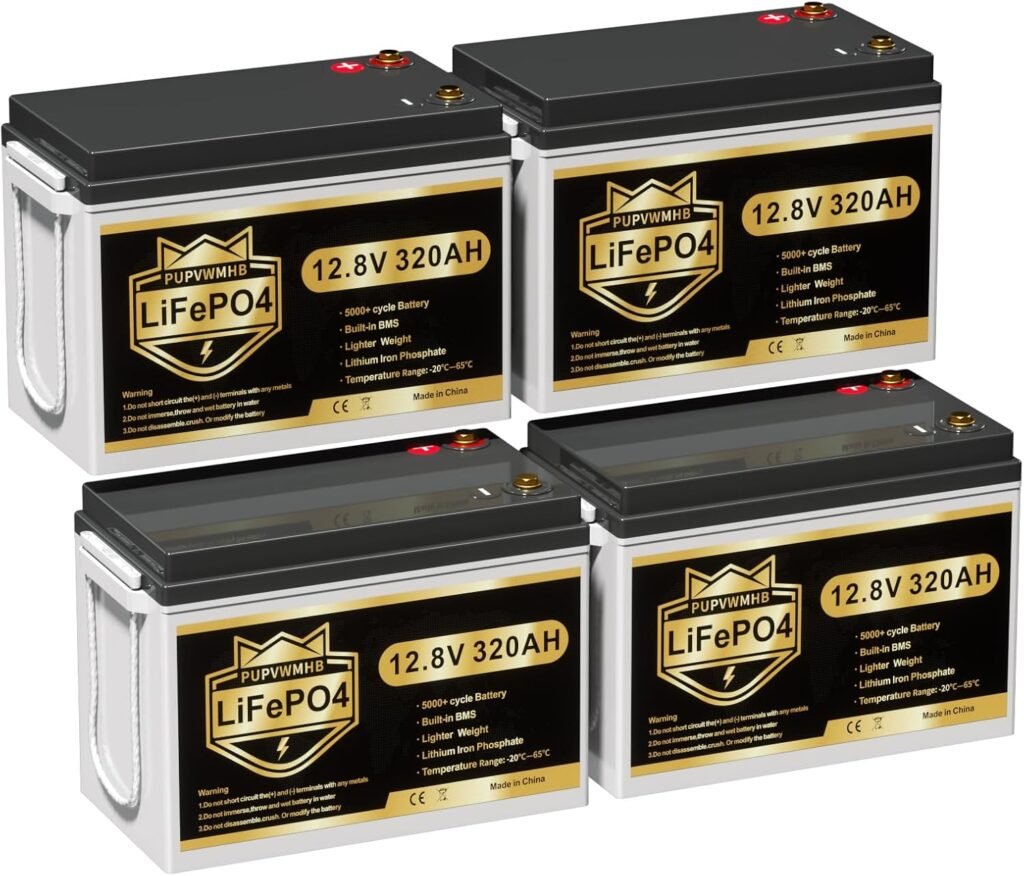
The listing says batteries can be connected in series and parallel, but it does not provide a maximum battery count, approved configurations, balancing procedure, or voltage limits. Series wiring increases system voltage; parallel wiring increases capacity while retaining the nominal system voltage. Unequal battery age, state of charge, cable length, or resistance can result in uneven current sharing, so expansion should not be assumed to be risk-free.
For a multi-battery bank, we would use matching units, bring them to the same state of charge, follow the manufacturer’s wiring diagram, and verify that the charger, inverter, fuse arrangement, and BMS behavior suit the combined system. Without those manufacturer details, the expansion claim is best treated as conditional rather than a guaranteed feature.
What Customers Are Saying About the 12V 320Ah LiFePO4 Battery
The supplied product data does not include a star rating, review count, or individual customer comments. We therefore cannot honestly say that many buyers praised the capacity, that several reported app problems, or that verified purchasers confirmed a particular cycle count. Any review presenting those patterns as established evidence would be inventing information rather than evaluating the product responsibly.
For this battery, the most useful customer evidence would cover several recurring themes: installation difficulty, handling compared with lead-acid, capacity during RV or solar use, Bluetooth pairing, packaging, terminal condition, BMS shutdowns, and warranty responses. First-hand reports of running a refrigerator or inverter are useful context, but they remain individual experiences rather than laboratory capacity tests.
We would separate repeated observations from isolated remarks. Multiple verified-purchase reports describing accurate state-of-charge readings or strong output would carry more weight than one unusually positive review. Conversely, repeated complaints about unexpected shutdowns, loose terminals, failed pairing, or capacity below expectations would deserve attention even if the listing claims otherwise.
Cold-climate feedback would be especially valuable. A battery that stops accepting charge below 32°F (0°C) may appear defective when the BMS is actually enforcing its protection limit. We would also compare reported warranty outcomes with the stated five-year after-sales service and advertised response within hours. The existence of a warranty is reassuring, but response quality, replacement decisions, and documentation requirements determine how useful it is in practice.
How the 12V 320Ah LiFePO4 Battery Fits Different Applications
For an RV or camper, the combination of high advertised storage, Bluetooth monitoring, and a substantially lower listed weight than equivalent lead-acid equipment is appealing. We would first calculate daily watt-hours, identify the largest continuous and surge loads, confirm the inverter size, and check the charging conditions in the intended compartment. A battery this large can support extended low-to-moderate loads, but it will not make a 12V installation immune to high current demand.
Solar and off-grid users should match the battery with a LiFePO4-compatible charge controller, suitable maximum charging current, adequate solar input, and an inverter whose output matches the planned loads. Overnight consumption is the key calculation: lights, networking equipment, refrigeration, pumps, and electronics may be manageable, while heating, air conditioning, electric cooking, and prolonged whole-home backup can quickly exceed practical 12V current and inverter limits.
For backup power, an inverter is required for ordinary AC appliances, and no inverter is identified in the supplied product data. That means the total project cost and complexity are higher than the battery price alone suggests. Essential loads such as networking equipment, lights, refrigeration, or compatible medical accessories should be prioritised rather than connecting every household circuit.
Boats, fishing equipment, trailers, and outdoor systems may benefit from the impact-resistant casing and IP65 design, but IP65 does not permit submersion or standing water around unsealed terminals. The battery may be excessive for a small weekend setup with modest loads and limited solar input. Our decision process would be: calculate daily watt-hours, identify continuous and surge demand, confirm charging temperatures, then choose one battery or a higher-voltage bank based on the result.
Price, Warranty, and Alternatives
The current listed price is $369, compared with an original price of $399, a $30 difference. We would treat that reduction as a current listing price rather than a permanent saving. Dividing $369 by the advertised 4,096Wh gives a headline cost of approximately $0.09 per advertised watt-hour. This is only a listing-based comparison and excludes inverter losses, usable-capacity limits, installation hardware, future degradation, and charging equipment.
The named alternatives are the LiTime 12V 300Ah LiFePO4 Battery and the Ampere Time 12V 300Ah LiFePO4 Battery. Their current prices, precise BMS ratings, monitoring features, protection ratings, cycle-life claims, and warranty terms are not included in the supplied product data, so we cannot responsibly assign figures or declare a price winner. We would compare those details as displayed at the time of publication rather than rely on outdated specifications.
A 300Ah competitor could still be preferable if it offers clearer technical documentation, a better-supported app, more transparent warranty wording, or a stronger history of service responses. Conversely, the PUPVWMHB option may justify its price when the larger stated capacity, lower weight, Bluetooth monitoring, and long cycle-life claims are genuinely useful.
We would compare the complete system cost, including a LiFePO4 charger or solar controller, inverter, fuses, cable, mounting hardware, and any temperature-management equipment. The value case is strongest when we will regularly use the large storage reserve and monitoring features, not when we only need a small occasional power source.
Before Buying and Installing This Battery
Before ordering, we would write down the system requirements rather than start with the battery’s headline capacity. The checklist should include:
- Required system voltage and daily energy consumption in watt-hours.
- Inverter continuous wattage and the surge demand of connected equipment.
- Charging method, controller limits, and winter operating temperature.
- Available mounting space, terminal layout, cable route, and fuse location.
- Whether the intended load justifies a large low-voltage battery bank.
We would confirm that the charger and solar controller offer a LiFePO4 profile and do not apply an unsuitable lead-acid equalization cycle. The supplied information also does not identify the physical dimensions, included accessories, app name, Bluetooth compatibility details, or complete installation instructions, so those points should be confirmed with the seller before purchase.
When the package arrives, photograph the box before opening it, inspect the casing for impact damage, check the terminals, and record the initial state of charge. If anything looks damaged or incomplete, we would keep the packaging and contact support promptly rather than installing the battery immediately.
For first use, we would charge it with compatible equipment, observe voltage and temperature, apply a modest load, and compare the app readings with the charger or inverter. Only after those checks passed would we connect high-demand equipment. During storage, disconnect unnecessary loads and check the state of charge periodically according to the manufacturer’s instructions. Retaining the receipt, warranty information, product documents, and installation records should make any future service request easier.
Pros and Cons
Pros
- Large advertised energy reserve for RV, solar, off-grid, and backup applications
- Listed 59-pound weight is substantially lower than the claimed equivalent lead-acid weight
- Built-in smart 200A BMS with Bluetooth monitoring
- Advertised cycle-life options of 4,000-plus cycles at 100% DOD, 6,000 at 80% DOD, and 15,000 at 60% DOD
- IP65 protection, ABS casing, and a stated five-year after-sales warranty
Cons
- The 3,840Wh nominal calculation does not exactly match the advertised 4,096Wh figure
- No inverter or charger is identified as included
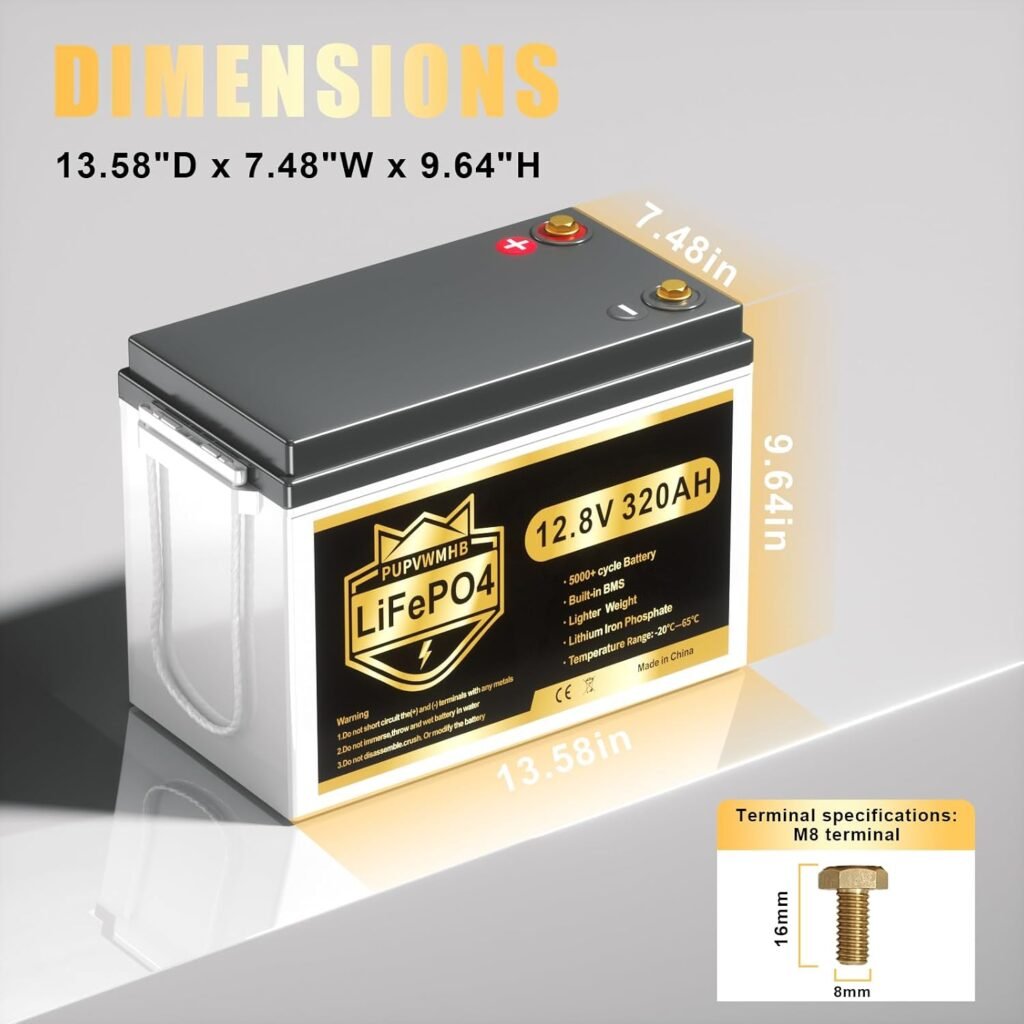
- Physical dimensions, terminal layout, app details, and expansion limits are not supplied
- Charging below 32°F (0°C) is blocked by the listed temperature protection
- No star rating, review count, or individual customer feedback was supplied for independent performance verification
Final Verdict
Key Takeaways
- The $369 listing price buys a large 12V storage battery with Bluetooth monitoring, a stated 200A BMS, and a five-year warranty, but the complete system will cost more once charging and inversion equipment are added.
- The advertised 4,096Wh figure differs from the approximately 3,840Wh result of multiplying 12V by 320Ah, so runtime estimates should allow for usable-capacity and conversion losses.
- The cycle-life claims are attractive, but actual service life depends on depth of discharge, temperature, charging practices, current, balancing, and cell quality.
- Cold-weather charging requires particular care because the listed BMS cutoff is 32°F (0°C).
- The product is most compelling for RV, solar, off-grid, and backup applications that can use its capacity and monitoring features; smaller occasional loads may not justify its size.
Frequently Asked Questions
What is the practical capacity of this 12V 320Ah battery?
The basic 12V × 320Ah calculation produces approximately 3,840Wh nominal capacity, while the listing advertises up to 4,096Wh. Actual usable energy will vary with discharge limits, temperature, connected equipment, and inverter losses, so the advertised figure should be used as a comparison point rather than a guaranteed runtime.
Can it charge in freezing temperatures?
The listed BMS charging cutoff is 32°F (0°C). Users in cold climates should prevent charging below that threshold and confirm that their solar controller or charger is compatible with the battery’s temperature-protection behavior.
Does the battery include an inverter or charger?
Neither an inverter nor a charger is identified in the supplied product information. Buyers should budget for compatible charging equipment, an inverter for standard AC appliances, cables, fuses, and mounting hardware.
Is the battery suitable for a boat or outdoor installation?
The product is described as having an impact-resistant ABS casing and IP65 protection. IP65 covers dust protection and low-pressure water jets, but it does not permit submersion, standing water around terminals, or installation without suitable mounting and environmental protection.
Disclosure: As an Amazon Associate, I earn from qualifying purchases.


