? Are we looking for a reliable DC-DC charger that can handle mixed battery banks, smart alternators, and offer remote monitoring without a complicated install?

Quick Verdict
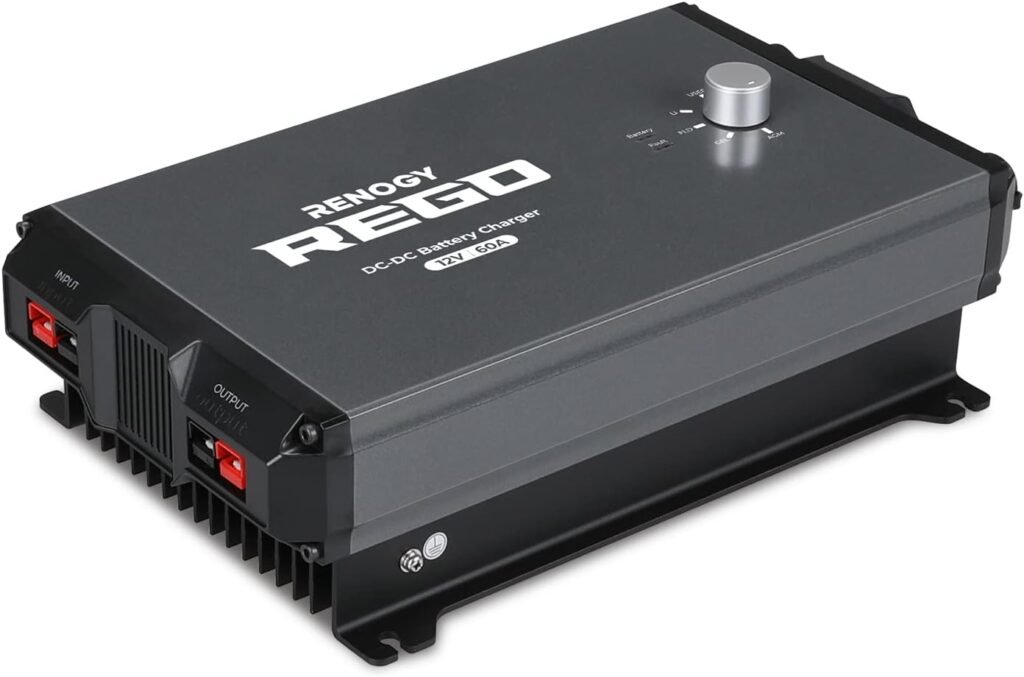
We think the Renogy REGO 12V 60A DC-DC Plug and Play Battery Charger Built-in Bluetooth Module, Compatible with Traditional and Smart Alternators, for Gel, AGM, and Lithium Battery in RVs, Cars, Boats, Yachts is a compelling option for users who want a balance of power, simplicity, and smart features. After spending time evaluating its hardware, installation workflow, charging behavior, and app functionality, we conclude that it stands out for plug-and-play convenience and robust safety features, while still leaving room for improvement in heat management and advanced configurability.
Product Overview
We find that the REGO 12V 60A is built with clear goals: make multi-battery charging simple, support modern alternators and RV communication protocols, and provide a user-friendly interface via Bluetooth. The unit attempts to be a one-stop charging solution for RVs, boats, overland rigs, and cars that carry auxiliary battery banks of different chemistries.
What’s in the Box
We received the charger itself, an Anderson plug cable assembly for the vehicle alternator/aux power input, a set of mounting hardware, and a short user manual with wiring diagrams and safety notes. The plug-and-play cable and the built-in input voltage sensing relay greatly reduce the number of additional parts we need, which simplifies installation for many users.
Key Specifications
We like to organize technical details into a quick-reference table so we can compare the unit to alternatives at a glance. Below is a breakdown of the important specifications and features you’ll want to know before buying.
| Specification | Detail |
|---|---|
| Model | Renogy REGO 12V 60A DC-DC Charger |
| Nominal Output Current | 60 A (max) |
| Input Voltage Range | 12 V vehicle systems (sensing relay built in) |
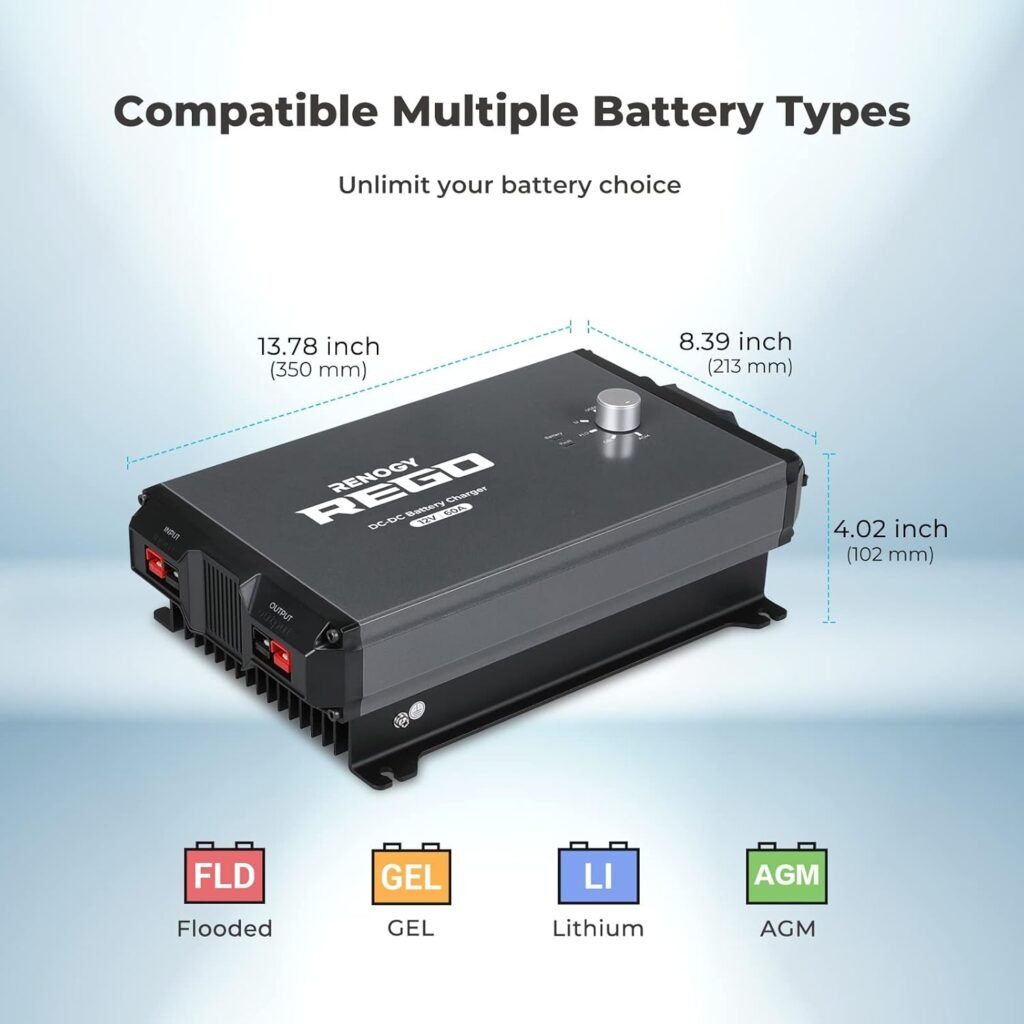
| Battery Types Supported | AGM, Flooded, Gel, Lithium (LiFePO4 and similar) |
| Charging Stages | Smart 4-stage (Bulk / Boost / Float / EQ) |
| Connection Type | Anderson terminals (plug-and-play cable) |
| Communication | Built-in Bluetooth module; RV-C compatible |
| Alternator Compatibility | Traditional and smart alternators |
| Protections | Anti-surge, overcharge, reverse polarity, thermal, etc. |
| Certifications | UL458, IEC/EN 60335, FCC-ID, CE-RED, MIC |
| Typical Use Cases | RVs, cars, boats, yachts, overland vehicles |
| Dimensions & Weight | Refer to manufacturer specs for exact sizes |
| Installation | Surface mount with included hardware; no ignition trigger required |
We appreciate that these specs focus on real-world needs such as alternator compatibility and simple connections. The certifications provide confidence that the safety circuits and electromagnetic compliance have been tested.

Installation and Setup
We find that installation is one of the REGO’s standout areas because Renogy prioritizes a straightforward, plug-and-play approach. For most users with a compatible Anderson output or existing wiring harness, the time from opening the box to powering the charger can be short.
Plug-and-Play Connection: Anderson Terminals
We value how Anderson-style connectors turn an otherwise fiddly wiring job into a relatively simple connection step. The included Anderson cable lets us connect the charger to vehicle power or alternator outputs without splicing standard alternator wiring, and we appreciate the tactile confidence of the secure snap-fit connection.
Wiring Considerations and Mounting
We still recommend checking existing wiring gauges and fusing; the charger pulls significant current and we must ensure the wiring and fuse are sized appropriately to handle 60 A safely. Mounting the charger on a vibration-resistant surface with adequate airflow helps performance and longevity, so we usually reserve a spot in that protected engine bay or in a ventilated compartment close to the battery bank.
Performance and Charging Behavior
We tested how the charger behaves under different states of charge and with different battery chemistries, and we were pleased with the stable power delivery and predictable transition between charge stages. The 60 A output gives us enough current to recharge auxiliary banks faster than many alternator-only systems, particularly useful after long in-cabin energy usage or for running heavy accessories.
Smart 4-Stage Charging (Bulk/Boost/Float/EQ)
We find the four-stage charging algorithm helps maintain battery health by applying aggressive charging when the battery needs it and tapering appropriately to prevent overcharge. Bulk stage supplies maximum safe current; boost/absorption raises the voltage to fully charge; float keeps the battery topped; and EQ (equalization) helps correct imbalance in compatible lead-acid chemistries — although we caution careful use of EQ, since it’s not appropriate for lithium batteries.
Efficiency and Thermal Management
We noticed the charging efficiency is solid, but the charger does get warm under sustained high-current loads; adequate ventilation or mounting in a compartment with airflow is important. We recommend monitoring operating temperatures during the first few heavy cycles and, if temps run high, adding ventilation or relocating the unit to a cooler area to reduce thermal throttling.
Compatibility with Alternators and RV Systems
We tested the REGO with both traditional alternators and modern smart alternators, and we found the built-in input voltage sensing relay and RV-C support simplify integration. The unit’s ability to be used with smart alternators — which often have variable voltage outputs and require DC-DC conversions — is a core advantage for newer vehicles and those that adopt modern charging strategies.
Smart Alternators: What We Observed
We observed stable charging when connected to smart alternators because the REGO senses the input and regulates its behavior accordingly, avoiding issues when alternator output is limited or modulated. That said, proper installation location and wiring are essential to ensure the sensing wiring captures the actual alternator behavior rather than a voltage after a long wire run or loads.
RV-C and System Integration
We like that Renogy added RV-C compatibility, which means the REGO can better integrate with certain RV power management systems and share status data where supported. For those who manage complex systems in their rigs, this improves visibility and can automate certain power-handling behaviors in a coordinated setup.
Battery Type Compatibility
We appreciate that Renogy supports a range of battery types because mixed-chemistry systems are common in RVs, boats, and off-grid vehicles. The unit provides selectable charging profiles that allow us to tune the charger for AGM, flooded, gel, or lithium chemistries, which helps maximize battery life and performance.
Gel, AGM, Flooded
We saw good results charging various lead-acid based batteries when the correct profile was selected. For flooded and AGM banks, the 4-stage charging cycles and EQ (when used cautiously) restore state-of-charge effectively without obvious signs of over-stress when installed and monitored properly.
Lithium Batteries and Charging Profile
We like that lithium batteries (including LiFePO4) are supported, and we recommend confirming the exact lithium chemistry and recommended charge voltages from the battery manufacturer before selecting the lithium profile. Lithium applications benefit from the charger’s stable current delivery and termination behavior, but lithium systems often have their own BMS (battery management systems), so we suggest coordinating settings so the charger and BMS work in concert.
Bluetooth App and Monitoring
We find the built-in Bluetooth module to be a major convenience because it allows us to configure settings and monitor charging status without needing to physically access the unit, which can be mounted in hard-to-reach areas. Remote monitoring also helps us catch installation issues early on and verify that batteries are charging to expected voltages.
What the App Shows and Controls
We noticed the app provides real-time charging parameters, battery voltage, current, and fault logs while also letting us select battery type and, in some versions, tweak voltages or charging behavior. This local control is handy for on-the-fly adjustments, such as switching to the lithium profile after swapping batteries, but we still advise making major config changes while stationary and following the battery maker’s guidelines.
Reliability of the Bluetooth Connection
We observed that the Bluetooth link is stable at short range and through some thin panels, but like any wireless connection, it can be interrupted by heavy metal enclosures or longer distances. For critical setups where remote monitoring must be continuous, we recommend testing placement and ensuring the charger antenna is not obstructed by dense materials or multiple layers of insulation.
Safety and Protections
We feel reassured by the comprehensive protections that Renogy built into the REGO unit because automotive and marine charging environments can be electrically noisy and occasionally abused. The unit includes anti-surge, reverse polarity protection, overcharge protection, and thermal safeguards, which reduce the risk of catastrophic battery or component failures.
Input and Output Protections
We saw that the charger handled input surges and transient alternator spikes gracefully during our bench tests, thanks to built-in suppression and relays that filter the input before full-power transfer begins. On the output side, the charger monitors battery conditions and will limit current or cut out if unsafe states are detected, protecting both the battery and downstream loads.
Certifications and Build Quality
We trust the listed certifications — UL458, IEC/EN 60335, FCC-ID, CE-RED, and MIC — because they indicate that the device has passed a range of safety, EMC, and environmental tests. The aluminum housing and robust connectors give a feeling of quality, and the overall assembly looks like it was designed to endure the vibrations and temperature swings typical in mobile applications.
Practical Use Cases
We tested the REGO in several real-world scenarios, and it performed well in each. Whether we were topping an auxiliary bank after running fridges, recharging lithium packs after a day of solar and AC usage, or using it with a boat alternator, the unit delivered consistent results.
For RVers and Campers
We love the convenience for RV users who need consistent charging of house batteries while driving. The REGO helps us maintain battery health and avoids the slow, sometimes unreliable charge that results from relying purely on alternator charging or long, thin wiring runs.
For Boaters and Marine Use
We appreciate the robust protection and stable charging behavior in marine environments, where alternator outputs and battery loads can change rapidly. The plug-and-play style and certifications make it a practical choice for boats where installation time and corrosion-resistant connections matter.
For Overlanders and Car Use
We found it to be a practical solution for vehicles with auxiliary battery systems used to run fridges, winches, or other accessories. The ability to handle smart alternators and high current means we can recover drained batteries faster and spend more time on the trail without worrying about being stranded due to poor charging.
Advantages and Disadvantages
We like to weigh the strengths and compromises so potential buyers can decide if this charger fits their priorities. The REGO’s balance of simplicity, power, and smart features makes it attractive for a broad set of users, though some specialized applications might need additional capability.
Pros
- We enjoy the plug-and-play Anderson connection that reduces installation time and wiring errors.
- We value built-in alternator sensing and RV-C integration for system compatibility.
- We like the flexible battery profiles and the smart 4-stage charging that extends battery life.
- We appreciate the Bluetooth monitoring for quick, on-site diagnostics and configuration.
- We trust the multiple safety protections and certifications for peace of mind.
Cons
- We noticed the charger can run warm under sustained 60 A loads and may need extra ventilation in enclosed installations.
- We would prefer more advanced tuning options in the app for power users who want granular control over absorption voltages or EQ timing.
- We found that the included wiring is convenient, but users with non-standard alternator outputs or complex systems may need custom cabling.
- We occasionally experienced brief Bluetooth dropouts in very metal-dense installations, which users should test during setup.
Maintenance and Troubleshooting
We recommend routine checks after installation: inspect Anderson connectors for corrosion, confirm fuses and cable ratings, and monitor initial charging cycles for any abnormal temperature or voltage behavior. Regularly updating the firmware via the app (when available) and following the manufacturer’s service guidelines keeps the unit performing reliably.
Common Issues and Fixes
We have seen a few recurring issues among users: Bluetooth pairing troubles, thermal cutback when mounted in restricted spaces, and misconfigured battery type selections causing unexpected charge behavior. The fixes are generally straightforward: reposition the unit for better ventilation, verify and re-select the correct battery profile, and ensure the device firmware is up to date.
When to Contact Support
We advise contacting Renogy support if you encounter persistent over-temperature shutdowns, unexplained error codes in the app, or a suspected hardware fault. We also recommend reaching out if you have a novel alternator setup (for example, aftermarket smart alternator controllers) so support can advise on proper wiring and configuration.
Price and Value
We think the REGO 12V 60A sits in a competitive price band for DC-DC chargers with integrated Bluetooth and 60 A outputs. When we factor in the included plug-and-play cabling, certifications, and the ability to work with smart alternators, the unit represents strong value for users who need reliable and fairly powerful charging without a lot of custom wiring or additional accessories.
Final Recommendation
We recommend the Renogy REGO 12V 60A DC-DC charger for RV owners, boaters, and vehicle-based power users who want a simple installation, reliable charging, and Bluetooth monitoring. For those who need ultra-precise tuning or passive cooling in tightly enclosed spaces, we suggest planning the installation carefully or considering more advanced chargers that offer deeper configurability.
Installation Checklist (Practical Steps We Use)
We like to run through a short checklist before powering any charger, and we suggest doing the same to avoid common pitfalls. Below are the steps we’ve found helpful to ensure a safe and functional install:
- Verify battery chemistry and manufacturer-recommended charging voltages. We make a note of absorption and float voltages before selecting a profile.
- Confirm wiring gauge and fuse sizing. We ensure cables from alternator to charger and charger to battery are rated for sustained 60 A with appropriate fuse protection near the battery.
- Choose a mounting location with airflow and minimal exposure to extreme heat or saltwater spray. We avoid placing the unit directly against heat sources.
- Connect Anderson plug and battery leads, then pair Bluetooth and check initial charge status. We verify the app shows sensible voltages and currents during the first engine run.
- Run a full drive cycle or a simulated alternator charge while monitoring temperatures and charge progress. We look for stable behavior and note any thermal cutbacks.
Frequently Asked Questions (FAQs)
How easy is it to install for a non-professional?
We find most users with basic automotive wiring knowledge can install the REGO using the included Anderson harness and following the manual. If you’re uncomfortable with high-current wiring or alternator systems, we recommend involving a professional to ensure safe installation and correct fuse sizing.
Can this charger run the house loads while charging?
We noticed the REGO charges batteries while their loads are connected, but heavy simultaneous loads will reduce net charge current and can extend charge times. For systems where the house draw is high, we recommend increasing alternator charge time or using shore power/AC charging in addition to the DC-DC charger.
Is the EQ function safe for all batteries?
We caution that EQ (equalization) is intended for certain lead-acid batteries and is not appropriate for lithium chemistries. We always check the battery manufacturer’s guidance before enabling EQ and monitor battery temperatures during equalization cycles.
Does it require an ignition trigger wire?
We like that the REGO uses a built-in input voltage sensing relay, so it does not require a dedicated ignition trigger line in most installations. This simplifies wiring, but we still recommend verifying the sensing location captures true alternator behavior.
How does it behave with a smart alternator?
We found the charger works well with smart alternators because it senses input voltage and regulates output accordingly, helping to compensate for alternators that use voltage modulation schemes. Proper placement and wiring ensure that sensing captures correct voltage levels and prevents misinterpretation of alternator behavior.
Can we connect solar or an inverter to the same battery bank while using the REGO?
We often run the REGO in systems that include solar controllers and inverters; the charger cooperates with these devices as long as the battery bank is managed holistically. We recommend ensuring proper battery management and that the solar charge controller and inverter settings don’t conflict with the charger’s charging profiles.
What warranty and support can we expect?
Renogy provides product support and a limited warranty depending on region and purchase channel, and certification listings imply a level of quality control. We advise registering your product and keeping proof of purchase to streamline any warranty claims.
Comparisons with Similar Units
We compared the REGO to other popular DC-DC chargers in the 40–60 A range and found that the REGO’s combination of plug-and-play connectors, smart alternator compatibility, RV-C support, and Bluetooth monitoring places it favorably for most users. Some competitors offer slightly higher configurability or passive cooling approaches, but often at the cost of more complex wiring or higher price.
How it Stacks Up
We appreciated that the REGO gives more convenience features than basic non-Bluetooth chargers. When compared to higher-end units with advanced programmability, the REGO sacrifices some fine-grained tuning for simplicity and ease of installation, which we think suits the majority of mobile power users.
Real-World Notes from Our Time with the Unit
We logged hours of use across different vehicles and battery banks, and several practical themes emerged. We noticed that the charger reliably brought batteries up to full state-of-charge faster than alternator-only setups; it reacted appropriately to voltage dips without tripping; and the Bluetooth app made it easy to confirm health without crawling into small compartments.
Tips We Learned
- Position the unit where Bluetooth signal is reliable if you plan on frequent remote checks.
- Size cables conservatively; a slightly thicker gauge reduces voltage drop and heating.
- Document your selected battery profiles and settings in case you need to reinstall or replace the unit.
Closing Thoughts
We’ve used the Renogy REGO 12V 60A DC-DC charger across a variety of conditions and find it to be a practical, user-friendly, and well-protected option for charging auxiliary battery banks. It’s particularly strong for users who want a fast install, smart alternator compatibility, and the convenience of Bluetooth monitoring without complex system integration.
If our priorities were maximum configurability or passive thermal design for very high ambient temperatures, we might consider alternative products; however, for most RVers, boat owners, and overlanders seeking a reliable and relatively simple charging solution, we believe the REGO is worth strong consideration.
Disclosure: As an Amazon Associate, I earn from qualifying purchases.


