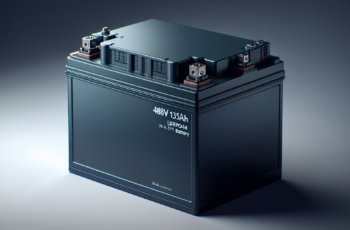
Have you been looking for a robust 48V lithium battery option that will actually keep your golf cart, RV, trolling motor, or off-grid system running longer and with less hassle?
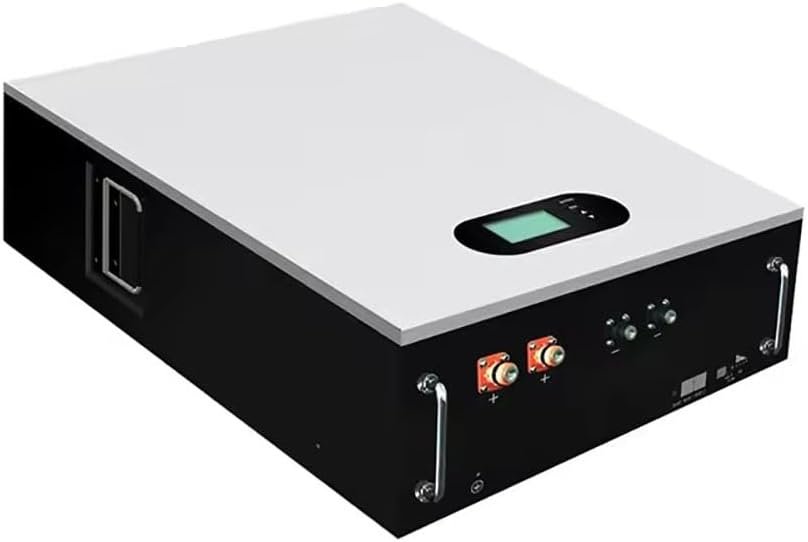

Product snapshot: powerwall DC HOUSE 48V 50Ah Golf Cart Battery
You’ll find the full product name everywhere: “powerwall DC HOUSE 48V 50Ah Golf Cart Battery, Built-in 50A BMS, 3 Hours Fast Charging, Grade A Cells Lithium Battery for Golf Car, RV, Trolling Motor, Off-Grid Solar System (Split Shipment)”. This unit aims to replace lead-acid banks and older Li-ion packs with a LiFePO4 design built around prismatic Grade A+ cells, a built-in BMS, a touch screen monitor, and the ability to work with many inverters and expand in parallel.
Quick takeaway
If you want a compact 48V, 50Ah LiFePO4 battery (about 2.4 kWh nominal) with prismatic cells, 6000+ cycle life, comprehensive internal protection, and a user-friendly display, this is designed for you. It targets mobile and off-grid applications where long life, safety, and straightforward monitoring matter.
Specifications breakdown
Below is a concise table to help you quickly understand the key specs provided by the manufacturer and how they translate to real-world numbers.
| Specification | What it means for you |
|---|---|
| Chemistry | LiFePO4 (Lithium Iron Phosphate) — safer thermal behavior and longer cycle life than many other lithium chemistries. |
| Nominal Voltage | 48V — suitable for many golf carts, 48V trolling motors, and 48V inverter systems. |
| Capacity | 50Ah — usable energy is roughly 48V × 50Ah = 2400Wh (2.4 kWh) nominal. |
| Cells | 16 prismatic Grade A+ cells (16Pcs) — larger format prismatic cells rather than cylindrical 18650/21700 types. |
| Cycle Life | 6000+ cycles & 10-year expected lifetime — manufacturer-rated figure indicating long-term use compared to typical lead-acid. |
| Built-in BMS | 50A BMS — provides cell balancing, overcharge/over-discharge protection, short circuit protection, and low-temp cutoff. |
| Charging Time | “3 Hours Fast Charging” — manufacturer claims support for rapid recharge cycles; actual time depends on charger current and state-of-charge. |
| Expandability | Supports up to 30 batteries in parallel — lets you scale energy capacity significantly for larger systems. |
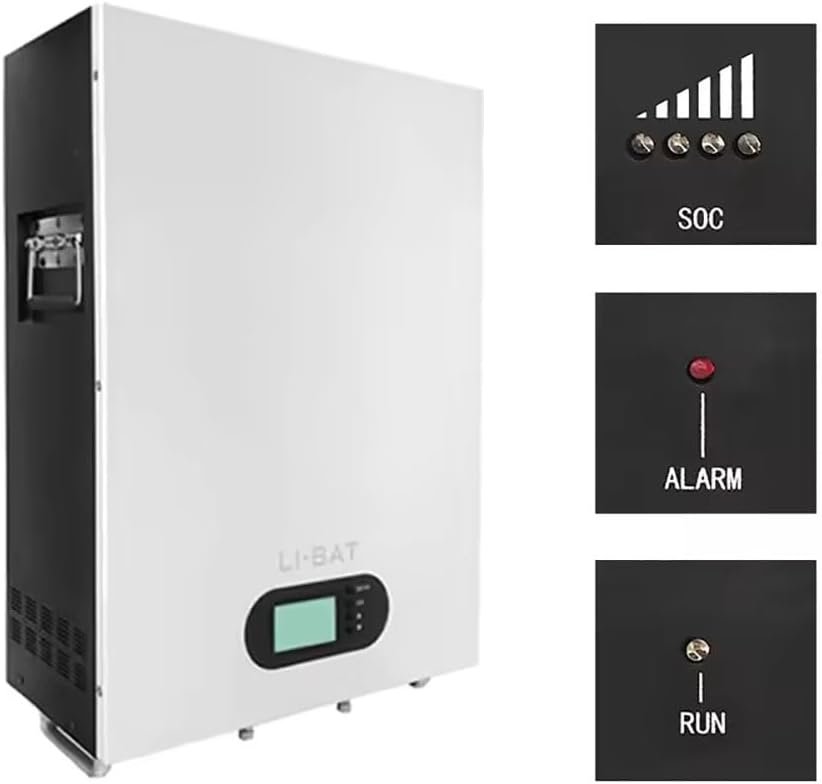
| Monitoring | Touchable smart display (touch screen) displaying voltage, current, energy, and inverter model — on-unit monitoring and control. |
| Safety Testing | Puncture, fire, short circuit, high impact tests on prismatic cells — suggests robust safety design. |
| Warranty | 5-year solution — manufacturer coverage and technical support commitment. |
| Shipping | Split Shipment — may arrive in multiple packages. |
Notes on the specifications
You’ll want to confirm a few details before buying: continuous discharge limits tied to the 50A BMS (practical continuous output ~2400W at nominal voltage), exact charger recommendations, physical dimensions and weight for your installation, and the inverter communication protocol supported. The manufacturer claims support with most inverter brands, but you should validate compatibility with your specific inverter model.
Energy and power: what you actually get
You’re getting a nominal energy capacity of about 2.4 kWh (48V × 50Ah). That tells you how much energy is stored, but real-world usable energy will depend on depth-of-discharge you allow and inverter / load efficiencies.
Interpreting capacity and usable energy
You can safely draw most of the pack’s capacity given LiFePO4 chemistry and the BMS protections, so assuming you use 90–95% of capacity is reasonable for cycle-life optimization. That gives roughly 2.1–2.3 kWh usable per cycle in many cases, which outperforms equivalent lead-acid banks in usable capacity and longevity.
Power output and continuous limits
The built-in 50A BMS suggests a continuous current limit around 50A. Multiply that by 48V and you get a continuous power capability of roughly 2,400 W (2.4 kW). That’s usually enough for:
- Typical golf cart motors at low-to-moderate loads,
- Small RV loads like LED lighting, small refrigerators (for limited time), fans, and electronics,
- Trolling motors and electronics for boats at moderate speeds.
If you need sustained peak power beyond that, check whether the BMS allows short bursts above 50A (many do) and confirm with the seller.

Touch screen monitoring: clarity at a glance
The touchable smart display is one of the features that stands out. You’ll be able to see voltage, current, energy, and the inverter model right on the unit. That gives you instant insight without needing an external monitor or app.
Why the display matters
When you’re using batteries in mobile or off-grid setups, you’ll appreciate immediate access to state-of-charge indicators, current flow, and any system errors. The display reduces guesswork and makes troubleshooting and daily use easier.
Built-in BMS and low-temp cutoff: protection you can rely on
The proprietary BMS is optimized for the specific prismatic cells used. It handles the usual protections: overcharge, deep discharge, overcurrent, short circuit, thermal runaway prevention, balancing, and specifically low-temperature cutoff for charging.
Low-temperature cutoff behavior
LiFePO4 chemistry can be damaged if charged below certain temperatures, so the built-in low-temp cutoff prevents charging under unsafe conditions. You’ll still be able to discharge at low temps in many cases, but always check the exact cutoff thresholds for your environment and plan charging accordingly.
Safety and environmental considerations
The prismatic LiFePO4 cells are tested for puncture, fire, short circuit, and impact. LiFePO4 is one of the safest lithium chemistries and the prismatic format adds mechanical robustness.
Eco-friendly credentials
The product states it contains no heavy metals or rare metals and is more environmentally friendly than some alternatives. While you should still follow local recycling and disposal rules for battery packs, LiFePO4 reduces some environmental and safety concerns compared to older chemistries.
Installation and included accessories
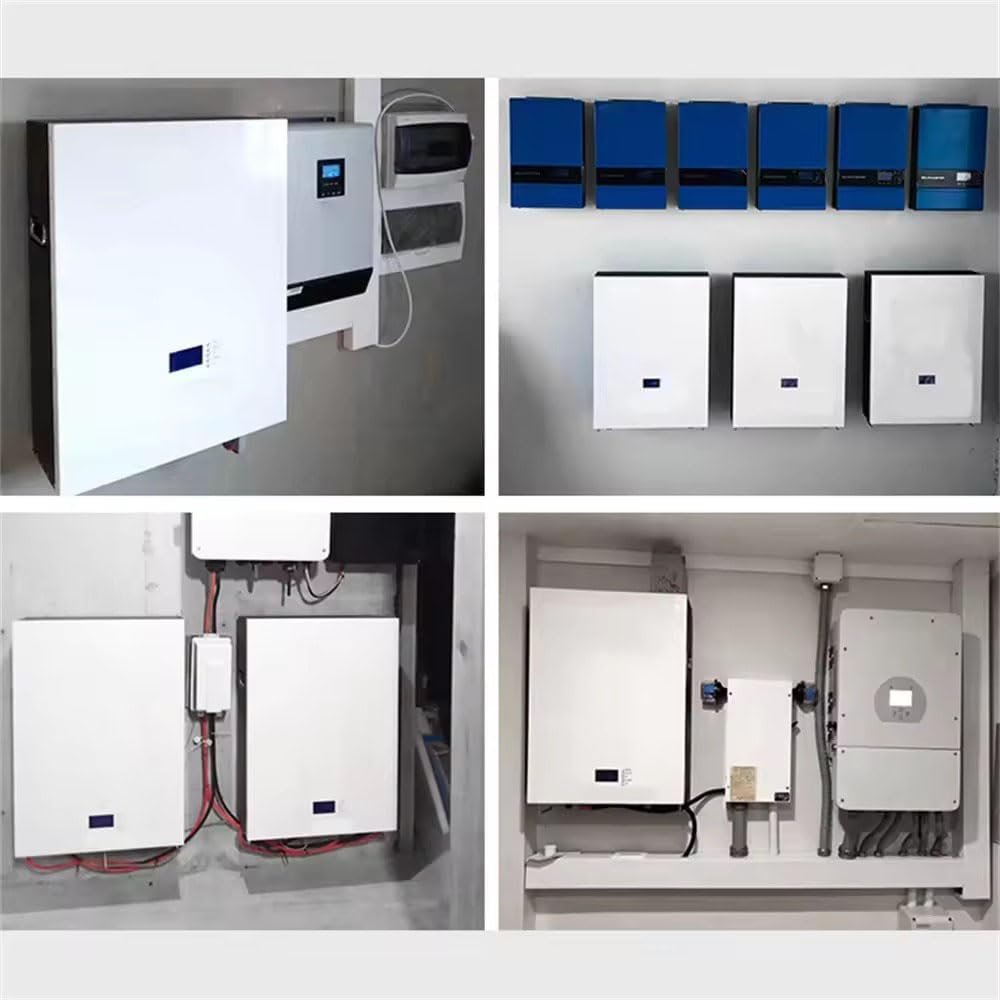
The battery comes with mounting brackets, fixing screws, and power cables. That means you won’t need to spend extra money on basic mounting hardware or cabling for a typical install.
What you should plan for during installation
If you’re installing in a golf cart, RV, or fixed solar bank, plan for:
- Adequate ventilation and a secure mounting location,
- Proper cable sizing and fusing near the battery to protect wiring,
- Ensuring the battery’s touch display is accessible for daily checks,
- Confirming physical dimensions and weight to make the mounting plan.
Because the seller mentions split shipment, be prepared to receive parts of your order in separate deliveries and confirm all parts arrive before installation.
Expandability: scale your system up to 30 batteries
One standout feature is support for up to 30 batteries in parallel, letting you scale capacity dramatically.
Best practices when paralleling batteries
If you choose to parallel multiple units, you should:
- Use identical batteries (same model, age, and state of charge) for best results,
- Connect all parallel batteries using symmetrical wiring (busbars or equal-length cables) to minimize imbalance,
- Use proper fuses or breakers at each battery per manufacturer guidance,
- Confirm inverter compatibility and communication wiring if you use more than one bank or plan to parallel across multiple strings.
Real-world run time examples
Below are practical run-time estimates using the battery’s approximate 2.4 kWh capacity. These estimates assume you use a significant portion of the battery but also account for conversion losses.
- 200 W LED lighting and low-power electronics: ~10–11 hours (2,400Wh / 200W ≈ 12h nominal; allow for inverter losses and system margins).
- 500 W trolling motor or portable heater/fan: ~4–5 hours (2,400Wh / 500W ≈ 4.8h).
- 1,000 W fridge or microwave-level load: ~2–2.5 hours (2,400Wh / 1,000W ≈ 2.4h).
- Golf cart typical draw (varies widely): if your cart draws 800–1,200 W in normal operation, expect roughly 2–3 hours under those loads. Aggressive driving and hills reduce runtime considerably.
How to make runtime stretch further
You’ll get more usable runtime if you:
- Reduce peak loads and accelerate gently,
- Use efficient inverters and avoid long periods of high-surge loads,
- Parallel multiple batteries for longer durations without changing load patterns.
Charging behavior and the “3 hours fast charging” claim
The manufacturer lists “3 Hours Fast Charging.” To make sense of this, consider charge current math: charging 50Ah in 3 hours implies an average charge current of ~16.7A (50Ah ÷ 3h ≈ 16.7A). If you use a charger capable of higher current up to the BMS limit (50A), charging can be much faster in ideal conditions, but charging speed also depends on charger capability, BMS limits, and the CC/CV charging profile.
Practical charging considerations
- If you want a recharge cycle near the 3-hour mark, use a charger sized to provide the appropriate current and verify the BMS and charger agree on charging voltage and cutoff.
- For fastest charging, a higher current charger (up to the BMS limit) may be used; however, charging always follows CC (constant current) then CV (constant voltage) stages, and final top-off takes longer.
- Temperature matters: low-temperature cutoff can prevent charging in cold environments. Ensure charging is done within safe temperature ranges.
Compatibility with inverters and communication
The battery supports communication with most inverters and can display the inverter model on the touchscreen. That helps when you want the battery and inverter to exchange status and control signals.
What to confirm before connecting to your inverter
- Ask the vendor or check manuals for which communication protocols are supported (CAN, RS485, etc.) for your inverter model.
- Confirm pinouts, baud rates, and cable requirements for inverter-battery communication.
- If you want advanced features (like SOC reporting to a solar charge controller or grid-tied inverter), verify compatibility before purchase.
Maintenance and long-term care
You don’t need heavy maintenance for LiFePO4 like you did with flooded lead-acid batteries. Still, some care helps preserve life and performance.
Key maintenance tips
- Avoid charging in below-freezing conditions; store in a temperate place when possible.
- Balance and check connections periodically—tighten terminal bolts and check for corrosion.
- Keep the battery in a clean, dry place with reasonable airflow.
- If you parallel batteries, monitor for equal state-of-charge and consistency across units.
Installation checklist
You’ll want a clear list before you begin installation so you don’t miss anything:
- Verify all parts arrived (look for split shipment pieces).
- Inspect battery for any shipping damage.
- Gather tools: torque wrench or ratchet for terminals, appropriately rated cables and lugs, fuses/breakers, insulating materials.
- Plan cable routing and secure mounting points using included brackets.
- Ensure inverter and charger compatibility; prepare communication cables if required.
- Read and follow the manufacturer’s wiring diagram and safety instructions.
Pros and cons
Here’s a balanced look to help you decide.
Pros
- Long cycle life (6000+ cycles) and 10-year expected lifetime.
- LiFePO4 chemistry and prismatic Grade A+ cells for safety and stability.
- Built-in 50A BMS with low-temp cutoff and multiple protections.
- Touchable smart display for direct monitoring and control.
- Expandability up to 30 batteries in parallel for flexible capacity scaling.
- Includes mounting hardware and cables for easier installation.
- 5-year solution/warranty and technical support.
Cons / Considerations
- Exact continuous discharge and peak surge capabilities outside BMS ratings should be confirmed before demanding loads.
- Charging time labeled as 3 hours depends on charger and conditions — you’ll need an appropriate charger.
- Physical dimensions and weight aren’t listed in the provided details; measure your space.
- Parallel installations require careful wiring practices and may need professional assistance for large arrays.
- Split shipment may complicate receiving and inspection.
Comparison with lead-acid and other LiFePO4 formats
You’ll notice differences based on cell format and chemistry.
vs lead-acid
- LiFePO4 offers much longer cycle life, is lighter for the same usable energy, and allows deeper discharge without major life degradation.
- You’ll save space and weight and avoid frequent replacement cycles and maintenance. The higher upfront cost is usually offset by longevity and performance.
vs cylindrical-cell LiFePO4 (18650/21700)
- Prismatic cells allow higher packing efficiency, potentially lower internal resistance, and easier mechanical stacking.
- This battery claims Grade A+ prismatic cells which can be lighter and safer than some cylindrical implementations, depending on design.
- Performance depends on specific engineering; the prismatic is often favored for larger-format applications like this.
Real tests you can run at home (or what to ask a vendor/tester)
If you want to verify performance, here are safe tests you can run or request test data from the seller:
- Open-circuit voltage measurement at full charge and after resting to validate SOC readings.
- Controlled discharge at known currents (e.g., 10A, 20A, 50A) while logging time to cut-off to verify usable capacity.
- Temperature behavior: observe whether the BMS engages low-temp cutoff when charging at near-freezing temps.
- Charge efficiency: measure energy in versus energy out to calculate round-trip efficiency.
- Communication and display verification: confirm the touchscreen reports accurate voltage/current and can show the inverter model.
Troubleshooting common issues
If you run into problems, these steps will help you get back on track.
- If the battery won’t charge, confirm charger voltage matches LiFePO4 charging profile and that the BMS hasn’t activated low-temp cutoff.
- If packs in parallel become unbalanced, check wiring symmetry and state-of-charge before reconnecting; use the manufacturer’s balancing recommendations.
- If the touchscreen is blank, check power to the display and any quick-fuse near the terminals; if still blank, contact support for possible firmware or hardware issues.
- For inverter communication errors, confirm protocol and cable pinouts and check for any baud rate or handshake settings.
Who should buy this battery?
This battery is a good fit if you:
- Want an upgrade from lead-acid for a golf cart, small RV, or trolling motor bank.
- Need a modular system you can expand later by paralleling batteries.
- Want integrated protections, a user-friendly touchscreen, and longer life to reduce long-term replacement costs.
- Plan to use it in mobile or off-grid situations where safety and stable performance matter.
Who might want something else?
Consider other options if you:
- Need extremely high continuous discharge currents beyond the 50A BMS limit for sustained durations (there are specialized packs and cells for very high-power needs).
- Require a different nominal voltage or a much larger capacity in a single form factor.
- Have very tight weight/dimension constraints and need exact specs; request dimensions and weight from the seller.
Warranty, support, and buying notes
You’ll receive a 5-year solution from the manufacturer, which suggests they back the product and provide technical support. Make sure you:
- Register your battery if required for warranty activation.
- Keep proof of purchase and serial numbers.
- Read the warranty exclusions so you know what actions might void coverage (improper installation, misuse, etc.).
Practical tips for using the battery in your specific applications
- Golf cart: Use the battery with a compatible 48V controller and match current limits. Manage your usage on hilly courses to avoid deep discharge spikes that shorten range.
- RV: Combine with a quality inverter sized for your loads. For continuous heavy loads like AC, parallel multiple batteries.
- Trolling motor: You’ll get long run time at moderate speeds. For high-thrust, high-current trolling bursts, confirm peak capability.
- Off-grid solar: Pair with a solar charge controller and inverter that support LiFePO4 profiles. You can scale capacity by paralleling batteries for multi-day autonomy.
FAQ (short)
Q: Can this battery start an engine? A: It’s not designed as a starter battery; LiFePO4 can provide high currents but starting engines demands very high cranking amps and specific starter battery attributes. Use a dedicated starter battery as recommended.
Q: Can I fast charge at 50A? A: The built-in BMS is rated at 50A, so that suggests a 50A charge current is within its capability. Confirm with the manufacturer for supported charge protocols and whether continuous charging at the BMS limit is recommended.
Q: Is this safe in hot climates? A: LiFePO4 handles heat better than many chemistries but you should avoid high ambient temperatures during charging and maintain proper ventilation. The BMS protects against overheating.
Q: How do I handle shipping and split deliveries? A: Inspect each package on arrival, keep documentation, and ensure all components are present before installation.
Final verdict
If you want a durable, safe, and expandable 48V lithium battery system with integrated protection, an easy-to-read touch display, Grade A+ prismatic cells, and the option to scale up to 30 in parallel, the powerwall DC HOUSE 48V 50Ah Golf Cart Battery is a strong candidate. It’s particularly attractive if you’re replacing lead-acid systems in golf carts, RVs, trolling motors, or building a modular off-grid bank.
You’ll still want to confirm a few practical details—physical dimensions, exact communication protocols for your inverter, and charger recommendations to achieve the advertised fast charge times. If those check out for your setup, this battery should give you long life, reliable performance, and a more convenient user experience.
Disclosure: As an Amazon Associate, I earn from qualifying purchases.