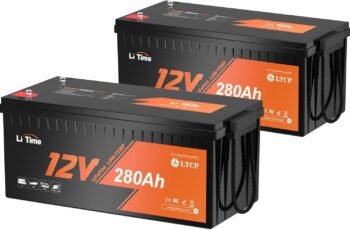
? Are we ready to evaluate the Power Queen 2Pack of LiFePO4 Battery 12.8V200Ah, Built-in 100A BMS, Max 2560Wh, Up to 15000+ Cycles, Support in Series/Parallel, Widely Used in Home Solar System, RV Camping, Off-Grid Power?

Product Overview
We’ll summarize what this 2-pack offers and why it might matter to our projects. The package includes two Power Queen 12.8V 200Ah LiFePO4 batteries, each with built-in 100A BMS and a nominal energy of 2560Wh per unit. These batteries are marketed for home solar systems, RV camping, and off-grid power, promising high cycle life, high energy density, and robust safety protections.
Key Claims from the Manufacturer
We want to be clear about the headline specifications and claims so we can judge performance against expectations. The manufacturer highlights automotive-grade LiFePO4 cells, a built-in 100A battery management system (BMS) for safety, claimed long cycle life (marketing materials contain mixed cycle figures), and support for series and parallel connections for flexible system design.
Technical Specifications (Quick Reference)
We’ll present a compact technical breakdown so we can compare numbers quickly and make decisions without hunting through text. This table compiles the essential numbers advertised for a single battery of the 2-pack.
| Specification | Value (per battery) |
|---|---|
| Nominal Voltage | 12.8 V |
| Nominal Capacity | 200 Ah |
| Nominal Energy | 2560 Wh |
| Cells | 8 automotive-grade LiFePO4 cells (arrangement implies 4S) |
| Built-in BMS | 100A (protects against overcharge / over-discharge / over-current / short) |
| Max Continuous Current (BMS limited) | 100 A |
| Weight | 48.28 lb (approx. 21.9 kg) |
| Energy Density (advertised) | 53.02 Wh/lb |
| Claimed Cycle Life | marketing: up to 15000+ cycles (name); product detail: 4000+ cycles |
| Depth of Discharge (DoD) | 100% (at 1C discharge) |
| Applications | Home solar, RV, off-grid, camping |
| Warranty | 5-year limited warranty |
| Notes | Not for engine starting; supports series/parallel connections |
We’ll note that there are conflicting cycle-life figures — the product name mentions “Up to 15000+ Cycles” while the product details reference “4000+ cycles” and a 10-year lifetime. We’ll discuss this further below.
Energy Density and Weight Comparison
We’ll put the advertised energy density into context and explain what that means for real-world use. The manufacturer compares the battery to a typical 12V 200Ah lead-acid battery, claiming roughly three times higher energy density. Using the given numbers: 2560 Wh at ~48.28 lb equals approximately 53.02 Wh/lb, while a comparable lead-acid example at 2400 Wh and 129 lb equals around 18.60 Wh/lb. That weight and energy advantage translates into smaller, lighter battery banks for the same usable energy.
Practical Implication of Higher Energy Density
We’ll clarify how the energy density affects system design. Because the Power Queen cells store more energy per pound, we can install fewer batteries to achieve the same usable capacity, reduce weight in mobile applications (RV, van builds), and minimize footprint in tight battery compartments for home systems.
Cycle Life and Longevity
We’ll explain the cycle life claims and what to expect in practice. There is inconsistency between the product name (up to 15000+ cycles) and the details (4000+ cycles). Real-world LiFePO4 cycle life depends on depth of discharge, charge/discharge rates, temperature, and quality of cell manufacturing.
Reconciling the Cycle Claims
We’ll take a cautious approach when interpreting marketing figures. The 4000+ cycles claim at a realistic DoD and reasonable conditions aligns with many well-manufactured LiFePO4 cells and would represent roughly a decade of typical residential use. The “up to 15000+ cycles” claim may refer to extremely shallow cycling or idealized laboratory conditions; we recommend treating the 4000+ cycles figure as the more practical expectation unless the manufacturer provides a clear, test-backed explanation for the higher number.
Built-in 100A BMS and Safety Features
We’ll describe what the built-in BMS protects and why it’s important. The integrated 100A BMS provides protections against overcharge, over-discharge, over-current, over-voltage, overload, and short circuit conditions. This simplifies installation by handling cell balancing and safety monitoring internally.
BMS Limitations and Real-World Considerations
We’ll add necessary caveats so we can design safe systems. While the BMS is rated at 100A continuous, some systems may produce higher surge currents (e.g., large inverters or motors). We should design around the BMS limits, using external fuses or contactors where appropriate to prevent damage. Also, internal BMS protections can behave differently in series or parallel configurations; we should match batteries and follow recommended wiring practices.
Charging Profile and Recommendations
We’ll outline recommended charging parameters so we can protect battery life. For a 12.8V LiFePO4 nominal battery (4 cells in series), the typical recommended maximum float/absorption voltage is in the 14.2–14.6V range (about 3.55–3.65V per cell) for bulk charging. Manufacturers sometimes advise a lower float (13.6–13.8V) if long-term float is required. The built-in BMS will also prevent over-voltage conditions.
Charge Current and BMS Considerations
We’ll clarify charging currents relative to the BMS. The 100A BMS limits charge and discharge to protect the cells; charging at or below 0.5C to 1C is acceptable for LiFePO4 chemistry, but staying under the BMS continuous limit keeps operation within safe ranges. For a 200Ah battery, 1C equals 200A (higher than the BMS), so practical continuous charge current should remain at or below 100A unless external charging and protection schemes are used.
Series and Parallel Usage
We’ll explain how the batteries perform when combined and what to watch for. The units support both series and parallel connections, allowing us to increase system voltage (series) or capacity (parallel). This flexibility makes the 2-pack suitable for building 12.8V, 25.6V, or larger banks depending on system needs.
Best Practices When Connecting Multiple Units
We’ll recommend safe practices to keep our packs balanced and reliable. Always use identical batteries (same model, same age, same state of charge) when connecting in series or parallel. Use equal-length cables to minimize imbalances, and install fuses or breakers at the battery outputs. For series connections, ensure the BMS of each battery can handle the expected system charging behavior and consider using a dedicated battery management solution if many batteries are interconnected.
Installation and Wiring Guidance
We’ll give practical installation tips to help our systems operate safely and efficiently. Mount batteries on solid, vibration-resistant surfaces, keep terminals clean, and torque terminals to manufacturer recommendations. Maintain ventilation for the compartment, even though LiFePO4 generate less off-gassing than lead-acid. Use appropriately sized cable for the 100A BMS — typically AWG 4/0 to AWG 2/0 (or local equivalent) depending on run length to limit voltage drop and heat.
Fusing, Breakers, and Contactor Recommendations
We’ll highlight critical protection steps. Install a DC breaker or fuse close to the battery positive terminal to protect wiring from short circuits. Choose a fuse or breaker rated slightly above the maximum expected continuous current but below the maximum safe conductor capacity. Use a properly rated inverter input breaker sized for the inverter’s surge needs while considering the battery’s 100A BMS limit.
Real-World Performance: DoD, Self-Discharge, and Efficiency
We’ll explain how the battery performs day-to-day. The Power Queen battery advertises 100% depth of discharge in 1C discharge, low self-discharge, and minimal capacity loss over time. In practice, LiFePO4 chemistry supports deep discharges with minimal degradation compared to lead-acid, and round-trip efficiency of LiFePO4 systems is typically high (85–95%), depending on system components and conditions.
What 100% DoD Means for System Sizing
We’ll translate 100% DoD into usable energy. If we trust a battery to deliver 100% of its nominal 2560Wh, we’ll get more usable energy per battery than with lead-acid equivalents that usually recommend 50% DoD to preserve life. That reduces the number of batteries we need but still suggests good design practice to avoid deep discharging repeatedly at high currents without adequate recharging.
Applications and Use Cases
We’ll detail practical scenarios where the 2-pack is most suitable. These batteries suit off-grid home energy systems, RV and camper electrical systems, solar storage for cabins, and general backup power. The lighter weight and higher usable capacity make them particularly attractive for mobile applications where weight and space matter.
Home Solar Systems
We’ll explain the fit for residential solar. For a small off-grid cabin or as a backup for parts of a home, two 12.8V/200Ah batteries give 5120Wh nominal total energy (two batteries), or 5.12 kWh before inverter/upstream losses. With 100% recommended DoD available, this represents significant usable energy for lights, small appliances, and critical loads.
RV and Mobile Use
We’ll outline considerations for mobile setups. The relatively compact footprint and lower weight compared to lead-acid make these batteries appealing for RVs and vehicle-scale energy systems. The built-in BMS reduces monitoring complexity, but we must ensure our charging source (alternator, solar charge controller) is configured for LiFePO4 and limited to the BMS current rating.
Comparison: LiFePO4 vs Lead-Acid and Other LiFePO4
We’ll compare the Power Queen battery to lead-acid alternatives and similar LiFePO4 offerings. Compared to lead-acid, the Power Queen promises higher energy density, longer cycle life, lower maintenance, and better usable capacity. Compared to other LiFePO4 products, the differentiators are the automotive-grade cells and integrated 100A BMS, but pricing, warranty handling, and actual cycle test data will influence final choice.
Cost and Lifetime Considerations
We’ll frame the total cost of ownership argument. Higher upfront cost for LiFePO4 is often offset by longer life and deeper usable capacity. The manufacturer’s claim that the battery will produce ~10,240 kWh over 4000 cycles (2560Wh × 4000 cycles) illustrates the long-term energy output relative to grid electricity, but actual savings will depend on charge sources and system efficiency.
Pros and Cons
We’ll summarize strengths and weaknesses clearly to help our decision.
Pros:
- High usable energy per unit (2560Wh nominal).
- Much higher energy density versus typical lead-acid.
- Built-in 100A BMS simplifies installation and adds safety protections.
- Supports series and parallel configurations for flexible systems.
- Low self-discharge and long service life advertised (4000+ cycles commonly cited).
- 5-year warranty and 24-hour technical support promise.
Cons:
- Conflicting cycle life claims (4000+ vs. 15000+) require clarification.
- BMS limits continuous current to 100A, which may constrain larger inverter surge demands.
- Not suitable as a starter battery for engines — limited to deep-cycle applications.
- Weight still non-trivial for some mobile installs (approx. 48.28 lb each).
- Manufacturer’s warranty terms should be reviewed for installation-specific exclusions.
Warranty and Support
We’ll explain what the warranty covers and our expectations for support. Power Queen offers a 5-year warranty and advertises one-on-one technical support within 24 hours. That level of support is helpful if installation questions or defects appear. We recommend documenting installation conditions (serial numbers, purchase proof, system configuration) to expedite any warranty claims.
Safety Notes and Environmental Considerations
We’ll outline important safety reminders and environmental benefits. LiFePO4 chemistry is more stable than many lithium chemistries and does not carry the same thermal runaway risks as older chemistries; the integrated BMS adds a layer of safety. LiFePO4 is also non-toxic and recyclable compared to lead-acid, and the longer cycle life reduces waste generation over time.
Not a Starter Battery
We’ll emphasize a critical limitation. The manufacturer states these batteries cannot be used as engine starting batteries. We must not attempt to use them where high cranking currents for extended durations are required; these batteries are designed for deep-cycle discharge and energy storage, not starting applications.
Sizing Examples and Practical Calculations
We’ll provide example calculations so we can size systems quickly. Using the two-battery pack as supplied (2 × 2560Wh = 5120Wh nominal), we can estimate usable energy depending on desired reserve and inverter losses.
Example scenarios:
- If we allow 90% usable DoD for everyday use (conservative for LiFePO4): 5120Wh × 0.9 ≈ 4608Wh usable.
- With an inverter efficiency of 90%, usable AC energy ≈ 4608Wh × 0.9 ≈ 4147Wh per full charge cycle.
- If our average daily load is 1000Wh, that usable energy would last about 4 days without recharge under these assumptions.
We’ll use these sample math steps to scale for different needs, adding batteries in parallel for more capacity or in series for higher voltage systems.
Maintenance and Long-Term Care
We’ll give practical maintenance tips to maximize lifespan. LiFePO4 batteries need less maintenance than lead-acid but benefit from sensible practices: avoid extreme temperatures, avoid prolonged storage at full charge in hot environments, keep them connected to a suitable charger when stored for extended periods, and periodically check terminal tightness and cable condition.
Storage Recommendations
We’ll recommend storage best practices. If we store the batteries for months, keep them at around 40–60% state of charge and in a cool, dry environment. Long-term float at full charge is not ideal for any battery chemistry; periodic top-ups are preferable.
Frequently Asked Questions (FAQs)
We’ll answer common concerns so we can make informed decisions quickly.
Q: Can we parallel the two batteries out of the box? A: Yes — they support parallel connection. We should connect two identical batteries (same state of charge) and use equal-length cables. Install appropriate protection and follow manufacturer wiring guidance.
Q: Can these batteries be charged by an alternator in an RV? A: They can be charged with an alternator if the charging voltage is matched to LiFePO4 requirements and current is limited near the BMS rating. Use an intelligent DC-DC charger or alternator regulator designed for LiFePO4 to protect both the alternator and battery.
Q: Are the batteries hot-swappable? A: Hot-swapping batteries in an array is generally not recommended without proper isolation and system design. We should de-energize the system or follow safe switching protocols when removing or adding batteries.
Q: How does ambient temperature affect the batteries? A: Extreme heat shortens battery life, while extreme cold reduces available capacity temporarily. Charge/discharge protocols should be adjusted or temperature-compensated in harsh climates.
Final Thoughts and Recommendation
We’ll provide our overall assessment after reviewing technical detail and practical implications. The Power Queen 2Pack of LiFePO4 Battery 12.8V200Ah provides a compelling blend of energy density, built-in safety, and flexibility for many off-grid and mobile applications. The advertised energy per unit and integrated 100A BMS simplify system design and reduce total weight compared to lead-acid options.
We recommend this product for those who want a high-capacity, durable battery bank for solar storage, RV power, or off-grid applications — provided we verify the actual cycle-life documentation and ensure system components (inverters, chargers, alternators) are compatible with the 100A BMS limit. If we need many batteries in a single bank or very high continuous currents, we should plan protection and possibly choose batteries with higher BMS ratings or add external equipment to manage surges.

Quick Purchase Checklist
We’ll summarize practical points to confirm before buying or installing so our deployment goes smoothly.
- Confirm which cycle-life metric the manufacturer guarantees (4000+ vs 15000+).
- Verify weight and dimensions fit our battery compartment and mounting.
- Ensure our inverter/charger setup can operate within the 100A BMS limit or add protections.
- Use identical batteries when wiring in series or parallel (same model, age, state of charge).
- Read warranty terms carefully and keep purchase documentation handy.
Closing Note
We’ll emphasize the essential balance between claims and real-world performance. The Power Queen 2Pack of LiFePO4 Battery 12.8V200Ah offers strong advantages over lead-acid in energy density, cycle life, and maintenance. With cautious system design around the BMS limits and attention to warranty details and charging parameters, these batteries can form the backbone of an efficient, long-lived energy storage system for many residential and mobile applications.
Disclosure: As an Amazon Associate, I earn from qualifying purchases.