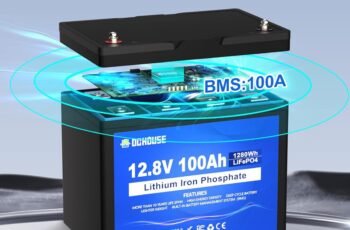
? Are we ready to see whether the Norsk Lithium 12V 120AH Heated Marine Lithium Cranking Battery | 900 CCA | LiFePO4 | Triple Terminals | Emergency Start Reserve | Deep Sleep | Bluetooth | 10+2 Year Warranty is the right choice for our boat, powersport vehicle, or emergency start needs?


Product snapshot and immediate impressions
We find this battery to be aimed squarely at anglers, boaters, and outdoor professionals who need reliable cold starts, lightweight weight, and robust durability. It combines LiFePO4 chemistry with an integrated heating system, a smart BMS, Bluetooth monitoring, and convenience features such as triple terminals and a claimed extended warranty. We like that the marketing emphasizes cold-weather reliability and ruggedness.
We should note an inconsistency in listings: the product name states 900 CCA, while some item descriptions claim 1200 CCA. That discrepancy matters for starting torque expectations, so we recommend confirming the exact CCA rating with the seller or the official spec sheet before purchase.
At-a-glance pros and cons
We’ll keep this quick for reference. The strengths are cold-start capability, long life, lightweight construction, and rugged IP67 protection. The trade-offs are cost compared with lead-acid, the need to verify alternator compatibility on some older charging systems, and having to confirm exact CCA specs due to listing inconsistencies.
Key specifications table
We’ve put the main specs into a compact table to make them easier to compare quickly. Where the listing is unclear, we note it.
| Specification | What the listing says / our note |
|---|---|
| Nominal Voltage | 12 V |
| Capacity | 120 Ah |
| Chemistry | LiFePO4 (Lithium Iron Phosphate) |
| Cold Cranking Amps (CCA) | Conflicting: product name lists 900 CCA; item description mentions 1200 CCA — confirm with seller |
| Heated | Integrated internal heating system (for subfreezing operation) |
| BMS | Smart Battery Management System with overcharge, over-discharge, short-circuit, low-voltage protection |
| Terminals | Triple terminals (for flexible wiring and dual connections) |
| Bluetooth | Yes — app monitoring and data reporting |
| Ingress Protection | IP67-rated (waterproof and dustproof) |
| Warranty | 10+2 Year Warranty (check terms — extra 2 years likely conditional on registration) |
| Weight | Significantly lighter than comparable lead-acid batteries (manufacturer: less than half weight; check spec sheet for exact pounds/kg) |
| Use cases | Marine cranking, powersports, emergency start reserve, general 12V systems |
Design and build: rugged and purpose-built
We appreciate that this battery is built with marine and harsh-environment use in mind. The IP67-rated housing means it tolerates immersion and dust, and the case is designed for vibration resistance. That matches what we’d expect for gear intended for boats and off-road equipment.
The triple terminal layout is thoughtful. When we wire a boat with multiple accessories and a starter lead, having multiple posts reduces the need for external distribution blocks and messy terminal adapters. It’s a convenience feature we value on cramped engine compartments.
Integrated heating system
Cold starts are commonly the largest failure mode for batteries in freezing weather. This model’s internal heating system is designed to maintain the cells at a safe temperature so they can deliver full power even below freezing. We like that no external heating pad or enclosure is required — that simplifies installation and reduces the potential for user error.
Practical note: the heating system itself will draw some power when active, so it’s worth understanding the conditions under which it engages and whether it draws from the battery or can be powered from an external source. Check the manual for activation thresholds and power draw specifications.
Smart BMS with voltage protection
Modern LiFePO4 batteries depend on competent battery management systems (BMS). This battery includes a BMS that protects against overcharge, over-discharge, short circuits, and low-voltage conditions. That gives us confidence for both safety and longevity.
We’d still recommend verifying how the BMS handles cell balancing and the thresholds for low-voltage disconnect and high-voltage cutoff. Those details determine whether, for example, the battery will let us finish a fishing day before disconnecting under a heavy load or will disconnect early to preserve cell health.
Capacity, weight, and lifecycle
The 120 Ah capacity positions this battery as a high-capacity option for cranking and cycling duties. LiFePO4 technology typically offers much more usable capacity than lead-acid at the same nominal rating because we can draw a greater percentage of the capacity without harming the cells.
We value that LiFePO4 cells are usually rated for thousands of cycles at moderate depth of discharge. The listing claims up to 5X the lifespan of lead-acid, which is in line with typical LiFePO4 performance. That contributes to a strong total cost of ownership argument when we consider replacement cycles.
Practical factors:
- Usable capacity: We can usually use roughly 80–100% of LiFePO4 rated capacity for many daily cycles. That means most of the 120 Ah is available to us compared to a lead-acid bank where we often limit draw to 50%.
- Weight savings: The battery is said to weigh less than half of comparable lead-acid units. For boats and powersports where weight matters, that helps performance and fuel economy.


Cold-weather performance and the heating advantage
Cold weather reduces available capacity and cranking performance for most batteries. This Norsk battery’s integrated heating system is a big selling point since it allows the cells to remain near optimal temperature and deliver dependable starts.
We appreciate the convenience of internal heating: no extra heater or enclosure required, and the system is designed to heat safely. For anyone operating in subzero climates or storing craft outdoors in winter, this feature significantly reduces the risk of a no-start.
Practical tip: Even with an internal heater, we recommend storing the battery partially charged if it will sit unused for extended periods in freezing conditions. The BMS protects cells, but best practice extends lifespan.
Starting power: understanding the CCA confusion
The listing presents conflicting CCA figures: 900 CCA in the product name but 1200 CCA in item details. Cold Cranking Amps is a critical spec for starting high-compression engines and many marine motors. We recommend the following steps before purchase:
- Confirm the precise CCA with the seller or manufacturer spec sheet.
- Match the advertised CCA to the engine’s cranking requirements. If the engine manufacturer recommends a certain CCA for reliable starts in cold conditions, choose a battery that meets or exceeds that recommendation.
- If the shipping page claims 900 CCA and the product listing claims 1200 CCA, treat the higher number cautiously until it’s verified.
If the battery truly delivers 1200 CCA, that’s outstanding for a 12V LiFePO4 120Ah battery and gives us a strong margin for starting. If it’s 900 CCA, that’s still ample for many boats and powersport engines, but larger high-compression diesels or big V8 outboards may require closer scrutiny.
Emergency Start Reserve and Deep Sleep modes: what they mean for us
The listing highlights “Emergency Start Reserve” and “Deep Sleep” — features that often add practical resilience.
-
Emergency Start Reserve: This typically means the battery’s BMS will preserve a reserve charge specifically to be recaptured for a starting event. In practice, that helps ensure we don’t lose starting capability due to accessory drains during storage or a long idle period. We should check how much reserve is preserved and how the BMS manages access to it.
-
Deep Sleep: Deep sleep is a low-power mode that reduces parasitic drains to preserve battery capacity during long-term storage. It’s useful for seasonal storage or boats that sit idle for weeks. We appreciate this because it reduces the need for manual disconnects or trickle chargers, but it’s important to know how the battery wakes from deep sleep (for example, by charging voltage or by a dedicated wake wire).
Check the manual or ask the seller:
- What triggers deep sleep?
- How long will deep sleep preserve the battery?
- How does the BMS allow wake-from-deep-sleep for an emergency start?
Bluetooth monitoring: useful data at our fingertips
We like Bluetooth-enabled batteries because they let us monitor state-of-charge, voltage, current, cell balance, and temperature from a phone. That’s helpful for pre-trip checks and for diagnosing issues in the field.
Things we look for in the Bluetooth implementation:
- Clear app interface that shows state-of-charge and voltage in real time
- Logging or history features to review past charge/discharge cycles
- Alerts for events like low voltage, high temperature, or BMS disconnects
- Reliability of connection and whether the app requires internet access
We recommend downloading the app and checking the UX before field deployment. Bluetooth is convenient, but it shouldn’t be our only means of monitoring critical systems.

Installation and wiring considerations
Installing a battery with triple terminals gives us flexibility. We typically use one terminal for the starter cable and the other(s) for accessory power or trolling motor feeds. That reduces the need for messy distribution blocks.
Practical installation tips:
- Use appropriately sized cable for cranking leads — undersized cable can rob cranking power and create voltage drop.
- Tighten terminals to torque specs in the manual. Over-tightening or using the wrong hardware can damage the terminal studs.
- Ensure the battery is secured using the manufacturer’s recommended clamp or bracket. LiFePO4 batteries can be physically smaller than lead-acid, so pick a mounting solution that fits the case and prevents movement under vibration.
- If the battery has a dedicated wake or heater control wire, route it carefully and protect it from chafe.
Charging and alternator compatibility
Charging LiFePO4 differs from lead-acid and AGM. The battery’s smart BMS will manage protection, but feeding it the correct charging profile optimizes charge speed and longevity.
General guidance:
- Bulk/absorption voltage for LiFePO4 typically ranges around 14.2–14.6 V. Float charging is usually not required and may be lower than lead-acid float voltages.
- Many modern multi-stage chargers include a LiFePO4 setting. If your charger has a programmable voltage profile, set it for LiFePO4.
- Alternators: Most direct-charge alternators will work, but some older or unregulated alternators produce voltages that may be too high. If the alternator voltage exceed the battery’s max charging voltage, the BMS will limit or disconnect charging, but that could lead to undercharging or frequent BMS tripping. Consider an alternator regulator compatible with LiFePO4 or a DC-to-DC charger if you have an older craft.
- Balancing charge: LiFePO4 cells rarely need equalization in the way lead-acid does, but a proper full charge at the correct voltage helps cell balancing over time.
We recommend reading the battery manual for the recommended charging voltages and limits. If the manual is unclear, contact the manufacturer.
Safety: inherent chemistry advantages and BMS role
LiFePO4 chemistry is generally safer thermally than other lithium chemistries; it’s less prone to thermal runaway. The included smart BMS adds an essential layer of protection against overcharge, over-discharge, short circuits, and low voltage.
That said, safe installation best practices still apply:
- Use appropriate fusing close to the battery to protect wiring.
- Avoid welding or drilling near the battery terminals once installed.
- Ensure ventilation for area where charging occurs (although LiFePO4 emits no hydrogen gas like lead-acid under normal operation, charging environments still benefit from ventilation).
- Follow the manufacturer’s instructions for disposal or recycling.
Durability: IP67, vibration resistance, and marine readiness
The IP67 rating means the battery is dustproof and can handle temporary immersion in water. For marine users, that’s a reassuring spec. Vibration resistance is also essential for outboard-mounted batteries or boats that see a lot of chop.
We still recommend locating the battery where it’s shielded from direct seawater spray and where terminals are not easily shorted by loose tools or metal hardware.
Warranty: understanding 10+2 years
The listing advertises a “10+2 Year Warranty.” In our experience, such warranties often mean a base warranty of 10 years with a conditional 2-year extension if the product is registered or if certain usage conditions are met. Warranty terms often have conditions:
- Warranty may apply only to the original purchaser.
- Registration within a limited period may be required for the extra coverage.
- Certain misuse, modifications, or lack of proper charging may void coverage.
We strongly advise reading the warranty document and asking the seller exactly what is covered, how to register the battery, and what claims procedure applies. Extended warranties are valuable but only if the conditions are feasible for our use.
Comparison: LiFePO4 vs AGM vs Lead-Acid for marine cranking
We’ll highlight the key differences in a compact table to help weigh options.
| Characteristic | LiFePO4 (this battery) | AGM | Flooded Lead-Acid |
|---|---|---|---|
| Weight | Much lighter (often <50% of lead-acid)< />d> | Heavier than LiFePO4, lighter than flooded | Heaviest |
| Usable capacity | High (80–100% usable) | Moderate (50–70% usable) | Low (50% recommended) |
| Cycle life | Very long (1000s cycles) | Moderate | Shorter |
| Cold cranking | High CCA possible; heating system improves cold use | Good CCA, degrades in cold | CCA reduced in cold; may need more capacity |
| Charging | Requires LiFePO4 profile for optimal life | Standard multi-stage chargers work | Standard chargers, equalization may be needed |
| Safety | Stable chemistry, BMS protected | Stable but can vent | Can vent hydrogen during charge |
| Cost | Higher upfront, lower TCO due to life | Mid-range | Cheapest upfront |
We find that for frequent use, weight-sensitive applications, or where reliability in cold is important, LiFePO4 offers a compelling advantage despite a higher purchase price. If budget is the primary concern for infrequent use, an AGM or lead-acid battery might be acceptable.
Real-world scenarios: how we’d use this battery
We like this battery for several specific applications:
- Bass boats and center consoles where weight matters and cold starts are critical in early-season fishing.
- Snowmobiles and sleds where deep cold can kill conventional batteries.
- Emergency start reserves in vehicles and marine craft that are stored outside for long periods.
- Hybrid systems where the battery serves both cranking and cycling duties (trolling motor and accessories).
We’d pair the battery with a LiFePO4-compatible charger for shore power charging and consider a DC-to-DC charger for alternator-based charging if our boat has an older alternator or complex charging system.
Installation checklist
Before we bolt this into our vessel or rig, here are the steps we follow:
- Confirm CCA and specs from the seller to match our engine’s starting requirements.
- Read the manual for terminal torque, heater wiring, and BMS wake/sleep behaviors.
- Choose correct gauge wiring for starter and accessory circuits.
- Install fuses or circuit breakers close to the positive terminal.
- Secure the battery with a suitable bracket or strap rated for marine vibration.
- Configure charger/alternator charging profile to LiFePO4 settings.
- Test Bluetooth connection and confirm reading of state-of-charge and alerts.
Maintenance and long-term care
One of the advantages of LiFePO4 is low maintenance compared with flooded lead-acid. Still, we recommend:
- Keeping terminals clean and corrosion-free; use dielectric grease if appropriate.
- Avoiding prolonged storage at extremely low state-of-charge — partial charge storage is best.
- Periodically checking Bluetooth app logs and state-of-charge before extended trips.
- Ensuring firmware updates for BMS if provided by the manufacturer.
Common questions we anticipate (FAQs)
Q: Will this battery work with my existing 12V charger? A: Many chargers will charge a LiFePO4 battery, but the optimal charging voltages differ. Use a charger with a LiFePO4 setting or programmable voltage to ensure best results.
Q: How does the heater affect capacity? A: The heater draws power to keep the cells at operating temperature. The BMS typically limits heater operation to necessary conditions. For extended cold storage, consider an external power source or shore power to supply the heater without depleting the main capacity.
Q: Can we parallel multiple units for more capacity? A: Many LiFePO4 batteries can be paralleled, but we should confirm with the manufacturer’s documentation about permitted configurations and balancing requirements. The BMS and Bluetooth monitoring may not be designed to manage multiple batteries without a proper parallel setup.
Q: What does “Deep Sleep” mean for how quickly the battery will start an engine after long storage? A: Deep Sleep preserves battery life by lowering standby power consumption. The battery’s design should allow wake-up via charging voltage or a specific wake input, but exact behavior varies — read the manual.
Pros and cons (summary)
We’ll summarize the most important trade-offs we noticed.
Pros:
- Integrated heater for reliable cold-weather starting.
- LiFePO4 chemistry for long life and high usable capacity.
- Triple terminals for flexible wiring.
- Bluetooth monitoring for convenient diagnostics.
- IP67 housing and vibration resistance for marine environments.
- Competitive long warranty (10+2 years) if terms are favorable.
Cons:
- Listing inconsistency on CCA requires verification.
- Higher upfront cost vs AGM or flooded lead-acid.
- Need to ensure charger/alternator compatibility for best life.
- Warranty conditions may require product registration and adherence to usage guidelines.
Final verdict: who should buy this battery?
We think the Norsk Lithium 12V 120AH Heated Marine Lithium Cranking Battery is an excellent choice for users who:
- Need dependable cold-weather starting (ice anglers, northern boaters, snowmobile riders).
- Want to reduce weight without sacrificing cranking power.
- Value the long lifecycle and lower total cost of ownership over many seasons.
- Appreciate Bluetooth monitoring and integrated protection features.
We caution buyers to verify the exact CCA with the seller, confirm charging compatibility with their onboard systems, and read the warranty terms carefully. When those items line up, this battery looks like a strong performer in demanding marine and powersport applications.
Closing considerations and practical next steps
If we’re considering this battery for our setup, our recommended next steps are:
- Confirm the true CCA rating on the official spec sheet or manufacturer website.
- Review the charging voltage and alternator compatibility recommendations in the manufacturer manual.
- Check the warranty fine print and register the product if required for extended coverage.
- Plan wiring and mounting with proper cables, fuses, and a secure bracket.
We like the combination of heating, robust BMS, Bluetooth, and marine-grade build. Once the CCA clarification is resolved and charging strategy is set, this battery delivers the features we want for cold-weather and high-reliability starting in a lightweight package.
Disclosure: As an Amazon Associate, I earn from qualifying purchases.