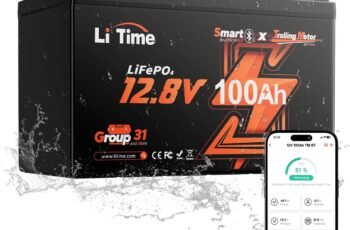
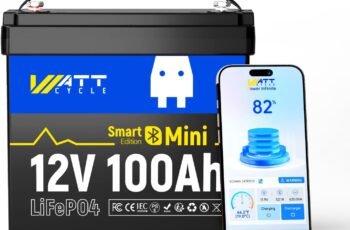
?Have we found a lithium battery that really meets the needs of our RV, solar system, or boat?

Overview of LOSSIGY 12V 280AH LiFePO4 Lithium RV Battery
We want to summarize what this battery claims and why it might matter to us. The full product name is LOSSIGY 12V 280AH LiFePO4 Lithium RV Battery, Perfect for Solar System, Marine, 2560Wh 5000+ Deep Cycles, Built in BMS with 10 Yrs Lifespan, and it aims to replace heavy lead-acid banks while offering longer life and higher usable capacity.
We note some inconsistencies across the listing details (which we address below), but the core selling points are: high-capacity 12V 280Ah (LiFePO4 chemistry), built-in BMS (battery management system), long cycle life, suitability for solar/RV/marine applications, and apparent support for series/parallel connections to create larger battery banks.
Key selling points in plain terms
We see several promises here: grade-A cells, long cycle life (multiple thousand cycles and a 10-year lifespan claim), robust BMS protections (over-charge, over-discharge, short-circuit, over-current, thermal), and simplified installation compared with lead-acid batteries. Those are exactly the types of features we look for when upgrading a mobile or off-grid power system.
How the specs line up — and what to verify
We like clear numbers, but the listing includes some contradictions that we should clarify before purchasing. We will break down the numbers and point out what to confirm with the seller.
Below is a quick reference table summarizing the key claims and our recommended verification points.
| Item | Listing Claim(s) | Our Practical Note — What to Verify |
|---|---|---|
| Nominal Voltage | 12V | Standard for many RV/inverter systems — check compatibility. |
| Capacity | 280Ah | Large capacity — confirm actual tested Ah at nominal voltage. |
| Energy (Wh) | 2560Wh (in title) | Inconsistent: 12V × 280Ah = 3360Wh. Verify which figure is correct. |
| Cycle Life | 5000+ deep cycles (title) / at least 4000 cycles (product details) | Expect 4,000–5,000 cycles under ideal conditions; confirm test conditions (DoD, temperature). |
| Chemistry | LiFePO4 (LFP) Grade-A cells | Positive — LiFePO4 is stable and long-lived. Ask for cell supplier/grade confirmation. |
| BMS | Built-in — protects from high/low temp, short circuit, over-current, overload, auto balancing | Good feature; request BMS specs: max charge/discharge current, balancing method, communication ports (CAN/RS232/LED). |
| Series/Parallel | Safe for series/parallel connections for 48V banks | Confirm manufacturer’s limit on number of batteries in series/parallel and recommended matching. |
| Warranty/Support | 90-day after-sales + 24-hour online technical support | Basic support; ask about full warranty duration and terms (10-year lifespan claim vs warranty length). |
| Applications | RV, solar, marine | Fits those uses if form-factor and mounting suit our equipment. |
We recommend confirming the exact rated energy (Wh) and continuous/discharge current specs before ordering. Those two differences (Wh figure and cycle count) are common in product listings but important for system design.


Practical energy math — how much usable power can we expect?
We like to do some realistic calculations so that we can plan system size, solar array, inverter, and expected runtime for appliances.
We’ll present a few scenarios based on the two energy figures presented in the listing and on typical LiFePO4 usable depth-of-discharge (DoD).
- The listing shows 12V and 280Ah. That mathematically equals 12 × 280 = 3360Wh (3.36 kWh) of stored energy. That is the theoretical total energy.
- The title claims 2560Wh. If the manufacturer is quoting usable energy at a particular DoD or a different nominal voltage, this might explain the lower number. We should confirm what they mean.
Estimated usable energy based on typical LiFePO4 DoD:
- If we use 90% usable DoD (common for LiFePO4), usable energy = 3360 × 0.9 ≈ 3024 Wh.
- If we use 80% usable DoD (a cautious approach), usable energy = 3360 × 0.8 ≈ 2688 Wh.
If the battery truly provides only 2560Wh usable (as title suggests), that corresponds to roughly 76% usable of the 3360Wh theoretical total. So expectations will vary depending on which figure is accurate.
We should verify the nominal voltage and the manufacturer’s definition of Wh to avoid undersizing our solar or inverter system.
Example runtimes (approximate)
We like to run a few typical loads to get a feel for runtime:
- Small 300W AC fridge (around 50W–60W average while cycling): If average draw is 60W, 3024Wh usable would run it for ~50 hours.
- 1000W microwave (short bursts): Running a microwave at full power uses 1000W; 3024Wh would run 3 hours at continuous draw — but microwaves are short, so we can run many cycles.
- 300W DC appliances (fans, lights, laptops): 3024Wh / 300W ≈ 10 hours.
Remember these are simplified estimates; real-world efficiency losses (inverter, wiring, battery internal resistance) reduce real usable hours.
Battery Management System (BMS) — what the listing promises
We value an internal BMS. The listing describes LOSSIGY’s BMS as composed of high-end chips with automatic cell balancing and protections for temperature extremes, short circuit, over-current, and overload. It also says batteries can be safely connected in parallel or series.
We appreciate that the manufacturer emphasizes automatic balancing and safety protections, because these directly affect longevity and safe operation in multi-battery setups. However, we should ask for more technical details: maximum continuous charge/discharge current allowed by the BMS, cutoff voltages, balancing current, communication interfaces (CAN/RS485/LED), and the maximum recommended number in series/parallel.
Why BMS details matter
We like to ensure that the BMS can handle our system’s peak draws and charging sources. For example, if we plan to run a 3,000W inverter, the battery and BMS must be rated for the peak discharge current. Without specific continuous and peak current ratings, we would be cautious about pushing the battery for heavy loads.

Installation and handling — easier than lead-acid?
The listing states the LOSSIGY 12V 280Ah LiFePO4 battery is easier to install and move compared to traditional series lead-acid batteries. We appreciate that claim, because mobility and ease of installation are common reasons to switch to LiFePO4.
We should expect:
- A lighter weight compared to an equivalent lead-acid bank (LiFePO4 typically weighs roughly 40–60% of an equivalent flooded lead-acid bank).
- No need for equalizing charges or topping up electrolyte (no ventilation needed for off-gassing under normal conditions).
- The capacity in a single 12V 280Ah battery replaces multiple lead-acid batteries wired in series/parallel for similar usable energy.
Always confirm the physical dimensions and weight before buying, and make sure mounting points and space in our RV/boat/battery cabinet will accommodate the battery. Also check terminal type and torque specs for safe installation.
Wiring best practices
We recommend:
- Using appropriately sized cables for current demands and voltage drop.
- Fusing close to the battery positive terminal for each string.
- Ensuring proper ventilation (even though LiFePO4 is safer, heat still matters) and secure mounting to prevent movement.
- Matching batteries when connecting in series/parallel: same model, same age, and ideally from the same production batch.
Safety and environmental factors
We like LiFePO4 for safety: the chemistry is much more thermally stable than other lithium chemistries, and the BMS is designed to protect the battery from many fault conditions. The listing includes protection from high/low temperature, short circuit, over-current, and overload.
We still want to follow best practices:
- Keep batteries within manufacturer-recommended temperature ranges during charge/discharge and storage.
- Avoid physical damage to the cells or exposure to prolonged high heat.
- Use a charger or solar charge controller programmed for LiFePO4 charging profile to prevent unnecessary cycles or premature aging.
Charging profile recommendations (general)
While the listing does not provide explicit charge voltages, typical LiFePO4 charging parameters are:
- Bulk/absorption charge voltage: around 14.2V–14.6V for a 12V bank.
- Float voltage: usually not required; if used, keep near 13.4V–13.6V.
- Maximum charge current: confirm with seller/BMS; typically banks of this size might support 0.5C–1C continuous charge if the cells and BMS allow it (for 280Ah, 0.5C = 140A).
Always verify exact recommended values with the manufacturer or product manual.

Longevity and cycle life — what to expect
The title claims “5000+ deep cycles” and “10 Yrs Lifespan,” while product details say “at least 4000 cycles.” We interpret this as a manufacturer positioning the battery for multi-thousand cycle life. We expect real-world cycle life to depend on depth-of-discharge (DoD), temperature, charge rates, and usage patterns.
We think a reasonable expectation is:
- 4,000–5,000 cycles when cycled at moderate DoD (50%–80%) under favorable conditions.
- If we operate at lighter DoD with good thermal management, those cycles could translate to many years of daily use—thus supporting the 10-year lifespan claim in many scenarios.
We recommend setting expectations conservatively and assuming around 4,000 cycles unless the seller provides detailed cycle testing conditions.
How DoD affects lifespan
We know that LiFePO4 holds up well to deeper cycles compared with lead-acid, but cycling to full depth repeatedly will still shorten life relative to shallow cycling. If we want to maximize lifespan, cycling no lower than 20% state of charge (SoC) and avoiding extreme temperatures will help.
System design suggestions — pairing with inverters and solar
We like batteries that integrate well into a broader system. The listing claims the battery is “perfect for solar system, marine” and implies it can be used in 48V banks via series connections.
Our suggestions:
- If we plan to use an inverter, make sure the inverter’s DC input matches 12V nominal systems or that we configure a 48V bank correctly by wiring four batteries in series (only with manufacturer approval).
- Choose a solar charge controller with an LiFePO4 charging profile or a programmable controller capable of matching the battery charging voltages.
- If connecting multiple batteries, use identical batteries and follow the manufacturer’s guidelines on series/parallel limits.
Recommended steps before finalizing system size
We like to perform these checks:
- Confirm continuous and peak discharge current ratings of the battery/BMS.
- Confirm recommended max charge current and charging voltage.
- Calculate daily energy needs (Wh) and match the usable battery capacity to those needs with a safety margin.
- Size solar array and charge controller to replace used energy in typical sunlight hours plus account for cloudy days.

Pros and cons — a balanced look
We always weigh positives and negatives before committing to a large battery purchase.
Pros:
- High nominal capacity (280Ah) in a single 12V unit, simplifying installations.
- LiFePO4 chemistry offers long cycle life (thousands of cycles) and stable thermal performance.
- Built-in BMS with auto-balancing and multiple protections improves safety and longevity.
- Easier handling and installation than multiple lead-acid batteries.
- Can be configured for larger voltage banks (48V) if series/parallel wiring is supported.
Cons / caveats:
- Listing inconsistencies (Wh, cycle count) require verification before purchase.
- The product’s advertised after-sales support is fairly short (90 days worry-free followed by 24-hour online support), so warranty terms should be clarified.
- The product details do not appear to list continuous/peak discharge currents and exact temperature operating ranges; we should request those before system design.
- LiFePO4 typically has lower low-temperature charging ability (charging below ~0°C can be restricted; BMS may block charging in sub-zero temps).
Who should consider this battery?
We think this battery fits several kinds of users:
- RV owners who want to replace heavy lead-acid banks with a higher-capacity, lighter lithium option.
- Off-grid solar users needing a large 12V bank for AC loads via inverters.
- Marine users who need a stable battery for trolling motors, house loads, and electronics.
- Anyone wanting a single-battery solution instead of multiple lead-acid batteries wired together.
We do not recommend buying without clarifying specs if:
- You require high continuous discharge currents (e.g., heavy inverter use) and the seller cannot confirm discharge current specs.
- You need a long warranty explicitly spelled out (we advise confirming warranty length and terms).
Installation tips and a checklist
We like checklists because they reduce mistakes. Below is a practical installation checklist we’ll use if we buy this LOSSIGY battery.
- Confirm exact physical dimensions, weight, and terminal types fit our space and racks.
- Verify energy (Wh), continuous/peak current specs, charge voltage, and temperature ranges in writing.
- Plan cable sizes based on peak current and acceptable voltage drop; use proper crimping and terminal protection.
- Install an appropriate DC main fuse or circuit breaker near the battery positive terminal.
- Ensure good ventilation and avoid direct exposure to heat sources; secure battery to prevent movement while traveling.
- Use a compatible charger or solar charge controller set to LiFePO4 profile.
- If paralleling/series-connecting, use identical batteries and follow manufacturer recommendations on maximum number and wiring layout.
Maintenance and long-term care
We prefer low-maintenance batteries, but there are still best practices.
- Periodically check terminal tightness and for any signs of corrosion.
- Store batteries at around 40%–60% state of charge if not used for extended periods.
- Avoid leaving the battery fully discharged for long-term storage.
- Keep firmware or BMS settings up to date if the manufacturer provides updates or service options.
- If using in cold climates, be aware the BMS may limit charging below freezing; consider battery heating solutions if needed.
Comparison with lead-acid batteries
We like to contrast real benefits to justify the upgrade.
- Weight: LiFePO4 is significantly lighter than flooded or AGM lead-acid for the same usable energy.
- Usable capacity: LiFePO4 allows higher usable DoD (often 80–90% usable) vs lead-acid’s typical 50% usable without drastically shortening life.
- Cycle life: LiFePO4 offers thousands of cycles vs lead-acid’s few hundred to ~1,000 cycles depending on depth of discharge.
- Maintenance: No watering or regular equalization required for LiFePO4, and no hydrogen off-gassing under normal conditions.
- Cost: LiFePO4 is more expensive up-front but generally cheaper long-term per cycle and per usable Wh.
We believe most RVers and off-grid users find the performance and longevity advantages compelling enough to offset the higher initial cost.
Warranty, support, and manufacturer claims
The listing mentions LOSSIGY’s commitment: 90 days worry-free after-sales service and 24-hour online technical support. The product title also includes a “10 Yrs Lifespan” claim.
We recommend clarifying:
- Actual warranty period and what is covered (defects, capacity retention, BMS failures).
- How warranty claims are processed and whether the seller handles international service or returns.
- What the 10-year lifespan claim translates to in warranty terms — is there a prorated warranty or replacement policy?
We always prefer transparency and a full written warranty before committing.
Questions to ask the seller before buying
We like to prepare a short list of must-ask questions to remove ambiguity:
- Confirm the true energy rating: is usable Wh 2560Wh or is theoretical energy 3360Wh (12V × 280Ah)? Please explain the difference.
- What is the maximum continuous discharge current and peak (10s) discharge current?
- What is the maximum continuous charge current and recommended charge voltage?
- Which communication outputs does the BMS provide (CAN, RS485, Bluetooth, LED indicators)?
- What is the recommended number of batteries in series/parallel and any balancing recommendations?
- What are the operating and storage temperature ranges for charging and discharging?
- What is the exact warranty period and coverage details?
Requesting these answers up front will reduce surprises and help us size the rest of our system.
Realistic performance expectations — real-world notes
We expect actual performance depends on several variables:
- Temperature: colder temps reduce effective capacity and may restrict charging.
- Load profile: heavy bursts vs steady loads behave differently; BMS current limits could intervene.
- Aging: after thousands of cycles capacity will reduce; how much depends on DoD and charge rates.
We would plan conservatively when sizing the rest of our system, assuming some efficiency losses and aging.
Frequently asked questions (FAQ)
We like addressing common concerns up front so we can decide confidently.
Q: Can several of these batteries be connected in series to create a 48V bank? A: The manufacturer states they can be connected in series/parallel to form larger banks, including 48V. We should confirm the maximum number in series and the recommended balancing procedure.
Q: Can we charge these in freezing temperatures? A: LiFePO4 cells are sensitive to charging below freezing. The listing mentions low-temperature protection in the BMS; confirm whether the BMS will block charging below a specific temperature and whether an internal heater is included or recommended.
Q: Is this battery safe for indoor use in an RV or home? A: LiFePO4 is among the safest lithium chemistries and does not off-gas under normal conditions. With proper installation (fusing, ventilation, and mounting), indoor use is common. Confirm with the manufacturer and follow local codes.
Q: How much lighter is it than an equivalent lead-acid bank? A: The listing doesn’t state weight explicitly here. Typically LiFePO4 will be much lighter; get the exact weight to compare to our existing bank.
Our verdict and recommendations
We like what LOSSIGY is offering: a high-capacity 12V 280Ah LiFePO4 battery with a built-in BMS, long cycle life claims, and a focus on RV/solar/marine use. These features align with what we want in a modern lithium bank: higher usable capacity, less maintenance, and longer life.
However, we caution that some listing details conflict (Wh and cycle count) and essential specs (continuous/discharge currents, weight, dimensions, exact BMS parameters) are not listed. Before buying, we would request clarifications on those items and confirm warranty coverage in writing.
If the seller confirms continuous/peak currents suitable for our inverter and charging sources, and the Wh/capacity figures align with the mathematical 12V×280Ah, we would consider this a compelling option for upgrading an RV or off-grid setup.
Suggested rating (subject to verification)
- Features & safety: 8/10 (solid BMS claims, LiFePO4 chemistry)
- Value for capacity: 7/10 (large capacity; final value depends on confirmed Wh and warranty)
- Suitability for RV/solar/marine: 8/10 (designed for these uses, but confirm specs)
- Overall recommendation: Conditional Buy (pending confirmation of specs)
We feel comfortable recommending this model provided the seller clarifies the key electrical ratings and warranty terms before we finalize the purchase.
Final checklist before we buy
We’ll finish with a punch-list so we don’t forget anything important:
- Confirm true Wh rating and explain discrepancy in listing.
- Request continuous and peak discharge ratings and max charge current.
- Obtain BMS specifications (cutoff voltages, balancing, communication).
- Verify operating temperature ranges and whether charging is blocked below 0°C.
- Get exact physical dimensions and weight.
- Confirm warranty length, coverage, and service process.
- Ensure compatibility with our inverter, charge controller, and wiring.
If all the answers are satisfactory, we’ll proceed and expect a much lighter, longer-lasting, and more user-friendly battery bank for our RV, solar system, or boat.
Disclosure: As an Amazon Associate, I earn from qualifying purchases.