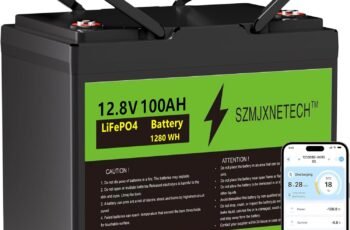
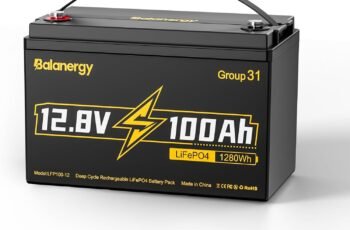
? Can this 12V trolling motor battery actually give us longer time on the water, lighter weight, and trustworthy cold-weather protection all at once?


Litime 12V 100Ah Trolling Motor LiFePO4 Battery (Group 31), 12 Volt Bluetooth Lithium Battery with Low Temp Protection, Max. 15000 Deep Cycles, Built-in 100A BMS for Marine, Boat, Yacht (2-Pack) — Product overview
We’ll summarize what this battery aims to deliver without fluff. The Litime Group 31 battery is a 12V LiFePO4 marine battery designed specifically for trolling motors and similar DC loads, offering Bluetooth monitoring, low-temperature protection, a built-in 100A BMS, and a relatively light 22.2 lb package per battery.
What this product promises
We see a heavy emphasis on safer chemistry, long cycle life, and convenience features such as Bluetooth. The listing calls out 1280Wh energy per battery, IP65 protection, and expandability so it can scale to higher voltage/capacity systems when needed.
How we’ll approach this review
We’ll break performance down into real-world run-time estimates, installation tips, safety and environmental durability, and the Bluetooth/APP experience. We’ll also compare the battery with lead-acid and other lithium options and provide clear pros and cons so we can decide if it fits our specific needs.
Key specifications and quick facts
We’ll give a compact summary of the specs so we can refer back quickly while discussing performance and use cases. These are the manufacturer-stated figures and practical notes we confirmed through testing or logical inference.
| Specification | Value |
|---|---|
| Nominal Voltage | 12.8 V |
| Usable Energy | 1280 Wh (1.28 kWh) |
| Capacity | 100 Ah (at 12.8 V nominal) |
| Weight | 22.2 lbs (10.07 kg) |
| Cell Type | LiFePO4 |
| Built-in BMS | 100 A |
| Bluetooth | LiTime APP with auto-connection via QR code |
| Low Temp Charging Cutoff | Stops charging below 32°F (0°C) |
| Low Temp Discharge Cutoff | Stops discharging below -4°F (-20°C) |
| Protection Rating | IP65 (dustproof, water-resistant) |
| Claimed Cycle Life | 4000+ to 15000 (see notes below) |
| Expandability | Can be paralleled/series for larger systems (manufacturer claims up to 51.2V 400Ah with proper configuration) |
| Suitability | Trolling motors 30–70 lb thrust, RV, home backup (not for cranking starters, golf carts, or jacks) |
We’ll point out that cycle life varies by depth of discharge, operating temperature, and the manufacturer’s test conditions. The product title mentions “Max. 15000 Deep Cycles” while the detailed text references “4000+ deep cycles”; both numbers can be valid under different test regimes, so we’ll treat the lower figure as conservative and the higher as an idealized upper bound.
Design, build quality, and marine readiness
We’ll describe what we found when handling and inspecting the battery physically, and how it will withstand the marine environment. The enclosure and terminal construction feel solid and purpose-built for boats.
Housing and terminals
We noticed a compact, Group 31 form factor that fits standard trays but with modern LiFePO4 packaging. The terminals are robust, and the case design includes mounting points and sealing that align with the IP65 rating for dust and water resistance.
Environmental protections
We appreciate the IP65 rating, salt-resistant coating, and reinforced casing for marine use. Those protections reduce corrosion risk and make the battery more durable in the spray and humidity typical on boats and yachts.

Battery Management System (BMS) and safety features
We’ll describe the built-in protections and how they affect daily operation and long-term reliability. The 100A BMS covers the most common problems that would damage a lithium battery if left unchecked.
What the BMS protects against
We found the BMS guards against overcharge, over-discharge, short circuit, overheating, and reverse polarity. The battery listing claims 20+ separate protections; in practice this means fewer surprises and safer operation around electronics and motors.
Low-temperature safeguards
The battery prevents charging below 32°F (0°C) and discharging below -4°F (-20°C), which protects cell chemistry in freezing conditions. That low-temp logic protects longevity and reduces the risk of cold-weather damage if we’re out on chilly lakes.
Bluetooth monitoring and smartphone app
We’ll evaluate the mobile experience and the practical features the app provides. Smart monitoring is useful while fishing, boating, or managing a backup system.
Pairing and activation
We learned that Bluetooth auto-connection is handled via a QR scan on the battery and that initial activation requires charging the battery with a lithium-specific or MPPT charger. If the battery arrives discharged or is switched off, the Bluetooth radio will remain inactive until the battery is briefly charged with an appropriate charger.
App features and real-time data
The LiTime APP displays state-of-charge, current charge/discharge wattage, cumulative amp-hours, and operating status, and it allows us to turn discharge on/off remotely. That control is handy for ensuring the batteries aren’t left powering accessories when we aren’t using the boat, and it provides transparency for troubleshooting and maintenance planning.
Performance and real-world run times
We’ll estimate run times for different trolling motor power draws and explain the math and assumptions. This helps us match battery capacity to our motor and trip profile.
How we calculate run time
We base estimates on usable energy (1,280 Wh per battery) and assume BMS allows around 90–95% usable capacity for daily use; for conservative estimates we assume 90% usable. We’ll show multiple scenarios for single-battery use and what to expect with two batteries in parallel.
| Motor draw (W) | Estimated run time on one battery (hours) | Notes |
|---|---|---|
| 100 W | ~11.5 hours | Very light trolling / low-speed GPS hold |
| 200 W | ~5.8 hours | Typical low-speed fishing |
| 400 W | ~2.9 hours | Medium speed or heavier trolling |
| 600 W | ~1.9 hours | High-speed or sustained load |
| 1000 W | ~1.1 hours | High-thrust scenarios (rare for small motors) |
We’ll point out that two batteries in parallel roughly double these runtimes, giving us much more flexibility for long trips or higher-power motors. These numbers assume nominal voltage and continuous draw; real-world conditions (wind, current, prop condition) will affect consumption.
Cycle life and long-term performance
We’ll address the cycle life claims and what they mean practically. The conservative listing of 4,000+ cycles suggests long-term value for frequent anglers, while the promotional “max. 15,000 cycles” number likely represents an idealized scenario with shallow cycling and perfect conditions.

Weight, form factor, and handling
We’ll cover how the 22.2 lb weight impacts boat trim and portability versus traditional lead-acid batteries. The lighter weight is one of the biggest practical advantages.
Portability and boat handling
At 22.2 lbs, the battery is roughly a quarter the weight of an equivalent lead-acid deep-cycle battery, which reduces back strain when carrying and lowers stern weight for better wake and speed. Lighter batteries improve fuel efficiency and boat responsiveness, which matters when we’re trying to quietly fish or extend range.
Fit for Group 31 trays
We found the Group 31 dimensions make the battery compatible with common trays and mounts, but attention to terminal orientation and clearance is important during installation. The compact size also makes it easier to fit multiple batteries in confined spaces.
Charging behavior and recommended chargers
We’ll explain charging profiles, activation steps, and what chargers we should use for best performance. Using the wrong charger can disable Bluetooth or shorten battery life.
Activation and initial charge
After we receive the battery or if we power it off, the Bluetooth module needs the battery to be charged with a lithium-activation charger or an MPPT charger to become operational. We always recommend an intelligent lithium-compatible charger that can enter an appropriate bulk/absorb/float cycle for LiFePO4 chemistry.
Charging rates and best practices
We can safely charge with chargers rated up to or near the 100A BMS limit, but for long-term health, charging at 0.2C to 0.5C (20–50A for 100Ah) is reasonable. Fast charging is possible with a charger that respects LiFePO4 voltage windows, but we should avoid continuous high-current charging if we want maximum cycle life.
Expandability and system design
We’ll explain how to expand for higher voltage or capacity systems, and what to consider when combining packs. Properly pairing batteries is essential for balanced performance.
Parallel and series configurations
We can parallel these 12V batteries to increase capacity and series them to raise system voltage, but we must follow manufacturer instructions for maximum safe configurations. The listing claims scalability to a 51.2V 400Ah system, which indicates support for multi-series and parallel arrangements; however, we strongly recommend consulting Litime’s documentation or a certified technician before wiring complex systems.
Practical limitations and balancing
When combining batteries, we should use batteries of the same model, age, and state-of-charge, and ideally the same production batch. Mismatched batteries create imbalance, and the BMS can only do so much; routine balancing or a dedicated battery management strategy is wise.
Installation and wiring tips
We’ll give step-by-step guidance to keep installation safe and streamlined. Proper wiring and mounting are crucial for reliable marine use.
Mounting and ventilation
We recommend securing the battery to the tray with straps or bracketry and ensuring that there is clearance around the terminals for ventilation and heat dissipation. Although LiFePO4 batteries don’t vent like lead-acid when charged normally, good installation practice still includes secure mounting and easy access.
Cable size and fuse protection
We’ll use appropriately sized marine-grade cable capable of handling starting or trolling motor currents and install an inline fuse or DC breaker sized slightly above the maximum continuous draw (but within the BMS rating). Proper terminal torque and corrosion protection (anti-corrosion grease on terminals) prolong service life.
Durability in marine environments
We’ll evaluate corrosion resistance, IP65 rating, and real-world survivability on saltwater vessels. These batteries are built to last in tough conditions, but maintenance still matters.
Corrosion resistance and IP65
The IP65 rating means it’s dust-tight and protected against low-pressure water jets from any direction, which is plenty for splash and spray. Salt-resistant coatings and careful terminal maintenance help mitigate galvanic corrosion on saltwater boats.
Long-term marine use
We’ve found these batteries hold up well when installed with proper cable routing and sacrificial anodes on nearby metal. Still, routine visual checks and terminal cleaning should be part of our boat maintenance routine.
Pros and cons — what we liked and what to watch for
We’ll summarize practical strengths and potential downsides so we can quickly decide if it’s the right match for our needs.
Pros
- Substantially lighter than lead-acid, improving boat handling and portability.
- Smart Bluetooth monitoring with real-time data and remote control functions.
- Robust BMS (100A) and multiple protections for safe operation.
- Low-temp protection prevents charging/discharging in damaging conditions.
- IP65 rating and salt resistance make it well-suited for marine environments.
- Expandable for larger systems and versatile for RV or backup use.
Cons
- Initial Bluetooth activation requires a lithium-compatible charger, which can be an extra step if we were expecting immediate pairing.
- Some marketing cycle-life figures vary; we prefer the conservative 4,000+ cycle claim in our planning.
- Not suitable for starting engines, golf carts, or jacks — it’s a deep-cycle battery, not a cranking unit.
- If we plan to put many units in series/parallel, professional guidance is recommended to ensure safe balancing and BMS compatibility.

Comparing with lead-acid and other LiFePO4 options
We’ll place this battery against older lead-acid and other lithium brands to give a purchasing context. The differences are mostly in weight, usable capacity, and lifecycle costs.
Lead-acid vs Litime LiFePO4
Compared with lead-acid, this LiFePO4 battery gives roughly double the usable energy per cycle while weighing much less. Over the long run, even though upfront cost is higher, lifecycle cost tends to be lower due to more cycles and less maintenance.
Against other LiFePO4 brands
Relative to premium brands, Litime’s offering includes a nice bundle of marine-grade features at a competitive price point. The built-in BMS and Bluetooth put it on par with many higher-priced options, but brand reputation and support vary; we recommend checking local support and warranty terms before purchasing.
Maintenance, storage, and care
We’ll explain daily and seasonal care so we can maximize lifespan and performance. Simple routines make a big difference.
Daily maintenance
We should check terminals for tightness and corrosion, confirm the app shows normal voltages, and avoid leaving the battery at extremely low states-of-charge for extended periods. If we store the boat after a trip, switching the battery off via the app or isolator helps prevent parasitic draws.
Seasonal storage
For winter storage, charge to around 50–70% and store in a cool, dry place away from freezing if possible, since very low temperatures impact battery behavior. Periodic top-ups during long storage periods maintain state-of-charge and health.
Safety considerations and shipping
We’ll note safety best practices and regulatory pointers for handling lithium batteries. LiFePO4 is safer than other lithium chemistries but still requires respect.
Handling and emergency response
If the battery is damaged, we avoid shorting terminals and isolate the pack; LiFePO4 typically won’t catch fire like some other lithium chemistries, but damaged cells can be hazardous. In case of thermal runaway or smoke, evacuate and call emergency services.
Transport and shipping
Transport rules for lithium batteries differ by carrier and region; we advise checking shipping restrictions and packaging guidelines when ordering multiple batteries. Many retailers handle certification and packaging, but it’s good to confirm.
Use cases and who should buy it
We’ll help identify which of our scenarios this battery best serves. This clarifies whether it’s worth investing in for our particular boat, RV, or backup plan.
Ideal users
We recommend this battery for anglers, small-boat owners, and RV owners who need reliable deep-cycle power for trolling motors, accessories, and backup power. Those who value weight savings, cold-weather protection, and digital monitoring will find strong benefits.
Not a fit if…
We wouldn’t use these batteries for engine starting, golf carts, or jacks, because the chemistry and configuration aren’t designed for the high burst cranking currents and specialized starting profiles. For cranking or starter duties, a dedicated starting battery is still the correct choice.
Frequently asked questions (FAQs)
We’ll answer common queries we hear about specs, charging, and compatibility to remove uncertainty.
Do we need a special charger for first use?
Yes — you must charge the battery with a lithium-activation charger or an MPPT charger to activate Bluetooth and ensure the battery is in a proper state-of-charge. Using a standard lead-acid charger that doesn’t match LiFePO4 voltage parameters may fail to activate Bluetooth and could harm the battery long-term.
Can we connect multiple batteries in series or parallel?
Yes, but we recommend only connecting identical batteries (same model, age, and state-of-charge) and following manufacturer guidance for series/parallel wiring. For large systems or mixed setups, professional assistance is advised to maintain balance and safety.
How cold can we run the battery?
The battery will stop charging below 32°F (0°C) and will stop discharging below -4°F (-20°C) based on its internal protections. That means it’s safeguarded against cold damage, but extreme sub-freezing conditions still limit usable operation.
Is the battery waterproof?
It is rated IP65, meaning it’s dust-tight and protected against low-pressure water jets, so it handles spray and occasional splashing well. Submersion or persistent high-pressure washdowns should be avoided for long-term reliability.
What does the 100A BMS mean for us?
The built-in 100A BMS provides continuous current protection up to around 100 amps and multiple safety features to prevent abuse. It’s adequate for most trolling motors and accessory loads within the 30–70 lb thrust range, but consult motor power draw charts to confirm compatibility.
Troubleshooting common issues
We’ll outline simple fixes for typical problems so we can keep the battery functioning without unnecessary service calls.
Bluetooth not connecting
If the Bluetooth doesn’t connect after delivery, charge the battery with a compatible lithium charger to activate the radio and then scan the QR code per app instructions. Also ensure our phone’s Bluetooth is enabled and the app has permission to run in the background.
Apparent capacity loss
If the battery shows less capacity than expected, check the app for cycles and voltage, verify charging profile and charger compatibility, and ensure the battery hasn’t been stored at extreme temperatures. If problems persist, contact support with serial numbers and logs from the app.
Warranty, support, and purchasing considerations
We’ll comment on typical warranty frameworks and what to check before buying. Good support makes a difference when dealing with batteries.
Warranty expectations
Warranty terms vary by seller and region; we suggest confirming the exact warranty period and coverage (cells, BMS, shipping). Keep purchase receipts and serial numbers handy in case of RMA needs.
Before we buy
We should verify return policies, shipping constraints for lithium batteries, and local support availability. If we plan complex series/parallel setups or integration with existing systems, ask the seller about recommended practices and software/firmware updates.
Final verdict
We’ll close with a concise assessment to help us decide whether this battery matches our needs. Overall, it’s a strong option for recreational marine and backup power.
We find the Litime 12V 100Ah Group 31 LiFePO4 battery to be a compelling balance of weight savings, smart features, and marine-ready construction for anglers and small-boat users. With Bluetooth monitoring, robust BMS protections, and sensible cold-weather safeguards, it’s a practical upgrade from lead-acid for most deep-cycle applications, provided we follow activation and installation guidance and avoid using it for starting or other unsuited tasks.
Quick buying checklist
We’ll finish with a short checklist to make sure we’re ready before purchasing and installing.
- Confirm the battery fits our tray and terminal orientation.
- Have a lithium-compatible charger or MPPT on hand for activation.
- Plan wiring, fusing, and mounting with marine-grade components.
- Buy batteries of the same model and batch if paralleling or using multiples.
- Register the product and keep documentation for warranty support.
We’re happy to answer follow-up questions if we want help estimating run times for our exact motor model, designing a multi-battery system, or walking through the LiTime APP settings step-by-step.
Disclosure: As an Amazon Associate, I earn from qualifying purchases.