?Thinking about whether the “48V 100AH Lithium Battery for Golf Cart with 18A Charger, 48V Lithium Battery with 200A BMS, LCD & Mobile Monitor, 5.12kWh with 10.24kW Output, 1000A Peak Current for Golf Cart” is the right power upgrade for your golf cart or other electric projects?

Product overview
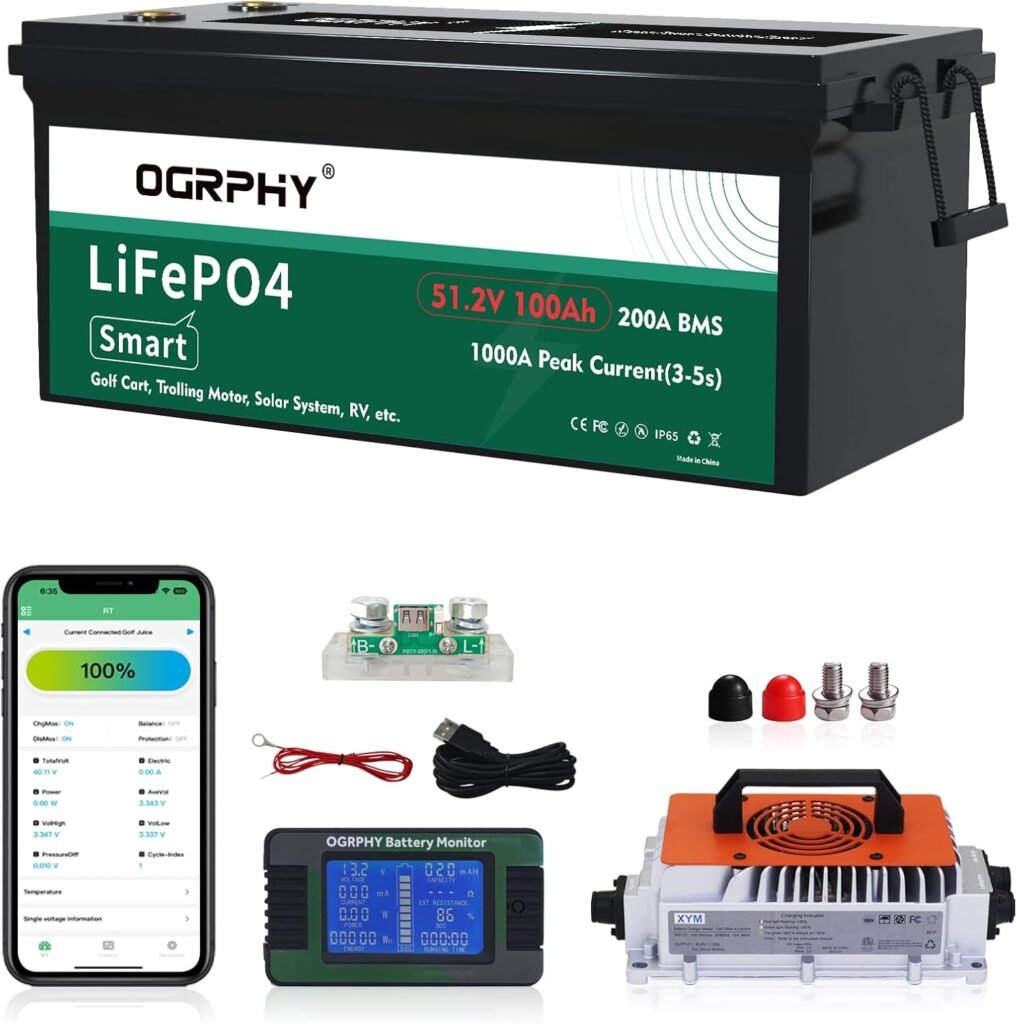
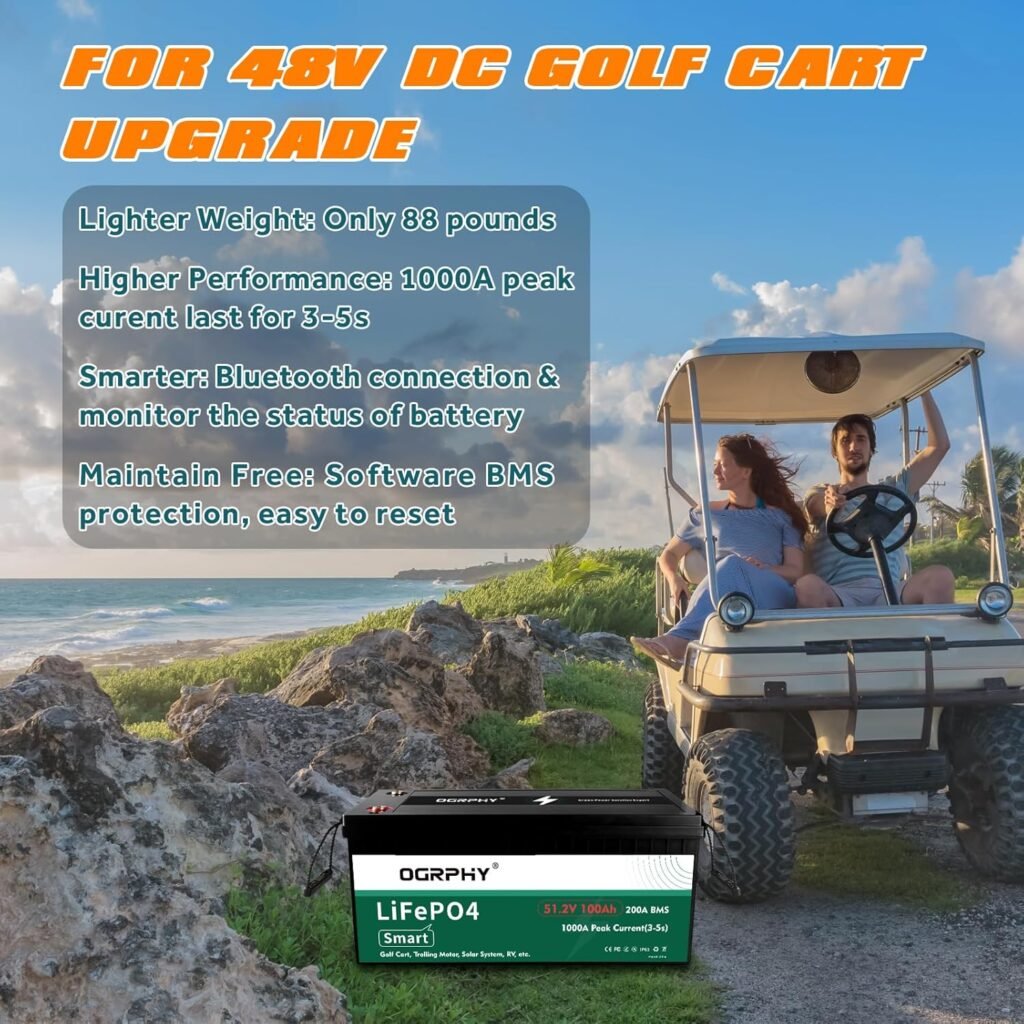
You’re looking at a 48V LiFePO4 battery pack rated 100Ah (5.12 kWh) that ships with an 18A charger, an LCD monitor, and Bluetooth-enabled BMS monitoring. The manufacturer emphasizes a long life (10 years and 5,000+ deep cycles) and an upgraded 200A Battery Management System (BMS) with generous short-duration peak current capability.
What this product promises you
This battery is designed to replace heavy lead-acid packs and give you more usable capacity, faster charging, and long-term cost savings. You’ll get active protection via the BMS, both an on-device LCD for local monitoring and a mobile app for Bluetooth telemetry so you can see voltage, current, temperature, and state of charge while you run.
Key specifications
Below is a concise table that breaks down the key specs so you can quickly compare them to your current battery or other options on the market. You’ll find both the raw ratings and practical notes on what those numbers mean in real-world terms.
| Specification | Value | What it means for you |
|---|---|---|
| Nominal voltage | 48 V | Matches most 48V golf carts and many 48V motors and systems. |
| Capacity | 100 Ah | 100 amp-hours gives you substantial runtime without the weight and maintenance of lead-acid. |
| Energy | 5.12 kWh | Total stored energy — useful for rough range and runtime calculations. |
| Continuous discharge (BMS) | 200 A | Continuous power ~9.6 kW at 48V; good for moderate to high-draw motors. |
| Peak discharge | 1000 A (3–5 s) | Very high short bursts for starting motors or heavy loads; not for sustained operation. |
| Short-duration performance | 300 A for 32 s; 600 A for 32 s | Manufacturer-specified durations for intermediate high currents; useful for torque-intensive starts. |
| Charger included | 18 A 48V charger | Faster charging than many standard golf cart chargers; expect partial to full charges in a few hours. |
| Monitoring | Bluetooth BMS + LCD monitor | Real-time telemetry on your phone and a dedicated onboard display for quick checks. |
| Cell chemistry | LiFePO4, Grade A cells (UL certified) | Safe, stable chemistry with strong cycle life and thermal stability. |
| Cycle life / lifetime | 5000+ cycles; 10 years lifetime | Long-lasting pack designed to lower lifecycle cost compared to lead-acid. |
| Protections | Over/under voltage, overcurrent, short-circuit, temperature | Integrated safety features to protect both battery and equipment. |
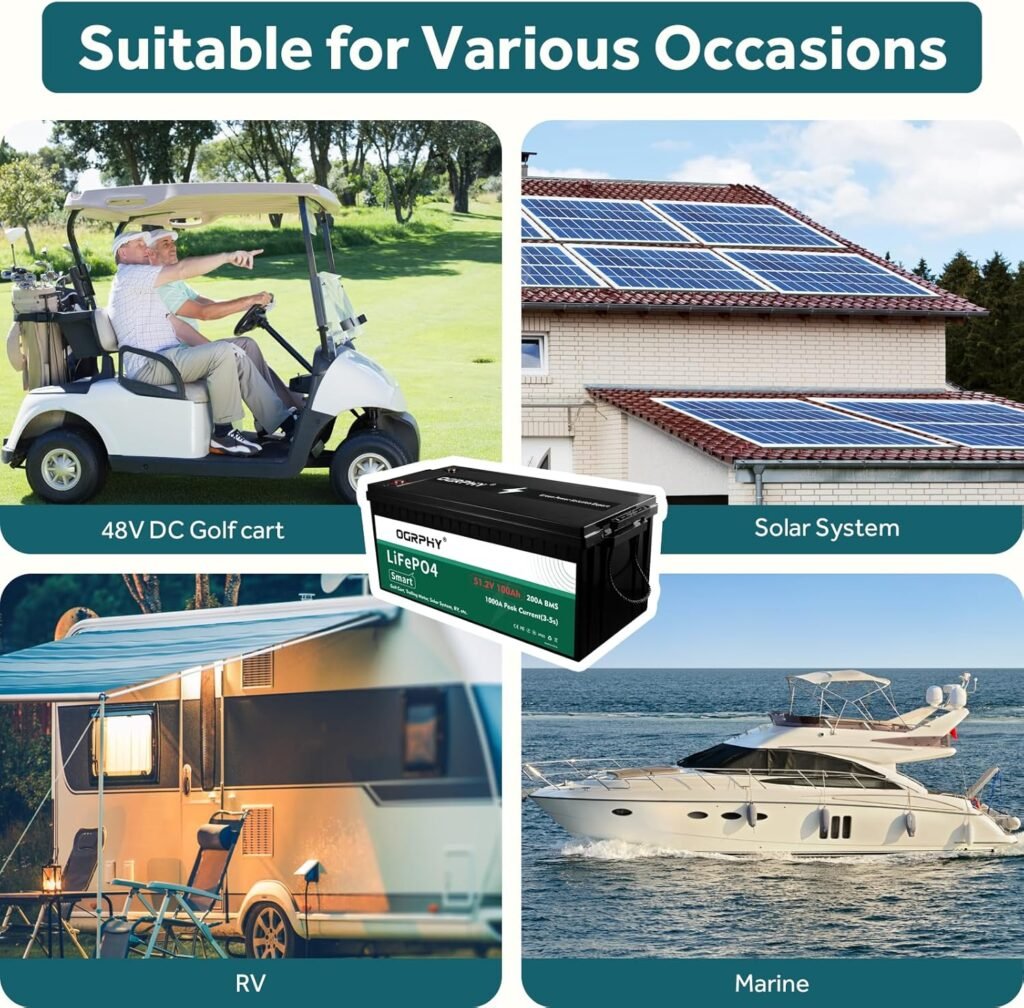
| Suggested uses | Golf carts, trolling motors, RV/solar/marine applications | Versatile—can be used beyond golf carts where a 48V source is needed. |

Design and build quality
You’ll find this battery built from UL-certified grade A LiFePO4 cells, which typically means tighter tolerances and better manufacturing controls than generic cells. The pack is assembled with a robust BMS and housings meant for under-seat installation in golf carts, though you should confirm mechanical fit and cable routing for your specific vehicle.
Materials and assembly
The cells and electronics are arranged to prioritize cooling, safety, and long life, and the presence of an LCD plus Bluetooth monitoring tells you the manufacturer focused on user feedback and diagnostic access. You should still route cables carefully and avoid placing the LCD module where it can be bumped or exposed to direct water spray.
Real-world performance and range
The manufacturer reports a test where the battery ran a golf cart with a 3 kW motor for about 30 miles, which gives you a useful real-world reference point. Actual range in your situation will vary depending on speed, terrain, load, accessory use, and driving style, but the test indicates a solid energy-to-range ratio for a golf-cart-type application.
How to interpret the 30-mile claim
That 30-mile figure equates to roughly 170 Wh per mile (5.12 kWh / 30 miles ≈ 0.171 kWh/mile), which is reasonable for a 3 kW motor run at moderate speed and load. If you carry heavier loads, encounter hills, or run accessories (lights, stereo, lifts), plan on lower range; conversely, conservative speeds and flat terrain can push the range higher.
Power delivery and motor compatibility
You’ll appreciate the BMS’ continuous 200A rating and extremely high short-term peak capability. For many motors, the continuous and peak current specs determine whether the battery will deliver reliable acceleration, hill-climbing, and trolling-motor thrust.
What the current specs mean in watts
At 48V, a continuous 200A discharge represents around 9.6 kW of continuous power (48V × 200A = 9,600W). The manufacturer also lists a 10.24 kW output in the product name, which is close to the continuous rating and may represent peak continuous capability under ideal conditions or marketing rounding. The 1000A peak is for seconds-long starts and will provide substantially higher short-term wattage, but should not be used continuously.
BMS features, Bluetooth app, and LCD monitor
You’ll be able to monitor your battery both locally and remotely. The built-in Bluetooth BMS lets you view parameters on a smartphone app, while the included LCD monitor mounts on the cart for a quick glance at voltage, current, and state of charge while you drive.
Safety and protection handled by the BMS
The BMS protects against low and over-voltage, overcurrent, short-circuit, and abnormal temperatures—so you have several layers of defense against the kind of failures that can damage batteries or equipment. Even though LiFePO4 is inherently safe relative to other lithium chemistries, the BMS adds peace of mind when the battery sits under your seat.
Charging: 18A charger and expected charge times
An 18A 48V charger is included, which makes charging reasonably fast compared to many lead-acid chargers that often run at lower amperages. You’ll usually get a full recharge in a single overnight session for normal use.
Estimating charge time
A simple estimate is battery capacity (Ah) divided by charger current (A): 100 Ah / 18 A ≈ 5.6 hours. Accounting for charging inefficiencies and the CV (constant voltage) taper phase at the end of charge, a near-empty pack will typically reach full in roughly 6–7 hours on that charger. If you routinely charge from partial SOC, times will be shorter.
Installation tips and electrical safety
You should follow the manual carefully and ensure proper fusing and contactors are in place because this pack can deliver high currents. If you’re swapping from lead-acid to LiFePO4, check battery compartment dimensions, terminal types, and mounting options to make a secure and vibration-resistant install.
Recommended wiring and safeguards
Match or exceed the conductor ampacity to the 200A continuous rating, and place an appropriately rated fuse or circuit breaker close to the battery positive terminal. Include a master switch or contactor designed for the current level and keep wiring runs short to reduce voltage drop and heating.
Maintenance and storage best practices
LiFePO4 needs less maintenance than lead-acid, but you still want to treat it carefully to maximize lifespan. Monitor state of charge during long-term storage, avoid leaving the battery fully discharged for extended periods, and check connections periodically for corrosion or loosening.
Long-term storage and temperature notes
Store the battery at partial state-of-charge (around 40–60% recommended for LiFePO4) if you won’t use it for several weeks or months. Avoid charging at below-freezing temperatures and consult the manual for the recommended operating temperature range for charging and discharging.
Safety considerations for daily use
The pack’s BMS protects against many failure modes, but proper placement, secure mounts, and keeping moisture away from the display and connectors are still important. You won’t have the same leakage or explosive risks as flooded lead-acid chemistry, but you should still avoid mechanical damage or severe overcurrent situations.
Handling high peak currents
Short bursts at extremely high peak currents (like the 1000A, 3–5s spec) are acceptable for starting or torque-demanding events, but avoid relying on those bursts continuously. Repeated extreme peaks may generate heat and accelerate wear, so tune controllers and motor settings to minimize unnecessary stress.
Comparison vs. a typical lead-acid setup
You’ll find several benefits switching from lead-acid to this LiFePO4 pack: more usable capacity per charge (you can use most of the pack instead of leaving 50% as a buffer), faster charging, lower weight for similar energy (usually), and far longer cycle life. Over years of use you’ll likely see lower total cost of ownership despite a higher initial price.
Practical savings over time
Because LiFePO4 can comfortably deliver 3,000–5,000+ cycles compared to 300–1,000 cycles for many lead-acid alternatives, you’ll replace batteries far less often. That translates to less downtime, less recycling and disposal, and a more reliable vehicle for your rounds or trips.
Where this battery fits best
This pack is optimized for golf carts but also suits trolling motors, small marine systems, solar storage for smaller arrays, and RV auxiliary systems where a 48V source is appropriate. If you run high-draw applications where short bursts of power are common (like hill starts or heavy trolling motors), this pack’s peak capacity is an advantage.
When to consider another option
If you need a battery with continuous discharge well above 200A for sustained heavy-duty industrial use, or if you require a custom physical size that this pack can’t fit into, you might prefer a different pack or a parallel bank of batteries sized for that continuous demand. Also check whether your charger and controller are compatible with LiFePO4 charging profiles.
Pros and cons
You want a clear, honest assessment to decide whether to buy. Below is a friendly, practical list that summarizes the strong points and the trade-offs to consider.
Pros
- Long cycle life and long expected lifetime reduce replacement frequency.
- Strong continuous (200A) and high short-term peak (1000A) discharge capability for demanding starts.
- Bluetooth BMS and LCD monitor let you track battery health in real time.
- Included 18A charger shortens recharge times relative to many stock chargers.
- LiFePO4 chemistry is safer and more thermally stable than many other lithium chemistries.
Cons
- The pack’s dimensions and terminal layout must be checked against your cart; you’ll need to confirm fit.
- Manufacturer specs like “300A for 32s and 600A for 32s” plus a 1000A peak for 3–5s are useful but slightly confusing; follow the conservative continuous rating for sizing wiring and contactors.
- Upfront cost will be higher than a lead-acid replacement; savings appear over years due to cycle life.
Practical calculations and examples
You’ll probably want to run some scenarios for your motor or setup. Here are a few simple examples to help you estimate runtime and charger performance in realistic terms.
Example: range for different motor draws
- 3 kW average draw: 5.12 kWh / 3 kW ≈ 1.71 hours of operation, which at typical golf cart speeds (say 9–12 mph) roughly matches the manufacturer’s 30-mile claim.
- 1.5 kW average draw (slow trolling or low-speed cruising): 5.12 kWh / 1.5 kW ≈ 3.41 hours of operation, which could translate to 30–40 miles at low speeds.
- 4 kW average draw (fast or heavy-load use): 5.12 kWh / 4 kW ≈ 1.28 hours, with range depending on speed.
Example: battery power and continuous wattage
- Continuous 200A at 48V = ~9.6 kW available. That means you can run motors rated up to that continuous power without overtaxing the BMS, but motor controllers and wiring also must be rated accordingly.
Compatibility checklist before buying
Before you commit, go through this checklist so you don’t run into surprises when the pack arrives. It helps to measure and plan, especially if you’re installing it yourself.
- Confirm the physical dimensions of the battery fit your compartment or mounting area.
- Verify terminal type and polarity match your cart or plan for adapter cables.
- Ensure your motor controller and wiring are rated for 200A continuous and possible high peak currents.
- Check whether your charger is compatible with LiFePO4 or use the included 18A charger.
- Plan a fuse or breaker close to the battery and a properly rated contactor or master switch.
Frequently asked questions
You’ll likely have some practical questions; here are answers to common ones you’ll see when comparing packs like this.
Will this battery fit under my golf cart seat?
You should measure your battery compartment and compare those dimensions with the product listing or seller-supplied specs before purchasing. Fitment is model-specific; many carts accept a 48V 100Ah pack, but confirm clearances and bracket points.
How long does it take to fully charge?
Using the included 18A charger, a nearly empty pack will typically reach full in roughly 6–7 hours accounting for charging taper. For daily top-ups, shorter times are needed since you’re not charging from empty.
Is a separate BMS or controller necessary?
No—this pack has an integrated 200A BMS with Bluetooth monitoring and protections. You’ll still need an appropriate motor controller and possibly a contactor or master switch sized for the electrical loads you expect.
How safe is LiFePO4 compared to lead-acid?
LiFePO4 is chemically stable and less prone to thermal runaway than many lithium chemistries, and it lacks the acid leakage concerns of lead-acid. The integrated BMS further reduces risks by preventing extremes of voltage, current, and temperature.
What warranty or support should I expect?
The product listing emphasizes a long lifetime and cycle count, but warranty terms vary by seller. Check the seller page or included documentation for the explicit warranty period and support process before you buy.
Cost-of-ownership perspective
You’ll pay more up front for LiFePO4, but because the pack can last thousands of cycles, your cost per kWh over its life typically beats lead-acid alternatives. That’s especially true if you run your cart frequently or rely on dependable performance with less maintenance.
Example: replacement frequency
If this LiFePO4 pack gives you 5,000 cycles at a reasonable depth of discharge, even daily use will take years before replacement. Compare that to lead-acid packs that might need replacement every few hundred cycles under heavy use.
Troubleshooting common issues
If you’re new to LiFePO4, a few issues can surface when swapping from lead-acid. You’ll want to be ready to address them so you maintain uptime.
Common problems and fixes
- Charger compatibility: If your existing charger isn’t LiFePO4-aware, use the included charger or a LiFePO4-compatible charger.
- Voltage readout differences: LiFePO4 charge curves are flatter; state-of-charge may not track the same way your old battery did—use the BMS app or LCD for accurate readings.
- Contactors and fuses: If you see tripped fuses or warm contactors, verify that the wiring and protective devices are sized to the battery’s current capability.
Final verdict
If you want a modern, long-lived replacement for a 48V lead-acid pack and you need reliable, punchy performance for golf carts, trolling motors, or auxiliary RV/solar setups, this 48V 100Ah LiFePO4 battery is a compelling option. You’ll benefit from long cycle life, strong continuous and peak current abilities, and the convenience of included monitoring and a faster 18A charger.
Who this is best for
This pack is ideal for owners who value long-term reliability, quick charging, and the ability to run higher-draw motors without the weight, maintenance, and replacement frequency of lead-acid. If you want to reduce maintenance and increase range and usable capacity while keeping safety and monitoring front-and-center, you’ll likely be satisfied with this battery.
If you’d like, tell me the model of your golf cart or the motor/controller specs you’re using and I’ll help verify fit and compatibility or walk you through wiring and fuse sizing.
Disclosure: As an Amazon Associate, I earn from qualifying purchases.