Are we on the hunt for a heavy-duty, long-lasting 12V battery that can handle a trolling motor, RV house loads, or an off-grid solar setup?

Quick overview of the KEPWORTH 12.8V 400Ah LiFePO4 Battery, Rechargeable Lithium Batteries with 200A BMS, up to 4000+ Deep Cycles, Grade A Lithium Iron Phosphate Cells, for Trolling Motor, Boat, Rv, Solar, Off-Grid
We’ll summarize the main selling points so we can quickly see what this battery brings to the table. The KEPWORTH 12.8V 400Ah LiFePO4 is positioned as a high-capacity, long-cycle-life battery with an internal 200A Battery Management System (BMS), a recommended 14.6V charge voltage, and support for parallel or series connections for capacity or voltage expansion.
Key specifications
We’ll list the hard numbers that matter when sizing and installing this battery. These specs help us determine compatibility, energy capacity, and installation requirements.
| Specification | Detail |
|---|---|
| Nominal voltage | 12.8V |
| Capacity | 400Ah |
| Nominal energy | ~5,120 Wh (12.8V × 400Ah) |
| Chemistry | LiFePO4 (Lithium Iron Phosphate), Automotive Grade A cells |
| Cycle life | Up to 4,000+ deep cycles (manufacturer claim) |
| BMS | Built-in upgraded 200A BMS with protections |
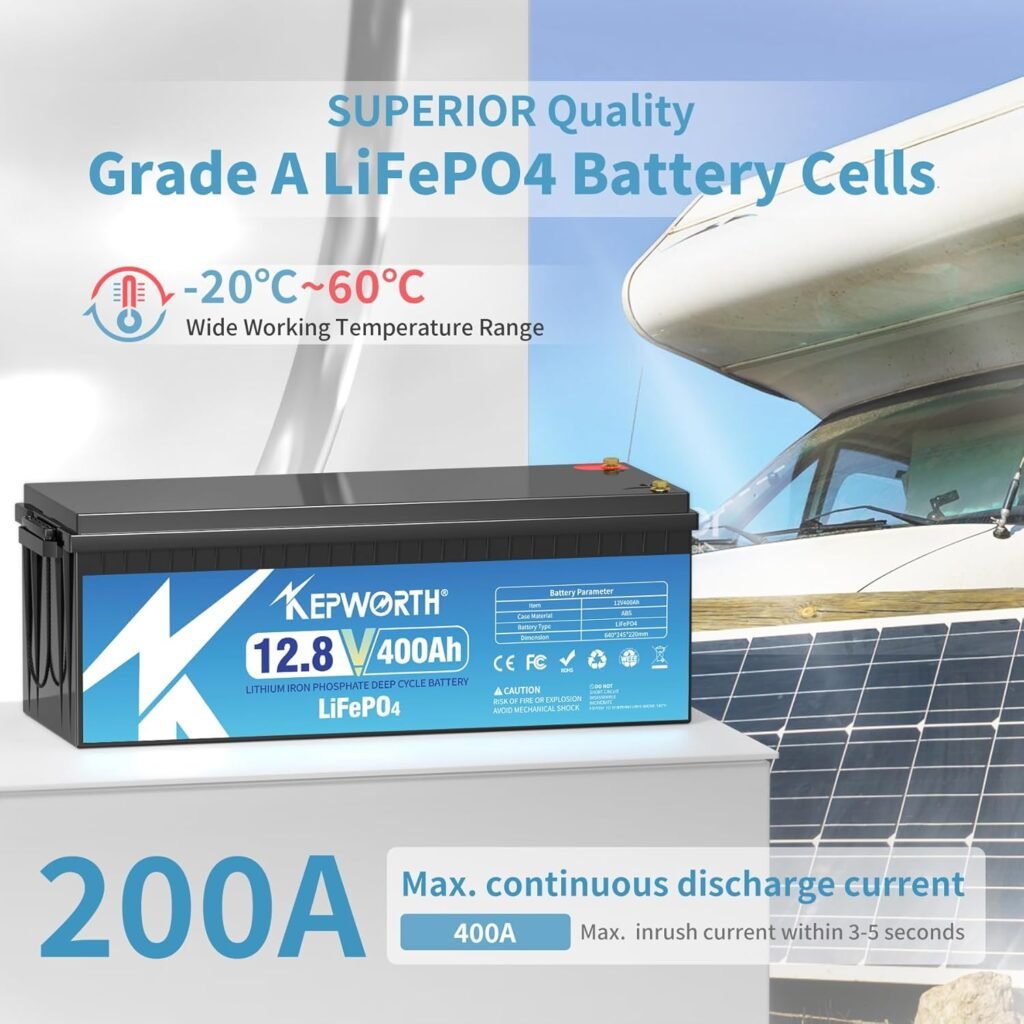
| Max continuous discharge | 200A |
| Inrush (peak) current | 400A for 3–5 seconds |
| Recommended charge voltage | 14.6V |
| Included charger | 7A charger (tester, complimentary) |
| Dimensions | 25.2 × 9.65 × 9.06 inches (L × W × H) |
| Parallel/Series | Supported (capacity expansion and higher voltage setups) |
| Service | 10-year lifetime ambition, 5-year after-service solution |
| Response time for issues | Within 24 hours via Amazon seller contact |

Physical dimensions and build quality
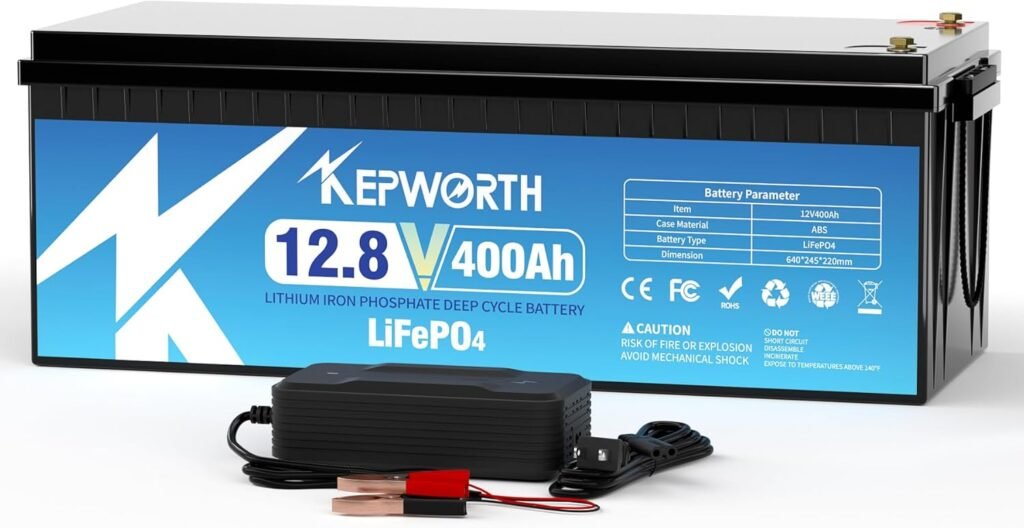
We’ll talk about the size and how that affects where we can mount it. The battery measures about 25.2 inches long, 9.65 inches wide, and 9.06 inches tall, so it requires a reasonably sized compartment for mounting, and we should plan for cable routing and ventilation access.
We’ll also note that KEPWORTH uses Automotive Grade A LiFePO4 cells. That suggests higher consistency and better energy density compared with lower-tier cells, and it reflects an emphasis on durability and stable performance in demanding applications.
Terminals, enclosure and mounting
We’ll check how the battery expects to be mounted and connected. The manufacturer provides standard post/terminal connections; we should inspect terminals for compatibility with our existing cables and consider terminal adaptors if needed.
We’ll also look for solid mounting points, secure fasteners, and a stable flat surface to minimize vibration in marine or mobile installations. Vibration dampening and secure mounts will lengthen the life of the battery and reduce the chance of terminal loosening.
Electrical performance and capacity
We’ll quantify the usable energy and how it translates to real-world runtimes. At 12.8V and 400Ah, the nominal energy is about 5,120 Wh (5.12 kWh). With LiFePO4 chemistry we can use a higher depth-of-discharge (DOD) than with lead-acid; conservatively we might regularly use 80–90% of capacity, giving roughly 4.1–4.6 kWh usable without hurting cycle life.
We’ll also account for inverter losses and system inefficiencies when estimating runtimes. If we run an inverter and motors, we should include those conversion losses in our calculations.
Charging recommendations and included charger
We’ll follow the manufacturer’s charging guidance to maximize life. KEPWORTH recommends a charging voltage of 14.6V. The battery ships with a small 7A charger as a tester, which is fine for maintaining charge or initial top-ups, but it’s slow for full recharges given battery size.
We’ll recommend a proper charger sized for our use case. For daily cycling in RV or solar applications, a higher-current lithium-compatible charger or DC-DC charger/inverter charger will be far more practical. Always select a charger that is specifically configurable for LiFePO4 or that has a LiFePO4 charging profile.
BMS protections and safety features
We’ll explain what the built-in BMS does for us. The KEPWORTH battery includes an upgraded 200A BMS that protects against overcharge, over-discharge, over-current, and short circuit. It also includes high-temperature and low-temperature cutoffs to prevent charging or discharging when the temperature reaches unsafe thresholds.
We’ll stress that these protections make the battery safer and more user-friendly than raw cell packs, but they do not replace safe wiring, proper fusing, and sensible installation practices.
Performance in common uses
We’ll consider typical applications and how the battery performs in each scenario. This battery is designed for trolling motors, boats, RV house banks, solar and off-grid systems, and as a replacement for lead-acid or AGM batteries in many 12V systems.
We’ll run a few example calculations so we can visualize runtimes under typical loads.
Runtime examples (approximate)
We’ll show how long the battery can run common loads. The usable energy will vary with our chosen depth of discharge, inverter efficiency, and actual load.
| Load | Power (W) | Usable energy assumed | Est. runtime (hours) |
|---|---|---|---|
| LED lighting + small fridge (RV) | 200 W | 4,600 Wh (90% usable) | ~23 hours |
| Small boat trolling motor (continuous) | 800 W | 4,600 Wh | ~5.7 hours |
| 1000W inverter (mixed loads) | 1000 W | 4,600 Wh | ~4.6 hours |
| Emergency home backup essentials | 1500 W | 4,600 Wh | ~3.0 hours |
We’ll remind ourselves these are approximate and depend on inverter efficiency, temperature, and how much of the battery we choose to use as a daily DOD.
Starting loads, inrush current and motors
We’ll note why inrush rating matters for motors. The KEPWORTH battery supports a 400A inrush for 3–5 seconds, which helps with starting motors and dealing with momentary surges from trolling motors or compressors.
We’ll still ensure our starter motor or trolling motor peak doesn’t exceed that inrush rating repeatedly and verify the BMS handles repeated surge starts without tripping.
Installation and wiring guidance
We’ll cover the essentials for a safe, effective installation. For a continuous discharge rating of 200A, we need heavy gauge cabling, proper fusing, and reliable terminal connections. The wire size depends on length and allowable voltage drop.
We’ll always include a DC-rated fuse or breaker sized slightly above the maximum expected continuous current. That protects the cable in the event of a short and complies with good electrical practice.
Recommended wire gauge guidelines
We’ll give practical wire gauge guidance based on current and run length. These are general recommendations for copper conductors and assume short runs typical in boats and RVs; consult local codes and a professional for final sizing.
| Approx. current | Typical recommended wire gauge (single conductor, copper) |
|---|---|
| Up to 60A | 6 AWG |
| 60–100A | 4 AWG |
| 100–150A | 3 AWG or 2 AWG |
| 150–200A | 2/0 AWG (00) or parallel runs of 2 AWG |
| Over 200A peaks | 3/0 AWG or multiple parallel conductors; consult an electrician |
We’ll also suggest keeping cable runs as short as practical to minimize voltage drop and heat buildup.
Fusing, breakers and safety devices
We’ll always fuse close to the battery. Place an appropriately sized fuse or DC breaker on the positive cable within 7–12 inches of the battery terminal. Use a fuse rated slightly above the maximum expected continuous current but below the conductor’s short-circuit withstand.
We’ll select a fuse type (ANL, MEGA, etc.) that fits our system and use proper insulated terminal boots to prevent accidental shorts.
Parallel and series connections: what we need to know
We’ll highlight that KEPWORTH supports both parallel (to increase Ah) and series (to increase voltage) connections. However, we must be very careful when connecting batteries in either configuration.
We’ll insist on these best practices: only connect batteries of the same model, age, state of charge (SOC), and capacity; use batteries from the same production batch when possible; balance them when connecting multiple units; and avoid mixing chemistries (e.g., LiFePO4 with lead-acid).
Safe steps for paralleling batteries
We’ll spell out a stepwise process for paralleling to minimize imbalance and current surges: 1) Fully charge each battery individually, 2) Disconnect chargers and loads, 3) Connect positive terminals together and negative terminals together with equal-length cables, 4) Add a system fuse/breaker, 5) Reconnect chargers/loads. We’ll also recommend monitoring closely for the first few cycles.
We’ll emphasize that if we’re unsure, we should consult the seller’s guidance or a qualified electrician.
Charging sources and system integration
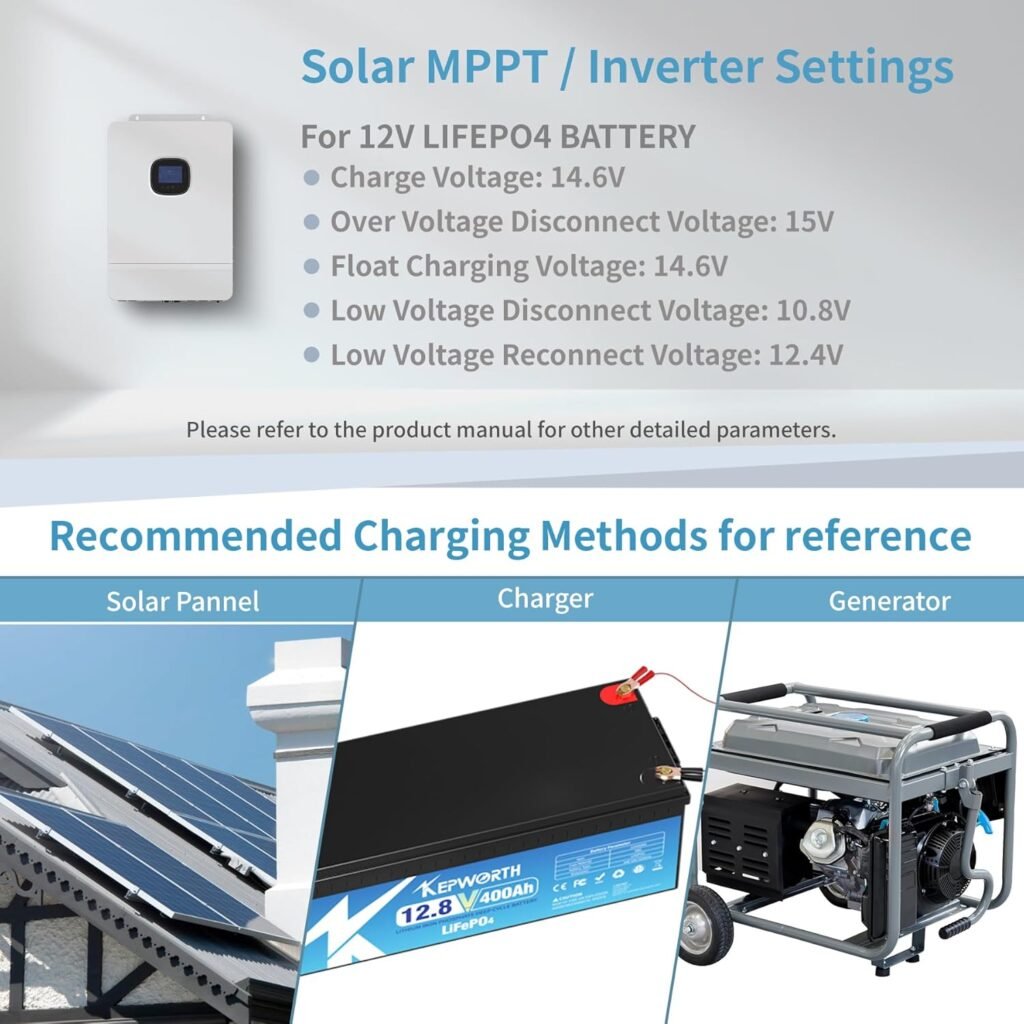
We’ll talk about common charging sources and how to integrate the battery into our systems. The battery can be charged by dedicated AC lithium chargers, inverter/chargers, DC-DC chargers from vehicle alternators, and MPPT solar charge controllers when set for LiFePO4.
We’ll ensure chargers are set to a lithium charging profile and that any charge controller’s absorption/float voltages are appropriate. KEPWORTH specifies 14.6V charge voltage; float may be lower depending on system design, but follow the charger and manufacturer guidance.
Alternator charging and DC-DC chargers
We’ll call out a special caution about alternators. Many vehicle alternators and OEM charging systems are tuned for lead-acid batteries and may not reach the correct lithium charge profile or may not safely charge at low temperatures. We’ll recommend a DC-DC charger or an alternator-compatible lithium charging solution if we’ll charge from the vehicle.
We’ll also suggest a properly rated DC-DC charger that supports LiFePO4 settings and is sized to the battery and typical charging current.
Solar charging and MPPT settings
We’ll set our solar charge controller for LiFePO4 or a custom profile: bulk/absorption at 14.6V and an appropriate float or maintenance voltage as recommended by the controller and manufacturer. We’ll use MPPT controllers for best efficiency and to maximize daily recharge times.
Temperature behavior and storage
We’ll pay attention to temperature limits and storage recommendations. LiFePO4 batteries tolerate higher temperatures for discharging than many chemistries but are sensitive to charging below freezing. The KEPWORTH battery has built-in high-temp and low-temp cutoffs; these will prevent charging/discharging when temperatures are outside safe ranges.
We’ll avoid charging below 0°C (32°F) unless the battery has an internal heater or we’re using a charger with cold-charging capability and the manufacturer explicitly allows it.
Long-term storage best practices
We’ll store the battery at about 40–60% SOC if we won’t use it for an extended period and keep it in a cool, dry place. We’ll check the charge every few months and top up as needed to prevent over-discharge during storage.
We’ll also avoid leaving the battery in a fully discharged state for long periods, as that can damage the cells.
Warranty, support and seller service
We’ll outline the service terms so we know what to expect after purchase. KEPWORTH states a 10-year lifetime ambition and offers a 5-year after-service solution for this 12.8V 400Ah battery, with responsive customer service and a 24-hour response promise on Amazon through the “contact seller” or “Ask a question” storefront option.
We’ll recommend documenting our order, taking photos of the battery on arrival, and contacting the seller promptly if there are shipping damages or faults. Quick documentation helps expedite any warranty claims.
Pros and cons
We’ll summarize strengths and weaknesses to help decide whether this battery suits our needs.
Pros:
- High usable capacity at 12.8V (400Ah ~ 5.12 kWh nominal).
- Long cycle life claim (4,000+ deep cycles) with LiFePO4 chemistry.
- Built-in upgraded 200A BMS for safety and reliability.
- Support for parallel and series configurations for flexible systems.
- Automotive Grade A cells suggest higher quality and stability.
- Included 7A tester charger for initial setup or maintenance.
Cons:
- Heavy and bulky compared to smaller batteries — requires planning for mounting space.
- 7A charger included is slow for full recharges — a higher-capacity charger is usually necessary.
- Charging below freezing may be restricted by the battery’s low-temp cutoff; add heating or avoid cold charging if needed.
- For very high continuous currents near 200A, heavy gauge cabling and proper fuses are mandatory.
Comparison with lead-acid and AGM alternatives
We’ll contrast the most common alternatives so we know why we might choose LiFePO4. Compared with lead-acid (flooded or AGM), LiFePO4 typically offers higher usable capacity, longer cycle life, lower self-discharge, and flatter voltage under load. That means more real-world run-time and less weight/space for the same usable energy.
We’ll accept that upfront cost for LiFePO4 is higher, but total cost of ownership often favors LiFePO4 because of its longer useful life and better cycle performance.
When lead-acid might still be chosen
We’ll note that lead-acid still can make sense in very low-cost, light-use or short-term situations where the upfront budget is the driving factor. For frequent cycling, deep-discharge scenarios, or mobile/marine applications where weight and space are at a premium, LiFePO4 is usually the better fit.
Common troubleshooting and how we fix problems
We’ll prepare for issues we might encounter and say how to handle them. Common problems are failure to charge, BMS cutoffs due to temperature or current, and unexpected voltage readouts.
We’ll try these steps:
- Check BMS LED indicators (if present) and any error codes in the seller documentation.
- Confirm all connections are tight and free of corrosion.
- Verify charger settings (14.6V absorption/charge; correct current limit).
- Check breaker/fuse status and replace blown fuses with correct-rated spares.
- If the battery refuses to charge and we’ve verified charger and cables, contact seller within the stated 24-hour response window.
We’ll always err on the side of safety and stop using the battery if it shows signs of physical damage, swelling, persistent overheating, or smoke, and then contact the seller.
Recommended accessories and complementary gear
We’ll list useful accessories that simplify installation and improve longevity. These items reduce headaches and improve safety.
- DC breaker/automatic reset breaker sized near the BMS continuous rating.
- ANL or MEGA fuses within a few inches of the battery positive terminal.
- Heavy-gauge cable (2/0 AWG or as recommended) for high-current runs.
- Quality lithium-compatible charger or inverter/charger with a 14.6V LiFePO4 profile.
- DC-DC charger for alternator charging in vehicles.
- Battery monitor (Shunt + BMV-style monitor) to read real-time Ah in/out and state of charge.
- Terminal covers or boots to reduce accidental shorts and corrosion.
Application examples and sizing tips
We’ll provide a few concrete scenarios where this battery is a strong fit, and we’ll show sizing logic so we can plan expansions or multiple-battery systems.
Example 1 — Weekend fishing boat with trolling motor:
- If our trolling motor draws an average of 40–60A, a 400Ah LiFePO4 bank gives many hours of run time even at heavy trolling use. The 400A inrush helps with motor starts.
Example 2 — RV house bank:
- For moderate RV loads (fridge, lights, water pump, small inverter loads), a single 400Ah battery could provide multi-day off-grid autonomy, especially when paired with solar and a quality MPPT controller.
Example 3 — Small off-grid cabin:
- At roughly 5.12 kWh nominal, the battery can serve as the core of a small off-grid system that includes solar and a proper charge controller and inverter. We’ll size solar arrays and charge controllers to replenish daily usage based on expected consumption.
We’ll always size for peak draws, consider inverter surge ratings, and ensure we have adequate charging capacity to replenish what we use each day.
Environmental impact and disposal
We’ll highlight that LiFePO4 is among the safer and more environmentally friendly lithium chemistries. It uses iron and phosphate rather than cobalt or nickel-heavy chemistries, reducing toxic metals and material cost.
We’ll dispose of the battery at an appropriate battery recycling facility at end of life. We’ll not throw it in regular trash and will follow local e-waste and battery disposal regulations.
Final recommendations and verdict
We’ll summarize our final take on whether this battery is a good buy. The KEPWORTH 12.8V 400Ah LiFePO4 battery is a strong option if we need large capacity, long cycle life, and the flexibility to expand capacity or voltage via parallel or series connections. The built-in 200A BMS and Automotive Grade A cells are attractive features for marine, RV, and off-grid use.
We’ll pair the battery with an appropriate charger, use heavy-gauge wiring and proper fusing, and follow the seller’s guidance for warranty and support. For those seeking a long-term energy bank with consistent voltage and high usable capacity, this is a compelling choice.
Frequently asked questions (FAQ)
We’ll answer the common questions we expect buyers to have and give concise, clear responses.
Q: What is the usable capacity? A: Nominal energy is around 5,120 Wh. With LiFePO4 chemistry, we can typically use 80–90% of that for regular cycling without significantly shortening life, giving roughly 4.1–4.6 kWh usable.
Q: Can we connect multiple batteries in parallel or series? A: Yes. The battery supports parallel and series connections for capacity or voltage expansion. We’ll only connect identical batteries (same model, age, SOC) and use equal-length cables and proper balancing/practices.
Q: Is the included 7A charger adequate? A: It’s suitable for initial testing and float maintenance but is slow for fully recharging a 400Ah battery. For regular recharging, we’ll use a higher-current lithium-compatible charger or an inverter/charger.
Q: Can we charge in cold weather? A: The battery has low-temperature cutoffs that prevent charging at unsafe temperatures. We’ll avoid charging below freezing unless the battery and system explicitly support cold-charge or heating.
Q: What should we do if the battery doesn’t respond or trips? A: Check connections, fuses, and charger settings first. If problems persist, contact the seller via Amazon “contact seller” or “Ask a question” and provide order details and photos; KEPWORTH promises responsive support within 24 hours.
Final checklist before buying and installing
We’ll list a short pre-install checklist so we don’t forget practical items during purchase and setup.
- Confirm physical space and mounting method for a 25.2 × 9.65 × 9.06-inch battery.
- Ensure cables and connectors are rated for up to 200A continuous (and handle 400A peak).
- Choose an appropriate charger or inverter/charger with LiFePO4 profile set to 14.6V.
- Plan for a proper fuse/breaker within inches of the battery positive terminal.
- Document order and inspect battery on arrival; contact seller promptly for any shipping damage.
- If paralleling or series connecting multiple units, verify all batteries are the same model and fully charged before interconnection.
We’ll conclude by saying that, with the right accessories and careful installation, the KEPWORTH 12.8V 400Ah LiFePO4 battery is a versatile and robust energy storage option for marine, RV, solar, and off-grid setups, and it offers a significant upgrade over traditional lead-acid solutions in terms of usable capacity and lifespan.
Disclosure: As an Amazon Associate, I earn from qualifying purchases.