?Thinking about upgrading your golf cart to the Enjoybot 48V 100Ah LiFePO4 Lithium Golf Cart Battery Conversion Kit – 4 X 12V 100Ah Group 31 LiFePO4 Battery, Built-in 100A BMS with Low Temperature Cut-Off Function, Peak Current of 350A?

Quick product snapshot
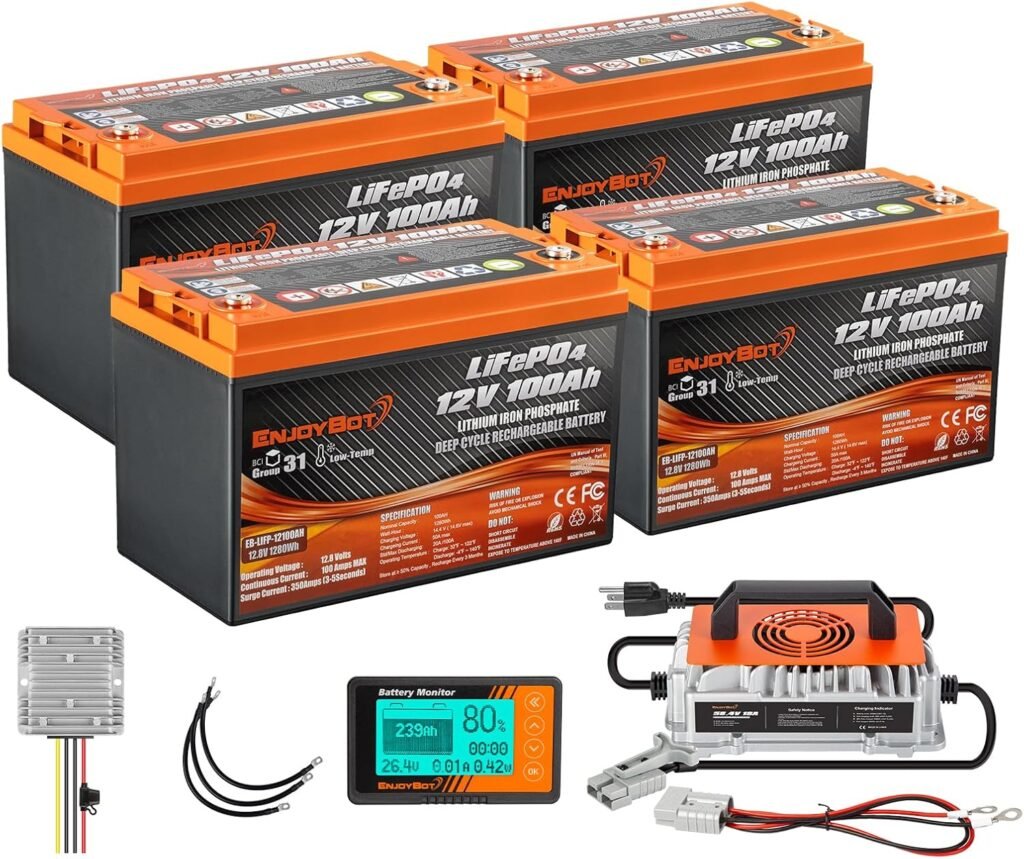
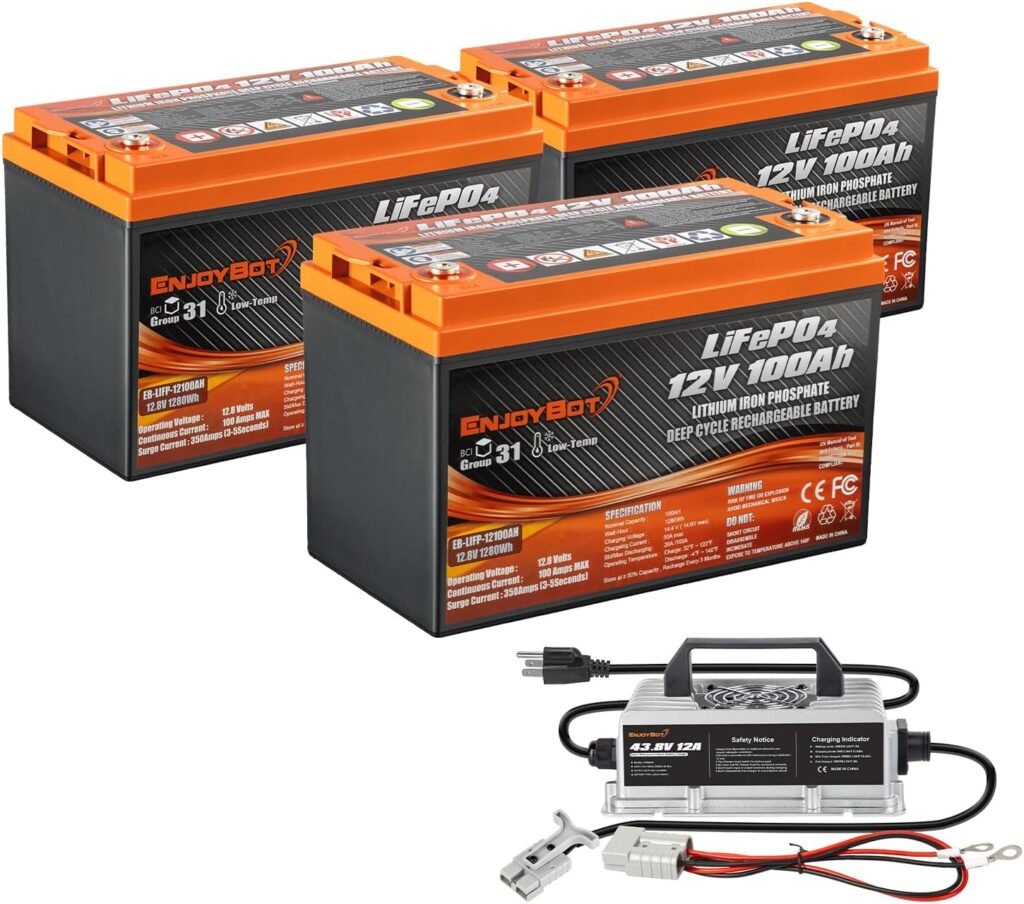
You get a 48V conversion kit made from four 12V 100Ah Group 31 LiFePO4 batteries designed to replace conventional 6V/8V/12V SLA or AGM batteries in a drop-in style. The kit emphasizes lower weight, extended runtime, a built-in 100A BMS with low temperature cut-off, and support for short peak currents up to 350A.
What the kit includes
Every kit ships with the four 12V batteries and essential accessories so you can convert your 48V system without buying many extra parts. Included items give you a charger, a battery monitor with shunt, a DC-DC converter for your 12V accessories, and series connection cables to simplify installation.
Key specifications at a glance
This section lays out the critical technical specs in one place so you can quickly check compatibility with your cart and controller. The table below organizes voltage, capacity, BMS behavior, charging hardware, and notable protections.
| Item | Specification |
|---|---|
| Product | Enjoybot 48V 100Ah LiFePO4 Lithium Golf Cart Battery Conversion Kit (4 × 12V 100Ah Group 31) |
| Nominal system voltage | 48V (4 × 12V in series) |
| Battery capacity | 100Ah per 12V battery (total system capacity still 100Ah at 48V) |
| Battery chemistry | LiFePO4 (Lithium Iron Phosphate) |
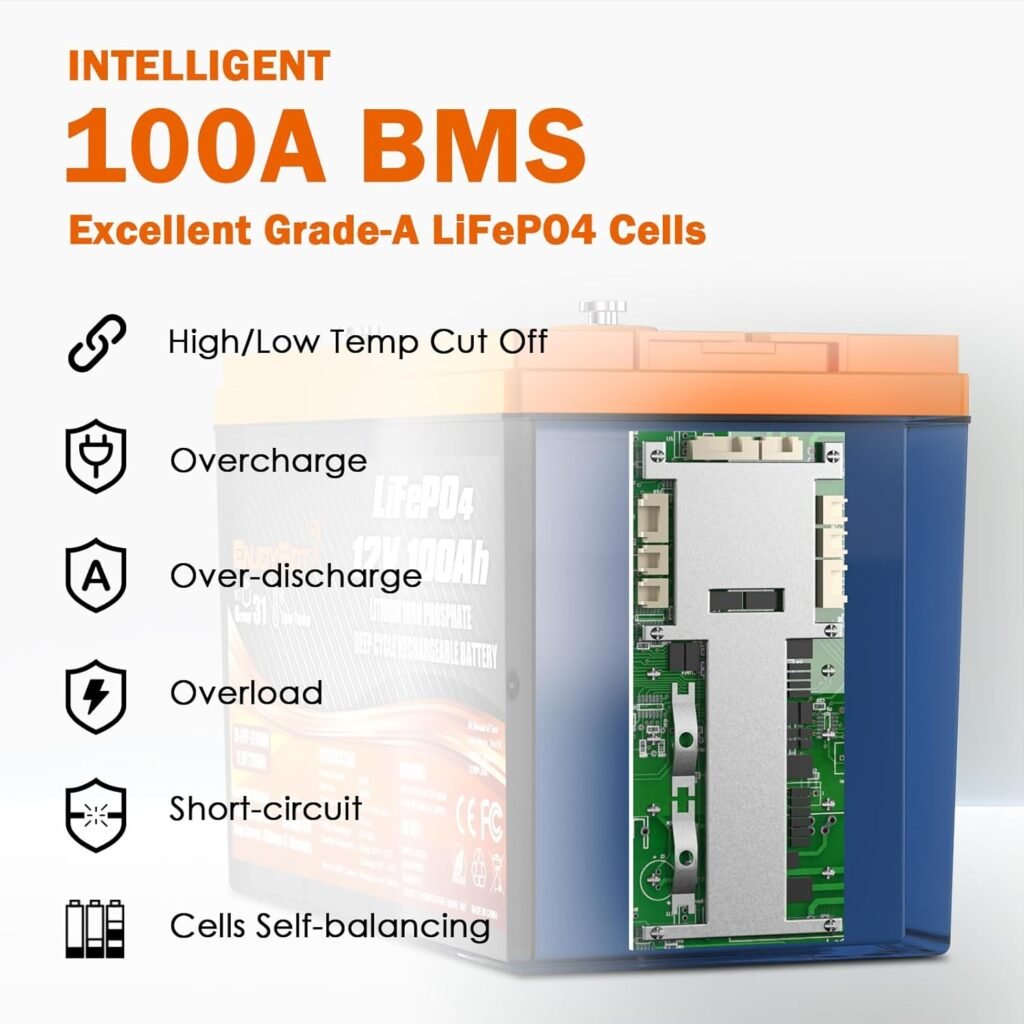
| Built-in BMS | 100A BMS per battery with low temperature cut-off; overall kit supports 1C continuous discharge |
| Continuous discharge | 1C (100A continuous for the 100Ah battery) |
| Peak current | Up to 350A (short bursts/surge capability for motor starts) |
| Cycle life | Service life over 6000 cycles (at 80% DOD per manufacturer) |
| Operating temperature | -4°F to 140°F operating tolerance |
| Charger included | 58.4V 18A charger — full charge in approximately 5.5 hours |
| Additional accessories | Battery Monitor 500A with shunt; DC-DC 48V→12V step-down converter; 3 × 3 AWG black cables with M8 terminals |
| Waterproof rating | IP67 |
| Warranty | 10-year warranty (manufacturer) |
| Compatibility notes | Recommended for carts with motors up to 5 kW and controllers up to 350A; used as energy storage (not starting battery) |

Why you might consider this kit
If you want longer run time, a lighter battery pack, and far more cycle life than lead-acid batteries, this kit promises a meaningful upgrade for your 48V cart. It’s tailored to users who prefer the convenience of drop-in replacement batteries plus plug-and-play accessories to manage charging and 12V accessories.
Who this kit is best suited for
You’ll benefit most if your cart has a motor up to 5 kW and a controller that supports up to 350A surge; that covers a large portion of standard and street-legal golf carts, many UTVs, and LSVs. If you run heavy accessories or very high-power motors, confirm your controller’s limits first and contact the seller for guidance where necessary.
Included components and how they help
Each included component is chosen to make conversion easier and to preserve 12V systems on your cart. The charger restores the entire 48V pack, the monitor lets you watch performance, and the DC-DC keeps 12V accessories running without relying on additional converters.
The charger and its role
The kit’s 58.4V 18A charger is matched to charge four series 14.6V-equivalent batteries to full; it claims a full charge in about 5.5 hours from a typical discharged state. You should use that charger or a compatible LiFePO4 charger to maximize cycle life and avoid charging issues.
Battery monitor and DC-DC converter
You get a Battery Monitor rated to 500A with a shunt so you can track amp-hours, state of charge, and instantaneous current — ideal for understanding real-world runtime. The DC-DC 48V to 12V step-down converter keeps your lights, radios, and other 12V accessories powered without tapping the high-voltage lines directly.
Compatibility and what to check on your cart
Before you buy, check your motor rating, controller capabilities, and physical battery compartment dimensions so the Group 31 batteries will fit. The seller notes compatibility for motors up to 5 kW and controllers supporting 350A, but you should also confirm battery box size and terminal access on your cart.
Mechanical and electrical fit
Group 31 batteries have standard dimensions, but LiFePO4 housings sometimes differ slightly; measure the space and mounting points in your cart. Electrically, ensure your controller’s continuous and peak current ratings match the kit: continuous draw should stay near or below 100A (1C) for long-term health, with short peaks allowed up to 350A.
What happens if your cart exceeds specs
If your motor or controller is larger than the recommended 5 kW/350A, you run the risk of tripping the BMS or shortening battery life; in that case, contact the seller for tailored advice or consider a pack rated for higher continuous current. The manufacturer asks you to contact them if you plan to use the batteries with trolling motors or unusually high-draw systems.
Performance: range, run time, and real-world expectations
Expect roughly twice the runtime of similar-size SLA/AGM batteries according to the product claims, partly because of higher usable depth of discharge for LiFePO4 chemistry. Real range depends on terrain, load (passengers, cargo), driving style, and accessory draw — but you’ll likely notice significantly longer usable runtime before recharge.
Practical runtime examples
If your cart consumes 800W on average while driving, a 48V 100Ah pack gives you 4.8 kWh usable, and at 800W that roughly translates to 6 hours of operation under ideal conditions. In real-world conditions with stops, heavier loads, hills, and accessories, expect less — plan for conservative estimates and check the battery monitor to learn your actual usage.
Power delivery and acceleration
The kit’s 1C continuous discharge (100A) supports moderate sustained power for normal driving and accessory use, while the 350A peak is there for acceleration and short surges. You shouldn’t expect unlimited high-current runs; sustained draws above the 1C rating will tax the BMS and battery and could trigger protection.
Battery management and safety features
The built-in 100A BMS protects the pack from common hazards like overcharge, over-discharge, short circuit, overcurrent, and notably low temperature charging. That low temperature cut-off prevents irreversible damage if you attempt to charge in freezing conditions.
Low temperature cut-off and operating range
The battery pack is designed to operate in a wide ambient range (-4°F to 140°F) but will protect itself from charging below the safe threshold to avoid plating and cell damage. If you operate in cold climates, you’ll want to plan to keep the pack above that threshold before charging — options include stored charging indoors or adding a heater/blanket designed for battery use.
IP67 waterproof rating
An IP67 rating means the battery enclosures are dust-tight and can withstand temporary immersion in water (up to 1 meter for 30 minutes per the IP67 spec). This makes the pack more suitable for outdoor use in boats, wet environments, or vehicles exposed to rain, but you should still protect terminals and ancillary electronics from corrosion.
Installation and setup: what to expect
Installing the kit is intended to be straightforward if you have basic mechanical and electrical skills and a little patience. The kit includes three 3 AWG cables with M8 terminals to link the four batteries in series and connect to your controller and charger.
Step-by-step overview
You’ll remove your old batteries, position the four Group 31 LiFePO4 batteries in the compartment, connect them in series using the provided cables, hook up the BMS outputs to your controller, install the DC-DC converter for 12V accessories, and plug in the charger to top off the pack. Use proper torque on M8 terminals, keep polarity strict, and secure cables away from moving parts.
Tools and safety tips
You’ll typically need wrenches for M8 terminals, a multimeter for verifying voltages, and insulated gloves to avoid shorting. Always disconnect all power before making connections, double-check polarity, and bolt terminals firmly; loose connections can overheat or spark.
Charging behavior and recommended practices
You must use a charger configured for LiFePO4 chemistry or the provided 58.4V 18A charger to ensure the correct voltage and cutoff behavior. The charger is sized to fully recharge the pack in about 5.5 hours under normal conditions, which is convenient for daily use.
Charging cycles and top-off strategy
LiFePO4 chemistry tolerates frequent partial charges, so you don’t need to fully cycle the pack each time — topping up after use improves battery longevity. Still, avoid leaving the batteries at full charge for extended periods if you won’t use the vehicle; moderate storage states help optimize cycle life.
Storage and seasonal care
If you store your cart for long periods, keep the pack at around 40–60% state of charge and in a temperature-controlled environment if possible. Avoid exposing the batteries to extreme heat for extended periods, and periodically check the state of charge using the included monitor.
Maintenance, longevity, and total cost of ownership
The listed 6000+ cycle life at 80% DOD means you’ll likely get many years of service — far more than typical lead-acid packs. That results in lower lifetime cost if you plan to use your cart frequently.
What to inspect over time
You should periodically inspect terminals for corrosion, check cable tightness, and verify the battery monitor readings against known load patterns. Keep firmware or software for monitoring devices updated if applicable, and follow manufacturer guidance for any diagnostics.
Troubleshooting common issues
If the BMS triggers protections, the monitor or the controller may display errors; you’ll need to isolate the cause — high current draw, low temperature charging attempt, or wiring issues are common culprits. Many issues can be resolved by checking connections, ensuring the batteries are within the operating temperature, and confirming the controller and accessories aren’t overloading the pack.
Low temperature cut-off triggers
If you get a charge-block at low temperature, the simplest remedy is to move the charger and batteries to a warmer location or let ambient temps rise above the cutoff before charging. Some installers add a battery heating solution or insulated compartment in cold climates to avoid frequent cut-offs.
BMS faults and resets
A hard fault from the BMS may require cycling power, removing loads, and charging to a safe voltage to clear; follow the manufacturer’s reset procedure and contact support if a fault persists. Never bypass BMS protections — doing so risks permanent damage and safety hazards.
Pros and cons to consider
You’ll enjoy substantial advantages in runtime, weight, and lifecycle, but you should be mindful of up-front cost and ensuring that your cart’s controller and motor are within recommended limits.
Advantages
You’ll get about one-third less weight compared with equivalent lead-acid packs and roughly double runtime according to the product claims, plus thousands of cycles of life and IP67-rated protection for outdoor use. The included charger, monitor, and DC-DC make this package more of a turnkey solution than buying cells alone.
Potential drawbacks
Up-front cost is higher than old-school lead-acid batteries, and continuous draw limits (1C) mean you need to respect sustained current to maintain battery health. If your cart uses accessories or motors that draw beyond these specs, you might need upgraded controllers or a different battery configuration.
Comparison against SLA/AGM lead-acid systems
Compared to SLA/AGM, LiFePO4 batteries offer substantially better cycle life, higher usable depth of discharge, and lighter weight for the same usable capacity. Your long-term economics usually favor LiFePO4 if you use the cart frequently and value lower maintenance and improved performance.
Practical benefits over lead-acid
You won’t need to water cells, you’ll get consistent voltage for accessories over most of the discharge curve, and weight reduction can help acceleration and handling. The built-in BMS also streamlines protection that you otherwise tackle with external devices in some lead-acid retrofits.
Consider total cost of ownership
While you’ll pay more up front, the long cycle life and improved efficiency often make LiFePO4 cheaper over several years compared to replacing lead-acid packs multiple times. Use conservative runtime estimates and local pricing to calculate payback, but many users find the investment worthwhile.
Warranty, support, and purchase tips
This kit comes with a 10-year warranty, which indicates the manufacturer’s confidence in the product and gives you a safety net. Keep purchase records and register the kit per the manufacturer’s instructions to ensure warranty coverage.
What to ask before buying
Confirm your motor and controller ratings, ask whether your cart’s physical battery space fits Group 31 LiFePO4 housings, and verify whether any firmware or charging settings on your controller need adjustment for LiFePO4. If you plan to run trolling motors or unusual accessories, contact the seller as suggested.
Extra accessories you might want
Consider terminal protectors, protective battery boxes or trays if your cart’s compartment is open to the elements, and a smart charger compatible with LiFePO4 if you plan to replace the included charger later. A small insulated blanket or dedicated battery heater can also be a good investment in very cold climates.
Frequently asked questions (FAQ)
Below are common questions you may have when considering this kit, answered in practical terms for your decision-making.
- Will these batteries fit in my cart? Measure your battery bay and compare to Group 31 dimensions; the kit is Group 31, but housings can vary. If you’re unsure, send measurements and pictures to the seller before buying.
- Can I use this kit with my 6V battery cart by rearranging? This kit is designed to replace the series voltage needed for 48V systems; if your cart currently uses 6V batteries totaling 48V, you can use this kit as a drop-in replacement provided physical fit and terminal orientation are okay.
- What happens in freezing weather? The BMS protects against charging at unsafe low temperatures; you should avoid charging below the specified cutoff and consider pre-heating or indoor charging for consistent winter performance.
- Can I parallel these batteries to increase capacity? The kit is designed as a 48V series pack; paralleling batteries is generally not recommended unless explicitly supported by the manufacturer. Contact Enjoybot for supported configurations.
- Is the DC-DC converter enough to run all 12V accessories? The included DC-DC converter is intended to keep 12V systems operating independently of the high-voltage pack; confirm the converter’s current rating versus your total 12V accessory draw.
Final thoughts and recommendation
If you want a modern, lower-weight, long-life battery solution for a 48V golf cart, street-legal cart, UTV, or similar vehicle that fits within the specified motor and controller limits, this Enjoybot kit is a strong contender. It’s a fairly complete package with charger, monitor, and DC-DC converter included, and the IP67 rating plus long cycle life and 10-year warranty make it a practical upgrade for many users.
Quick buying checklist
Before you purchase, confirm: motor ≤ 5 kW, controller supports up to 350A peak, your battery bay fits four Group 31 batteries, and you’re comfortable with the 1C continuous current limit. If any of those are uncertain, contact the seller for guidance — they offer pre-purchase support for golf cart and trolling motor use cases.
If you follow the setup and maintenance guidance, you’ll likely notice immediate improvements in runtime and maintenance convenience compared with lead-acid systems, and the included electronics make the transition smoother for your everyday use.
Disclosure: As an Amazon Associate, I earn from qualifying purchases.