Can the Litime 12V 200Ah Plus LiFePO4 Lithium Battery meet our needs for cold-weather charging, high-cycle life, and versatile off-grid use?

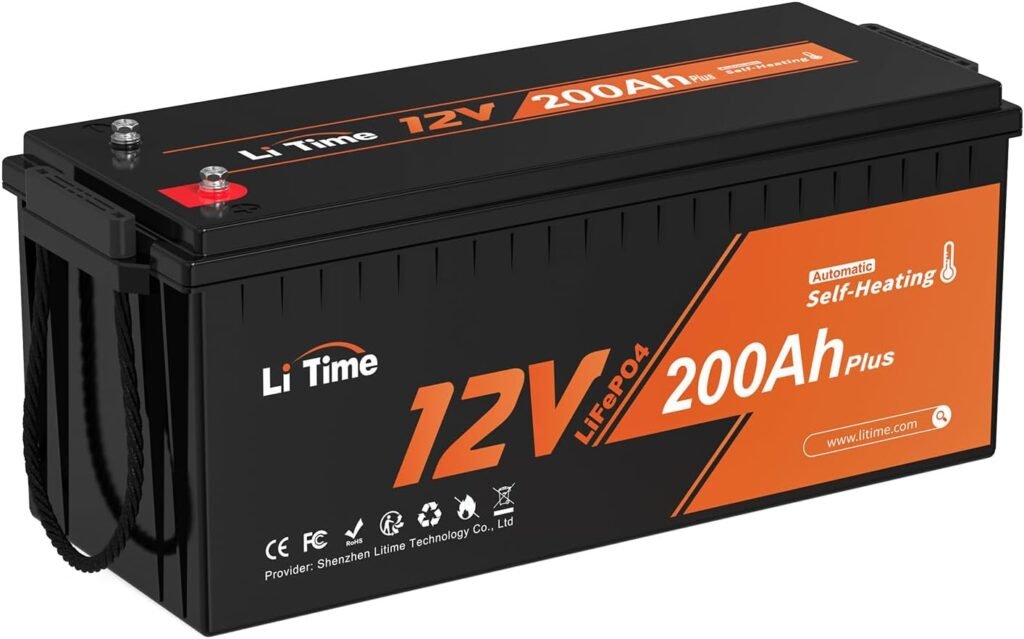
Product overview: Litime 12V 200Ah Plus LiFePO4 Lithium Battery, Self-Heating & Low Temperature, 2560Wh Energy, Built-in 200A BMS, 4000+ Deep Cycles for RV Home Energy Storage and Off-Grid etc.
We like to start with a plain summary so we know what we’re evaluating. This battery is a 12V LiFePO4 unit with 200Ah capacity (nominal 12.8V), giving 2560Wh of usable energy, a built-in 200A BMS, a self-heating function for low-temperature charging, and a manufacturer-claimed 4000+ deep cycles plus 5-year support. It’s positioned for RVs, home energy storage, off-grid setups, marine use with trolling motors, and recreational vehicles like golf carts.
Quick highlights
We find it helpful to call out the standout features in a few lines. The battery self-heats to allow charging at cold ambient temperatures, supports a wide operating temperature range for charge and discharge, and can be expanded into larger banks (up to 4S4P) for 48V high-capacity systems. The 200A BMS provides robust current handling for most inverter and motor loads within its limits.
Detailed specifications and technical breakdown
We like to put the essential specs in one place so readers can scan quickly and compare. Below we list the core specifications and then break them down with short explanations.
| Specification | Value | Notes |
|---|---|---|
| Nominal Voltage | 12.8 V | Typical for LiFePO4 cells (4 cells in series). |
| Capacity | 200 Ah | High-capacity 12V module. |
| Energy | 2560 Wh | 12.8 V × 200 Ah = 2560 Wh nominal. |
| Built-in BMS | 200 A | Protects against over-current, over/under voltage, balancing, temperature. |
| Chemistry | LiFePO4 | Stable, long cycle life, thermally safer than many lithium chemistries. |
| Cycle Life | 4000+ deep cycles | Manufacturer-claimed; dependent on depth of discharge and usage. |
| Self-Heating | Auto on when charging temp <41°f (5°c); stops at 50°f (10°c)< />d> | Allows charging down to -4°F once heated; improves cold-weather reliability. |
| Charge Temp Range | -4°F ~ 122°F (-20°C ~ 50°C) | Charging allowed when heater has raised battery to safe temp. |
| Discharge Temp Range | -4°F ~ 140°F (-20°C ~ 60°C) | Discharge allowed across a wide range, suited for extreme environments. |
| Expandability | 4S4P (up to 48V 800Ah or 40.96 kWh) | Nominal per-battery voltage 12.8V; 4 in series -> 51.2V nominal; 4P -> 800Ah. |
| Warranty & Support | 5-year support + 24/7 online help | Manufacturer provides multi-year coverage and round-the-clock tech support. |
We find this table helpful because it clarifies nominal voltage assumptions (12.8V per unit), why the expandable bank math reaches 40.96 kWh (51.2V × 800Ah), and how the self-heating and temperature ranges work in practice.
On nominal voltages and expandable configs
We want to be explicit about some math that manufacturers sometimes omit. Each battery’s nominal voltage is 12.8V (4 LiFePO4 cells in series), so:
- Single battery energy = 12.8V × 200Ah = 2560 Wh.
- 4S (4 in series) nominal voltage = 51.2V.
- 4S4P (4 series × 4 parallel) = 51.2V × 800Ah = 40,960 Wh = 40.96 kWh.
This clarifies the “40.96 kWh” expansion claim, which uses the 12.8V nominal voltage rather than 12.0V.

Self-heating and low-temperature behavior
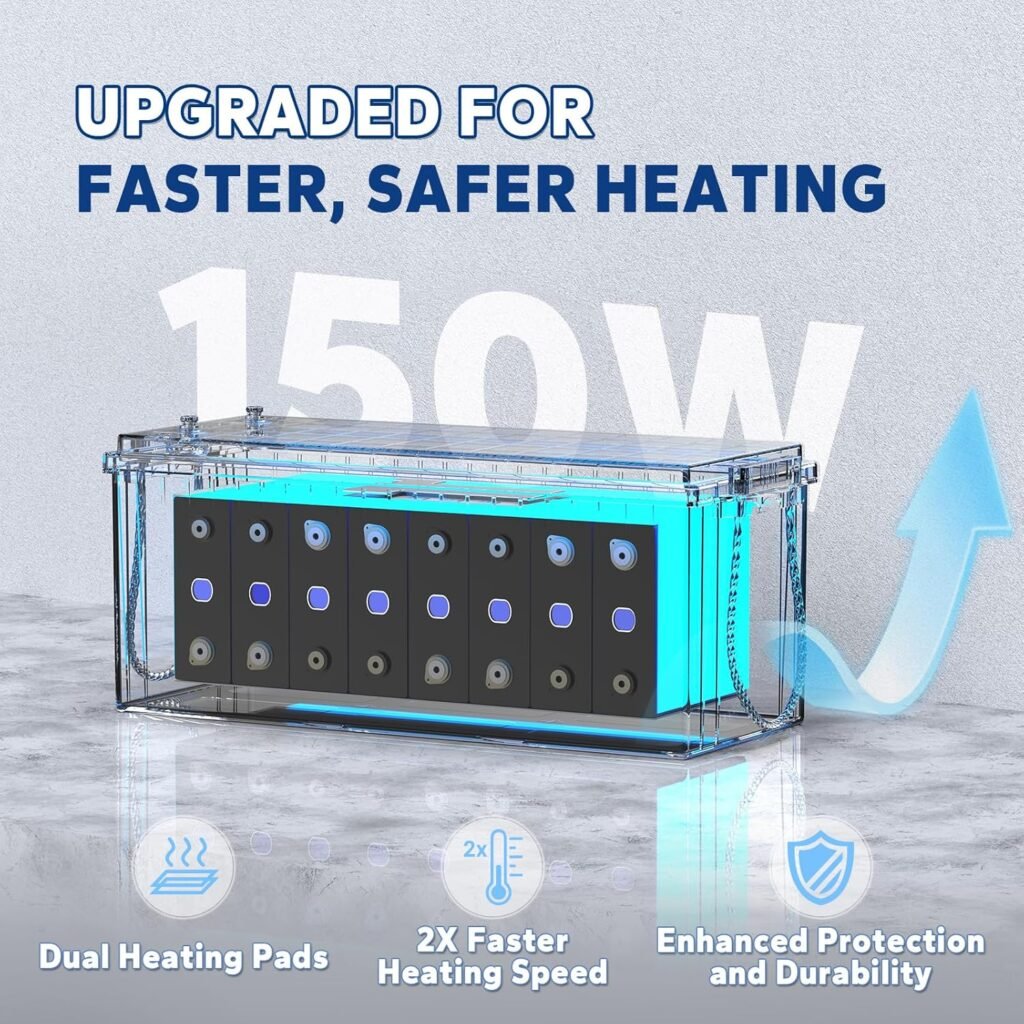
We appreciate batteries that manage low-temperature charging intelligently because charging lithium batteries below certain temperatures can permanently damage the cells. This unit’s built-in heater addresses that.
How the auto self-heating works
We like that the heating is automatic: when the battery detects a charging temperature below 41°F (5°C), the heater turns on and continues until the temperature reaches 50°F (10°C). That removes the need for manual intervention before charging in cold environments, which is especially useful for mobile setups like RVs and boats where we don’t want to babysit batteries.
Cold charging limits and practical impact
This battery claims charging operation down to -4°F (-20°C) once the internal heater has brought temperatures into a safe range. The battery’s charge-temperature window is stated as -4°F to 122°F (-20°C to 50°C), and discharge down to -4°F and up to 140°F (-20°C to 60°C). In practice, that means:
- If the ambient is very cold, the heater will engage when charging begins and will bring the cells to a temperature at which charging is safe.
- We should expect slightly lower effective capacity at very cold ambient temps until the battery warms.
- The heater consumes some energy while active; we should account for that when running long, cold-weather charge cycles.
We like the simplicity: the battery automates the thermal safety step so we don’t need a complex external heating bundle or manual pre-warming.
Built-in 200A BMS and safety features
We’re always cautious about safety and protections, and the integrated BMS is a critical component for that.
What the BMS protects against
We find it reassuring that a 200A BMS can typically handle heavy inverter loads and motor draws within reason. The BMS is expected to manage:
- Over-voltage protection during charging.
- Under-voltage protection during deep discharge.
- Over-current and short-circuit protection.
- Cell balancing to maintain long-term capacity equality.
- Temperature monitoring to prevent charging or discharging outside safe limits.
This means we can confidently link the battery to inverters, chargers, and DC loads while relying on the BMS to intervene if abnormal conditions occur.
Practical limits: continuous vs. surge current
We want to be pragmatic: the BMS rating is 200A, which for a 12.8V battery equates to approximately 2.56 kW continuous (12.8V × 200A). Short-duration surges might be tolerated by the cells and wiring, but for engine starting (high cranking amps) or heavy motor inrush, we recommend verifying the BMS’s surge capability in the manual and using appropriate external relays or contactors for peak loads. For trolling motors and golf carts (30–70 lb thrust), this battery is well within its intended use.
Performance expectations and runtime examples
We prefer concrete examples over vague promises. Here are realistic runtime estimates so we can plan loads and system sizing.
Simple runtime math and examples
With 2560 Wh nominal energy:
- A 300 W load will run for ~8.5 hours (2560 / 300 ≈ 8.5 h).
- A 500 W inverter load will run for ~5.1 hours (2560 / 500 ≈ 5.12 h).
- A 1000 W load will run for ~2.56 hours.
- A 50 A DC load (at ~12.8 V ≈ 640 W) will last ~4 hours (2560 / 640 ≈ 4 h).
We should note that usable runtime will vary with depth of discharge policies, inverter efficiency (typically 85–95% for modern inverters), and temperature. At very low temperatures before the heater warms the pack, usable capacity may be reduced.
Cycle life and long-term capacity retention
The manufacturer advertises 4000+ deep cycles. We like that because even with daily cycling, that equates to many years of service. For example, if we cycle the battery once per day:
- 4000 cycles / 365 ≈ 11 years of daily cycles.
Of course, real-world cycle life depends on depth of discharge, charge/discharge rates, temperature extremes, and maintenance. Keeping cycles shallow when possible (for example 20–50% DoD per cycle) will extend calendar life.
Installation, charging, and wiring recommendations
We prefer straightforward installation steps and guidance to avoid common mistakes that shorten battery life.
Charger and inverter compatibility
We find that LiFePO4 batteries typically require a charger/inverter profile that uses CC/CV charging with appropriate voltages. Typical recommended settings are:
- Bulk/absorb charge voltage: about 14.2–14.6 V (for a 12.8V nominal pack).
- Float voltage (if used): around 13.4–13.6 V (though float is optional for LiFePO4).
- Maximum charge current: generally up to the BMS rating (200A) but check manual for recommended charge currents; charging at high C rates may heat the pack or trigger BMS limits.
We recommend verifying the manufacturer’s recommended charge voltage and current in the product manual. For alternator charging in vehicles, a DC-to-DC charger configured for LiFePO4 is often the best practice when alternator output is not tailored to LiFePO4 voltage profiles.
Wiring, fusing, and safety best practices
We always wire batteries with safety in mind. Consider the following:
- Use appropriately sized cables to handle up to 200A continuous with minimal voltage drop.
- Install a properly rated fuse or circuit breaker near the battery positive terminal to protect wiring against faults.
- Ensure good battery ventilation (LiFePO4 produces little gas under normal operation, but cooling and space are still prudent).
- When paralleling or series-connecting multiple units, use identical new batteries in matched groups and follow manufacturer instructions for balancing and first-charge procedures.
If we plan to build the 4S4P expandable bank, we should assemble identical batteries at the same time and ensure proper series/parallel wiring with robust busbars and correctly rated fusing per string.
Use cases and suitability
We like to match the battery’s strengths to typical applications so we can choose wisely.
RV and camper electrical systems
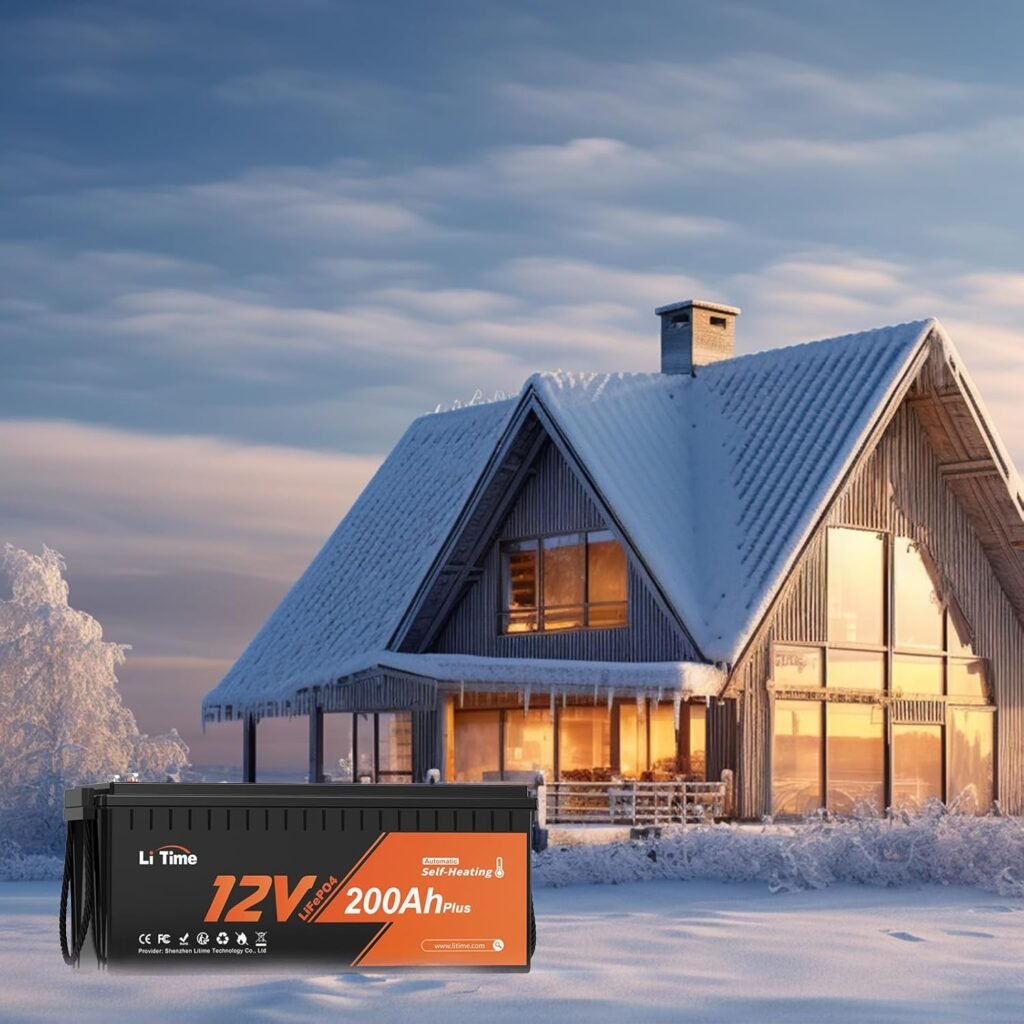
This battery is well suited to RV use. The 200Ah capacity gives a lot of usable energy at 12V for lights, fans, pumps, and 12V appliances. The built-in heater is a big plus for winter camping because it enables reliable charging in cold conditions where conventional LiFePO4 would refuse to charge.
Off-grid and home energy storage
We can use this battery as a building block for larger home energy systems. If we need 48V inverter systems, the expandability to 4S4P allows us to scale up to a multi-kWh bank (up to ~40.96 kWh nominal as claimed). For whole-home backup, we’d typically parallel multiple strings and ensure our inverter and charge controllers are sized accordingly.
Marine, trolling motors, and golf carts
The battery is designed to support trolling motors and golf carts. The product notes that it fits 30–70 lb thrust motors and provides reliable storage for marine and recreational gear. The high cycle life means we can discharge deeply for long fishing days without rapidly degrading the pack.
Not recommended as a starting battery for large engine cranking
We should be cautious about using this battery as a starter for large internal combustion engines. While the BMS supports 200A continuous, engine cranking often requires very high peak currents for short bursts. If we plan to use this for engine start, we should verify the battery’s cranking amp rating and consider a dedicated starter battery or a DC-to-DC isolator setup.
Comparisons: LiFePO4 vs lead-acid for this capacity
We like to compare on weight, cycle life, usable capacity, and lifetime cost. This helps make sense of upfront cost versus long-term value.
Short comparison table
| Metric | Litime 12V 200Ah LiFePO4 | Typical 12V 200Ah AGM Lead-Acid |
|---|---|---|
| Usable capacity (recommended) | ~80–100% (recommendations vary) | ~50% recommended to maximize life |
| Cycle life | 4000+ cycles (manufacturer claim) | 300–700 cycles typical |
| Weight | Much lighter (LiFePO4 ~30–60% of lead-acid weight) | Heavier |
| Maintenance | Low (no watering, no equalization) | Periodic maintenance possible |
| Charging speed | Faster charging accepted | Slower, more limiting |
| Cold charge | Heater allows charging in cold | Susceptible to capacity loss; may require warming |
| Cost | Higher upfront, lower life-cycle cost | Lower upfront, higher replacement cost |
We find LiFePO4’s higher initial cost is often offset by vastly greater cycle life, lower maintenance, and usable capacity. For long-term off-grid, RV, or marine use, the LiFePO4 option frequently becomes more economical over the battery’s lifetime.
Installation tips when expanding to 4S4P (48V 800Ah)
We approach expansion with caution so that we maintain balance and longevity.
Best practices for series/parallel assemblies
We always recommend:
- Using identical batteries from the same production batch where possible.
- Wiring series strings first and verifying correct voltage across the strings before paralleling.
- Ensuring proper fusing on each series string to protect against reverse current or string failures.
- Checking the BMS and manual for any required initial balancing procedure when configuring multiple batteries.
If we are not experienced with high-current DC installations, we strongly suggest consulting a qualified technician, especially for 48V multi-string systems at several hundred amps.
Maintenance and storage recommendations
We prefer simple maintenance protocols to keep performance consistent across years.
Storage state-of-charge and temperature
We like to store LiFePO4 around 40–60% SOC for long-term storage if possible, though they tolerate higher states better than lead-acid. Key guidelines:
- Avoid leaving fully charged at very high temperatures for extended periods.
- For long-term storage, keep in a cool, dry place; periodic top-up charges may be needed every few months depending on self-discharge.
- Be mindful of the heater and temperature cycles if the battery is stored in freezing conditions.
Routine checks
Every few months we recommend:
- Visual inspection for terminal corrosion or physical damage.
- Voltage checks to ensure cells remain within expected range.
- Firmware/BMS update checks if the manufacturer provides updates (consult support).
Troubleshooting common issues
We want to be pragmatic when things don’t work perfectly.
Not charging in cold weather
If the battery appears not to accept charge in cold weather, it may be that the internal heater has not engaged or is insufficient to raise cell temperature quickly. We suggest:
- Verify AC charger or alternator is delivering current; the heater may not activate without a charging signal.
- Allow time for the heater to warm the pack; in extremely cold ambient temps this can take longer.
- Contact 24/7 support if the heater appears non-functional.
BMS trips or disconnects loads
If loads suddenly drop, the BMS might have tripped due to over-current, short-circuit, low voltage, or over-temperature. We recommend:
- Inspect for external shorts or large sudden loads.
- Check cable connections and fuse integrity.
- Reduce current draw and attempt to reset per manual instructions or contact support.
Warranty, support, and customer service
We value strong after-sales support because batteries are long-term investments.
5-year support and 24/7 help
The manufacturer provides a 5-year support coverage and 24/7 online assistance. We find fast access to technical support especially helpful for systems where downtime is costly (for example, a primary RV battery mid-trip or off-grid home backup).
What to document and expect
If we need to file a warranty claim, we’ll document:
- Purchase receipt with date.
- Serial number and any production codes.
- Photos of installation, terminals, and any label details.
- A brief description of the issue and steps taken for troubleshooting.
This helps the vendor process claims quickly and reduces back-and-forth.
Pros and cons summary
We like concise lists to weigh decisions quickly.
Pros
- Automatic self-heating allows charging in cold climates without manual intervention.
- Long cycle life (manufacturer-claimed 4000+ cycles) translates to better lifetime value.
- High capacity at 2560 Wh in a single 12V module; scalable to multi-kWh systems.
- Built-in 200A BMS simplifies integration and provides critical protections.
- Good suitability for RVs, off-grid, marine trolling motors, and recreational vehicles.
- 5-year support and 24/7 online help provide peace of mind.
Cons
- Higher upfront cost than lead-acid alternatives.
- For very high cranking applications, the 200A BMS may be limiting; check surge specs.
- Heater draws power when active, slightly reducing net energy available during charging in extreme cold.
- Installation of multi-unit systems (4S4P) requires careful planning, correct wiring, and appropriate fusing.
Safety and certifications
We prefer to rely on established safety standards. While LiFePO4 chemistry is inherently more thermally stable than many alternatives, we always recommend checking the product documentation for relevant certifications (UN38.3 for transport, CE, RoHS, etc.) and following local regulations for battery installation.
Frequently asked questions (FAQ)
We find FAQs address common, practical concerns we all have before buying or installing.
How long will it take to charge from 20% to 100%?
Charge time depends on charger current. For example, with a 100A charger at nominal 12.8V:
- Energy to add from 20% to 100% = 2560 Wh × 0.8 = 2048 Wh.
- At ~12.8V × 100A = 1280 W charging power (minus inefficiencies), roughly 1.6–2 hours in ideal conditions. Real-world charging closer to 2–3 hours due to tapering near full charge and conversion losses.
We recommend using a charger that matches the battery chemistry and follows safe charge protocols.
Can we connect this battery in series or parallel with other brands?
We advise against mixing different battery brands, capacities, or ages in series/parallel arrays. For best performance and safety, match capacity, voltage, age, and manufacturer recommendations.
Can this battery be used for engine starting?
We recommend caution. The built-in 200A BMS supports moderate continuous and DC loads but may not be optimized for high cranking amps required by some engines. For starting engines with high cranking currents, use a dedicated starter battery or consult the manufacturer about peak cranking capability.
Is the battery safe to use in marine environments?
LiFePO4 chemistry is suitable for marine use, and the heater adds reliability in colder waters. We still recommend using marine-grade connectors and ensuring installation prevents exposure to corrosive salt spray on terminals and hardware.
Practical buying checklist
We like to provide a checklist to help decide if this battery is right for our setup.
- Do we need winter charging capability? If yes, the self-heating is a big advantage.
- Do we require high cycle life? The 4000+ cycles are compelling for daily cycling.
- Are we planning to expand to 48V systems? Check the 4S4P guidelines and wiring practices.
- Is our inverter/charger compatible with LiFePO4 voltage profiles and BMS behavior?
- Do we have wiring, fusing, and mounting infrastructure to handle up to 200A continuous?
If we can answer yes to these items, this battery is a strong candidate.
Final verdict
We find the Litime 12V 200Ah Plus LiFePO4 Lithium Battery to be a compelling option for anyone needing durable, cold-capable, and high-cycle 12V storage. The automatic self-heating feature targets one of the most frustrating limitations of Li-ion batteries in mobile and cold-weather applications, and the built-in 200A BMS makes integration straightforward for many inverter and motor loads. For RV users, off-grid homeowners, marine applications with trolling motors, and those planning expandable 48V banks, this battery offers a blend of convenience, longevity, and performance that justifies the premium over lead-acid alternatives.
We recommend verifying charger and inverter compatibility, using matched batteries when expanding, and following recommended wiring and fusing practices. If those steps are taken, this battery can become a reliable core of our power system for many years.
If you want, we can help calculate run times for your exact loads, design a 48V battery bank plan using these modules, or draft a wiring and fusing diagram checklist for your install.
Disclosure: As an Amazon Associate, I earn from qualifying purchases.