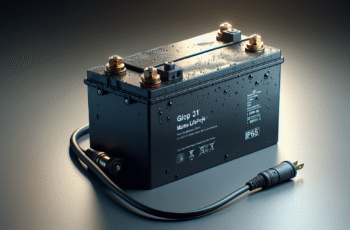
Thinking about upgrading your golf cart or off-grid setup with the 48V100Ah Lithium Golf Cart Battery, Built-in 200A BMS, 5,000+ Cycles Rechargeable LiFePO4 Battery, Max 10.24kW Continuous Power Output, with Battery Charger, Power Converter, LCD Monitor,Bluetooth APP?

Product overview
You’re looking at a complete LiFePO4 package built for vehicles and portable power, not just a bare cell pack. The battery combines a 51.2V (nominal 48V) 100Ah LiFePO4 pack with a built-in 200A battery management system (BMS), a charger, power converter, an LCD monitor, and Bluetooth app monitoring for hands-on control.
You’ll appreciate that the design emphasizes safety, convenience, and a long cycle life. The manufacturer rates the pack for 5,000–15,000 cycles, claims IP65 protection, and sets thermal cutoffs to protect the battery under extreme conditions.
What this product includes
You receive the 51.2V 100Ah LiFePO4 battery plus several accessories to get started. These include a dedicated battery charger, a power converter, an LCD monitoring module, and Bluetooth connectivity that pairs with a mobile app for real-time data.
Because accessories are bundled, you won’t need to track down a third-party charger or additional monitoring hardware to get basic functionality and visibility into battery status. Still, you’ll want to confirm cable lengths and connector types for your specific application before installation.
Quick spec breakdown
Here’s a simple table that breaks down the most important specs so you can scan what matters fast. You’ll see nominal voltage, capacity, BMS rating, power output, and environmental protections in one place.
| Specification | Details |
|---|---|
| Nominal Voltage | 51.2 V (marketed as 48V) |
| Capacity | 100 Ah |
| Total Energy | 51.2 V × 100 Ah = 5,120 Wh (5.12 kWh) |
| Built-in BMS | 200 A |
| Max Continuous Power | 10.24 kW (51.2 V × 200 A) |
| Cycle Life | 5,000 – 15,000 cycles (manufacturer claim) |
| Cell Chemistry | LiFePO4 (LFP) Grade A cells |
| IP Rating | IP65 (water & dust resistant) |
| Temperature Protection | Charge cutoff above 50°C (122°F); charge cut-off below ~0°C; discharge cut-off below ~-20°C |
| Certifications | UN38.3, CE, RoHS (stated) |
| Weight Savings | About 1/4 the weight of equivalent lead-acid sets; can cut ~200 lb or more |
| Typical Applications | Golf carts (Club Car, EZGO, Yamaha, ICON), boats, RVs, solar storage, backup power |
| Included Accessories | Charger, power converter, LCD monitor, Bluetooth app support |
You should treat the table as a quick reference — details like cycle life and real-world energy depend on how you use and charge the battery. The listed certifications are helpful to know for legal transport and safety expectations.
Design and build quality
The outer construction aims to be practical and weather-resistant for outdoor vehicle use. The IP65 rating means you can expect decent protection against dust and water jets, which is useful if you park your cart outdoors or use it on wet trails.
You’ll notice the pack is compact compared with a group of lead-acid batteries that provide the same voltage and capacity. That compactness plus reduced weight makes mounting and wiring simpler and cleaner in most carts and small vehicles.
Construction and materials
You’re getting LiFePO4 cells described as Grade A LEVEL, which are currently the preferred chemistry for deep-cycle, long-life applications. The stronger thermal stability and mechanical robustness of LFP cells make them suitable for vehicle and stationary applications where long life and safety matter.
The pack includes a rigid enclosure and integrated hardware for connections and monitoring. While the enclosure looks robust, you should still avoid prolonged immersion and protect the terminals from corrosion if you’re mounting the battery in a marine environment.
IP65 rating and environmental resistance
IP65 gives you good protection against dust ingress and protection from low-pressure water jets. That’s practical for rainy conditions and dusty courses. The rating doesn’t mean the battery is submersible, so you’ll need to keep it above surface water during floods or heavy immersion situations.
Temperature cutoffs are integrated to stop charging over 50°C (122°F) and to prevent charging and discharging beyond safe low-temperature thresholds. You’ll get better long-term reliability by honoring those protections and avoiding extreme environments for extended periods.
Battery management system (BMS) and safety
You’ll appreciate that a high-capability BMS is built into the battery, which reduces the need for external protective hardware and simplifies installation. The 200A BMS manages cell balancing, over/under-voltage protection, over-current protection, and short-circuit shutdown.
Because the BMS is internal, you’ll have a compact, safer solution compared with bare Li-ion cells that require external balancing and heavy-duty fusing. This is particularly valuable in golf carts where wiring space and accessibility are limited.
Built-in 200A BMS features
The BMS protects the pack from overcharge, over-discharge, over-current, and short circuit conditions. You’ll get automatic balancing between cells so the pack remains healthy over many cycles, which is a key to achieving the long cycle life the manufacturer states.
The 200A current limit gives you a generous margin for high-current draw events such as acceleration or hill climbs. That current rating also defines the 10.24 kW continuous output claim, meaning the battery can support powerful motors or multiple loads simultaneously.
Thermal and low-temperature protections
High-temperature cutoffs stop charging above 50°C (122°F) and the pack has intelligent low-temp cut-off logic that prevents charging below approximately 0°C ±4°C and discharging below approximately -20°C ±4°C. You’ll avoid damage from charging in freezing conditions that can otherwise create lithium plating and reduce cycle life.
These cutoffs mean you can safely leave the battery in outdoor storage in cold climates, but you’ll need to manage charging in cold weather — consider using a warm storage location or a temperature-controlled charger if you frequently charge in sub-zero conditions.
Performance and capacity
At 51.2 V and 100 Ah, you’ve got a nominal energy capacity of about 5.12 kWh. Because LiFePO4 tolerates deep discharge well, you’ll get a high usable portion of that energy — typically in the 80–100% depth of discharge range compared to only 30–50% recommended for lead-acid.
That improved usable capacity is one of the primary performance advantages you’ll notice: more runtime for the same rated Ah compared with lead-acid, and a much flatter voltage curve under load for consistent motor performance.
Energy and power output
The pack’s 5.12 kWh gives you a meaningful amount of energy for short excursions, shore power for small appliances, or backup needs. The 200A continuous capability translates to a 10.24 kW continuous output, which means the battery can support substantial loads and steep hill starts.
You’ll need to consider how your motor/controller system or inverter interacts with that power capability. Many golf cart controllers won’t draw the full 200A continuously, but the battery gives you headroom for peaks and accessories like winches or high-power trolling motors.
Cycle life and longevity
Manufacturer claims of 5,000 to 15,000 cycles reflect the long-term durability of LiFePO4 when used and charged correctly. You’ll typically see thousands of cycles at moderate DoD and appropriate charging practices, translating to a decade or more of service in many use cases.
To hit the higher end of the cycle life range, you’ll want to avoid constant full-discharge/recharge cycles at high currents and keep the battery within its safe temperature window. Real-world lifespan depends on usage patterns, depth of discharge, and environmental stressors.
Charging, discharging, and efficiency
Charging LiFePO4 is more efficient than lead-acid, with less energy lost to heat and gassing. The included charger is designed for the chemistry and provides the proper charge profile to maximize capacity and minimize cell stress.
You’ll find that charging is generally faster and you can run your pack through more frequent partial charges without harming the cells. That flexibility is especially handy when you’re using the battery as both a vehicle and backup energy source.
Charger and charging behavior
With the included charger, the battery will accept a proper CC/CV (constant current / constant voltage) profile suited for LiFePO4 chemistry. You should confirm the charger’s current rating and connect it to a suitable AC source; fast charging at very high currents can stress cells and heat the pack.
You’ll also appreciate that LiFePO4 accepts charge at a nearly constant voltage and doesn’t require the prolonged absorption stage that lead-acid cells need. This means shorter full-charge times for the same amount of energy replenished.
Max continuous output and peak power
The 200A BMS allows a sustained 200A draw, equating to about 10.24 kW continuous power. You’ll benefit from that capacity during strong acceleration or when running multiple high-load accessories.
Keep in mind that motors and controllers often draw high peak currents for short durations, and you’ll want to make sure wiring and fusing are sized correctly for those peaks. The battery’s BMS will protect against sustained overcurrent, but good system design prevents nuisance trips and maximizes performance.
Weight, installation, and fitment
One of the biggest practical perks you’ll notice is weight reduction. The manufacturer states the LiFePO4 pack weighs about one-quarter as much as an equivalent lead-acid set, often allowing around 200 lb or more of weight savings in golf cart applications.
That weight reduction improves handling, acceleration, and reduces suspension and drivetrain wear. It also simplifies installation because a single person can move and position the pack without the heavy lifting required for lead-acid batteries.
Weight savings vs lead-acid
If your cart originally used six or eight lead-acid batteries, switching to this single 51.2V 100Ah pack can cut the battery weight dramatically. You’ll notice better hill performance and efficiency because your motor isn’t hauling around as much dead weight.
Lower weight can also translate into better range per charge in real-world use because the system overall is lighter. However, be mindful of balance and mounting location to preserve the cart’s original handling characteristics.
Compatibility and wiring
The battery is intended to be a drop-in replacement for many common golf cart models like Club Car, EZGO, ICON, and Yamaha, but you’ll need to verify physical dimensions and terminal arrangement for your specific cart. You’ll also need to ensure your controller is compatible with the slightly higher nominal voltage if your system was tuned tightly to 48V lead-acid pack voltages.
Wiring is relatively straightforward due to the integrated BMS and included accessories, but you should always use appropriately sized cables, fuses, and connectors. If you’re unsure, consult a professional or the cart manufacturer to avoid voiding warranties or damaging electronics.
Connectivity and monitoring
Bluetooth connectivity and LCD monitoring give you the visibility you’ll want for managing charge cycles, understanding state of charge (SoC), and diagnosing issues. The Bluetooth app pairs with your phone so you can check voltage, current, temperature, and other key metrics on the go.
The LCD monitor provides a local, simple way to see charge level and status without needing your phone. You’ll benefit from both remote and onboard views, especially if you like to track performance over time.
Bluetooth app and LCD monitor
You’ll be able to view real-time battery parameters through the Bluetooth app — things like current, voltage, temperature, and State-of-Charge. That data helps you decide when to charge, how hard you can push the cart, and whether environmental conditions are affecting performance.
The LCD monitor offers a quick glance option for status when you don’t want to open the app. Between the two, you’ll have the monitoring tools you need for both everyday use and troubleshooting.
What you can monitor and control
You can track SoC, individual cell voltages (if the app exposes that level of detail), temperature sensors, total cycles, and error codes. If the BMS sends protection events, those will usually show up in the app and on the LCD, helping you diagnose issues without disassembling the pack.
This visibility also allows you to optimize charging schedules and understand how different driving habits affect runtime and longevity. If you like data-driven maintenance, this setup will suit you well.
Use cases and real-world range estimates
This battery works well in a variety of uses: golf carts, small electric vehicles, boats, RV house banks, solar storage systems, trolling motors, and as a portable camping power bank. Your actual runtime and performance depend on load, speed, terrain, and accessory use.
To give you a sense of range for golf-cart use, consider energy consumption examples. If your cart uses about 300 Wh per mile on average (reasonable for moderate speeds and mixed terrain), the 5.12 kWh pack could yield roughly 16–18 miles per charge. If your cart’s consumption is closer to 400 Wh/mile, you’ll see around 12–13 miles per charge. Those numbers vary widely with terrain, passenger weight, driving style, and accessory draw.
Golf carts: practical range and performance
You’ll get the best range if you drive conservatively, keep tires properly inflated, and avoid constant deep discharge. Typical range will likely fall between 12 and 18 miles depending on setup and conditions, and you’ll appreciate consistent voltage under load compared with lead-acid setups.
Because of the weight savings, you may also see slightly better efficiency and responsiveness, which can extend real-world range compared with heavier lead-acid configurations.
RVs, boats, solar, and backup power
As a house battery in an RV or boat, the 5.12 kWh capacity gives you usable energy for lights, fridges, pumps, and electronics for several hours depending on total draw. In a solar off-grid setup, it can serve as a medium-sized storage bank for critical loads.
You’ll find LiFePO4 particularly practical for mixed-use applications because it can be cycled daily without suffering the rapid degradation you’d see in lead-acid at the same DoD. For camping and trolling motors, the Bluetooth monitoring and high discharge capability are very useful for making sure you don’t get stranded mid-trip.
Maintenance, troubleshooting, and tips
This battery is largely maintenance-free compared with lead-acid, which requires water checks and equalization charges. You’ll still want to keep terminals clean, ensure good ventilation if mounted in an enclosed compartment, and avoid exposing the battery to extreme temperatures for prolonged periods.
If you see warnings in the Bluetooth app or LCD monitor, note the error codes and conditions before attempting resets or reconnects. Many BMS events are user-recoverable with a proper power cycle and checking wiring/fuse conditions.
Routine care
You’ll want to keep the battery charged to a reasonable state-of-charge rather than storing it fully discharged for long periods. If you store the battery for extended intervals, maintain a partial charge (around 40–60%) and check it periodically.
Also, keep the battery’s environment clean and dry, and avoid setting the battery directly on conductive surfaces. Corrosion on terminals can lead to voltage drops and heat under load, so a light application of terminal protectant where appropriate is useful.
Common issues and fixes
If the BMS prevents charging in cold weather, your first step should be to move the battery to a warmer location for charging or use a charger with a built-in heating feature. If you experience a BMS overcurrent shutdown, verify wiring and fuses, then reset per the manual.
If Bluetooth connectivity is intermittent, ensure your phone’s Bluetooth is up to date and within range, and that no other devices are interfering. For persistent faults, reach out to the seller or a qualified service technician to avoid voiding any support options.
Comparison: LiFePO4 vs lead-acid and other lithium chemistries
You’ll find LiFePO4 stands out for safety, longevity, and stable voltage under load when compared to lead-acid. Compared with other lithium chemistries (like NMC), LiFePO4 offers superior cycle life and thermal stability, though it can be slightly heavier by energy density than the highest-energy lithium chemistries.
For golf cart applications, LiFePO4 is often the best choice because it balances safety, cycle life, and cost for vehicle duty cycles. You’ll also appreciate minimal maintenance and easier thermal management relative to some higher-energy but less stable chemistries.
Performance and value
When you calculate total cost of ownership, LiFePO4 often wins due to far greater cycle life and lower maintenance costs even if up-front cost is higher than lead-acid. You’ll need fewer battery replacements and less down time for maintenance over a decade of use.
Value also shows in uptime: you’ll be able to use more of the battery’s capacity regularly without damaging it, giving you real-world energy that lead-acid cannot match at similar Ah ratings.
Safety and maintenance differences
You’ll notice LiFePO4 has much lower risk of thermal runaway than common NMC lithium-ion types, and it doesn’t off-gas hydrogen like lead-acid. You won’t need to top off water, worry about acid spills, or deal with gassing during charging, which makes installation in passenger compartments and enclosed mounts easier.
However, you still need to respect proper charging and wiring precautions — proper fusing, correct charger, and secure mounting are essential for safety and reliability.
Accessories, certifications, and what’s included
Because the product ships with a charger, power converter, LCD monitor, and Bluetooth app support, you’ll have most of what you need to start using the battery in a cart or as a power bank. That said, you’ll want to verify connector compatibility and cable lengths for your installation.
Certifications like UN38.3, CE, and RoHS are useful indicators that the battery meets transport, safety, and environmental standards. You should still verify warranty and support terms with the seller for long-term confidence.
Included items
You’ll get the battery pack itself, a charger designed for LiFePO4 chemistry, a power converter that may be useful for accessories, and monitoring tools (LCD + Bluetooth). Having these included reduces the initial setup friction and ensures the charging profile matches the battery’s needs.
Confirm the versions and specs of included items when you receive the pack so you can plan mounting and cable routing. If you need extended cable runs or specialized connectors for your vehicle, budget those into the installation.
Certifications and compliance
With UN38.3, CE, and RoHS listed, you’ll have basic assurances related to transport and European safety/environmental norms. UN38.3 is particularly relevant for shipping lithium batteries, while CE shows conformity with relevant EU directives.
Always keep documentation for these certifications handy in case you need to ship the battery or prove compliance for installations in commercial settings.
Pros and cons
You’ll want a clear, balanced view before making a purchase decision. Below are the main strengths and potential drawbacks to weigh for your situation.
Pros:
- Long cycle life and expected service life, reducing replacement frequency and long-term cost. You’ll likely get many years of reliable use compared with lead-acid.
- High continuous power (10.24 kW) and a robust 200A BMS for confident acceleration and accessory use. You’ll have headroom for demanding loads.
- Lightweight compared with equivalent lead-acid sets, improving handling, efficiency, and installation. You’ll find mounting and access much easier.
- Integrated safety features (BMS, temp cutoffs) and IP65 protection for better real-world durability. You won’t need an external BMS or frequent maintenance.
- Included charger, converter, LCD, and Bluetooth app offer a turnkey solution for many users. You’ll be monitoring and charging with correct hardware out of the box.
Cons:
- Up-front cost is higher than lead-acid alternatives, so you’ll need to consider total cost of ownership rather than initial price alone. You’ll likely recoup the investment over several years, but the initial expense may be significant.
- Not fully submersible — IP65 protects against jets and dust but won’t tolerate long-term immersion. You’ll need to mount and seal appropriately for marine applications.
- Charging below freezing is disabled by the pack’s protection, so you’ll need to manage charging in cold climates to avoid downtime. You’ll need a heated space or controlled charging strategy for winter use.
- Confirm physical fit and terminal compatibility for your cart; it may not be an exact “drop-in” without minor modifications in some models. You’ll want to check dimensions, mounting points, and cable runs.
Buying advice and final recommendations
If you prioritize long-term reliability, lower maintenance, and improved performance, this 48V100Ah LiFePO4 solution is a strong choice. You’ll benefit most if you use your cart or vehicle frequently and want to avoid the recurring costs and maintenance fuss of lead-acid systems.
Before you buy, verify the physical fit in your vehicle, confirm the included accessories meet your needs, check the seller’s warranty and support terms, and ensure your controller and wiring are compatible with a LiFePO4 pack. You’ll save effort by checking these items early and avoid surprises during installation.

Frequently asked questions (FAQ)
How much usable energy do you actually get?
You’ll have about 5.12 kWh nominal energy (51.2 V × 100 Ah). Because LiFePO4 tolerates deep discharge, you can effectively use a much higher fraction of that energy than with lead-acid — often 80–100% depending on your tolerance for cycle life versus usable capacity.
You should plan for roughly 4.6–5.1 kWh of practical usable energy depending on whether you choose to limit DoD for longevity.
Will this battery fit my cart without modification?
You’ll need to check the battery’s physical dimensions and terminal locations against your cart’s battery compartment. While the pack is intended for many common brands (Club Car, EZGO, ICON, Yamaha), you may still need minor bracket or cable adjustments to make it a neat fit.
If in doubt, measure your compartment and compare to the product dimensions or reach out to a technician for a quick compatibility check.
Can you charge it in freezing weather?
The pack’s intelligent low-temperature cut-off prevents charging below approximately 0°C ±4°C to protect cell health. You’ll need to charge in a warmer environment or use a heater or temperature-controlled enclosure to allow charging in freezing weather.
This is a protective feature, not a defect — it prevents permanent damage that can occur if lithium cells are charged while cold.
What maintenance does this battery require?
You’ll perform minimal maintenance compared to lead-acid: keep terminals clean, check mechanical mounts, and ensure connectors remain tight. Periodically monitor the battery through the app or LCD and store at a partial charge for long-term storage.
No watering, equalization charging, or frequent desulfation-like routines are required.
Final verdict
You’ll find the 48V100Ah Lithium Golf Cart Battery, Built-in 200A BMS, 5,000+ Cycles Rechargeable LiFePO4 Battery, Max 10.24kW Continuous Power Output, with Battery Charger, Power Converter, LCD Monitor,Bluetooth APP to be a well-rounded, practical upgrade for golf carts, RVs, boats, and off-grid systems. It combines strong safety features, generous continuous power, and long cycle life with convenient accessories and modern monitoring.
If you’re ready to pay more up front for a cleaner, lighter, and longer-lasting solution that cuts maintenance and improves performance, this battery is worth serious consideration. Make sure you check fitment, wiring, and local support or warranty terms so the transition to LiFePO4 is smooth and trouble-free for your specific use.
Disclosure: As an Amazon Associate, I earn from qualifying purchases.