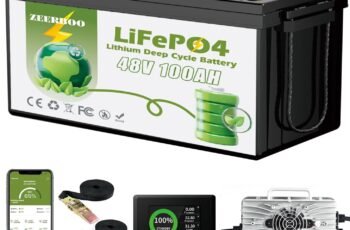
Thinking about whether the “48 Volt Lithium Battery for Golf Cart with 18A Charger, 48V Lithium Battery with 200A BMS, LCD & Mobile Monitor, 5.12kWh with 10.24kW Output, 1000A Peak Current for Golf Cart(100AH)” is the right upgrade for your golf cart or other power needs?

Product overview
You’re looking at a LiFePO4 (lithium iron phosphate) battery pack built for demanding use on golf carts and similar applications. The OGRPHY 48V 100Ah unit pairs high cycle life and a robust BMS with both an onboard charger and monitoring options, so you can manage performance and safety from the seat or your phone.
Key specifications
Here are the core specs you’ll want at a glance. These numbers tell the story of capacity, power capability, and what the included charger delivers.
| Feature | Specification |
|---|---|
| Nominal voltage | 48V |
| Capacity | 100 Ah |
| Energy | 5.12 kWh |
| Continuous discharge (BMS rated) | 200 A |
| Peak discharge | 1000 A (3–5 seconds) |
| Intermediate discharge durations | 300 A (32 sec), 600 A (32 sec) |
| Peak output power (stated) | 10.24 kW |
| Chemistry | LiFePO4 (Lithium Iron Phosphate) |
| Cycle life | 5000+ deep cycles |
| Lifetime estimate | 10 years (under normal use per manual) |
| Charger | 58.4V, 18A LiFePO4 onboard charger (0V wake function) |
| Monitoring | LCD monitor + Bluetooth BMS mobile app |
| Protections | Low/over voltage, overcurrent, short circuit, temperature protection |
| Use cases | Golf carts, trolling motors, solar, RV, marine |
What you get in the box
You’ll receive the battery and the accessories that let you install and monitor it right away. The included components are meant to make setup easier and provide both visual and mobile monitoring options. Check the manual for the wiring diagram and mounting guidance.
- 48V 100Ah LiFePO4 battery pack
- 58.4V 18A LiFePO4 onboard charger
- LCD monitor for mounting in the dash area
- Cables and connection hardware (per the product manual)
- Product manual with charger, monitor, and Bluetooth app instructions
Performance and range expectations
You want predictable range and reliable power delivery. The 5.12 kWh usable energy figure and the manufacturer test claiming roughly 30 miles with a 3 kW golf motor give you a real-world ballpark for planning.
If you’re running a 3 kW continuous draw, simple math shows:
- Runtime = 5.12 kWh / 3 kW ≈ 1.71 hours. If you average about 17–18 mph (typical for many golf carts under load), that lines up with a 30-mile estimate. Keep in mind that factors like terrain, passenger/load weight, speed, and accessory usage (lights, audio, lift) will affect that range.
Discharge capability and power under load
You’ll appreciate how the upgraded 200A BMS changes the performance envelope compared with many smaller BMS systems. Here’s what the numbers mean for you in practice.
- Continuous discharge of 200 A gives steady power for most driving scenarios and many accessory loads.
- The 1000 A peak for 3–5 seconds is designed to handle high inrush events: hard acceleration, quick torque demands, or motor stall conditions.
- The listed intermediate durations (300 A and 600 A for roughly 32 seconds each) indicate the battery can sustain heavier temporary loads for short intervals — useful when climbing hills or getting moving from a stop while under heavy load.
What this means for you: if you have a higher-draw motor, heavy passengers, or frequent hills, the battery’s peak capabilities reduce the chance of BMS cutoffs and will sustain your cart through short bursts of high demand.
Charging: onboard charger details and charging time
You get a 58.4V 18A LiFePO4 charger that’s designed for onboard mounting and also features a 0V wake function. That 0V capability is especially helpful if the battery’s BMS has fully cut off due to low voltage — the charger can bring the pack back to life safely.
Estimated charging time:
- Charger output ≈ 58.4 V × 18 A ≈ 1.05 kW.
- Battery energy = 5.12 kWh.
- Ideal charge time ≈ 5.12 kWh / 1.05 kW ≈ 4.9 hours.
- With charging efficiency and tapering near full charge, expect around 5.5–6.5 hours from low to full in normal conditions.
Because the charger is onboard, you can mount it under the seat or in a protected compartment and charge directly through your cart’s charge port. That convenience means you don’t have to remove the battery for regular charging.
Battery Management System (BMS) and protection features
The built-in 200A BMS is central to both performance and safety. It manages cell balancing and provides multiple protections so the battery operates reliably under a variety of conditions.
Core protections include:
- Over-voltage and under-voltage protection to prevent cell damage.
- Over-current and short-circuit protection to guard wiring and loads.
- Temperature protection for both high and low extremes to avoid damage or unsafe operating states.
- Cell balancing to maximize usable capacity and extend cycle life.
You’ll also be able to configure and view key battery parameters through the Bluetooth-capable BMS and the provided app. Use that to monitor state of charge, voltage, current, and temperature in real time.
Monitoring: LCD display and mobile (Bluetooth) monitoring
You get two monitoring options: an LCD monitor (hardwired) and a Bluetooth mobile app. That combination gives you visual confirmation on the dash plus remote insight on your phone.
- The LCD monitor shows cell status and pack parameters at a glance while you drive. Mount it in the dash area for quick reference.
- The Bluetooth BMS connects to a mobile app that displays detailed parameters and historical info. Turn on your phone’s Bluetooth, open the app (instructions in the manual), and you’ll see state-of-charge, voltage, current, temperatures, and alerts.
Having both options is helpful: the LCD for immediate driving awareness, and the mobile app for setup, logging, and troubleshooting when you’re off the cart.
Durability and cycle life
You’re picking a battery that’s designed for long-term use. The manufacturer cites 5000+ deep cycles and a 10-year lifetime under normal operating conditions and proper care. That kind of cycle life is typical for high-quality LiFePO4 cells and far exceeds the typical life you’d expect from lead-acid batteries.
What that means for you:
- If you cycle the battery moderately (say once per day), the pack should last many years while retaining significant usable capacity.
- The high cycle life makes the higher upfront cost more economical over the battery’s lifespan, especially if you use the cart frequently.
Safety considerations
Safety matters when you keep a battery under the seat or in a compact compartment. LiFePO4 chemistry is among the safest lithium chemistries, offering thermal stability and minimized risk of thermal runaway.
Safety highlights:
- UL-certified Grade A cells help ensure consistent manufacturing quality and safety testing standards.
- The comprehensive BMS protections reduce the chance of failure due to abuse, short circuits, or temperature extremes.
- The battery is designed without the leakage and chemical maintenance requirements that come with flooded lead-acid systems.
You should still follow basic safety and installation practices: secure the battery to prevent movement, protect wiring from chafing, and follow the manufacturer’s temperature and charging guidelines.
Use cases and compatibility
This battery is versatile: although marketed primarily for golf carts, the pack is capable of serving in several roles where 48V systems are used. You can use it in various applications where a robust 48V LiFePO4 source is helpful.
Common use cases:
- Golf carts and utility vehicles: direct drop-in replacement for many 48V systems.
- Trolling motors: the high peak current capability supports large-thrust trolling motors.
- Solar energy systems: can be integrated with 48V inverters and charge controllers, depending on compatibility.
- RV and marine auxiliary systems: reliable power for accessories and propulsion assist in many cases.
Before using the battery in a different application, verify your controller, inverter, or motor’s voltage and BMS compatibility, and follow any manufacturer guidelines.
Real-world examples and scenarios
You’ll want to see how the battery performs under different real-world loads so you can set expectations.
Scenario A — Leisure golf cart use:
- Motor: 3 kW average
- Conditions: mostly flat course, two passengers, moderate driving speed
- Expectation: about 1.7 hours runtime, which aligns with the manufacturer’s 30-mile claim under test conditions.
Scenario B — Heavier use (hills, extra load):
- Motor: 4–5 kW peak demand at times
- Conditions: hilly course, heavier load, frequent stops and starts
- Expectation: range reduces as continuous draw increases. The BMS’s peak capabilities and 200A continuous rating will help prevent unnecessary cutoffs, but you’ll see fewer total miles on a single charge.
Scenario C — Trolling motor application:
- Trolling motor rated for 70 lb thrust or similar high inrush motors
- The battery’s high peak current capacity supports motor starts and higher load moments without immediate BMS tripping.
Always plan conservatively: assume 10–30% less range than ideal test figures depending on conditions that add drag or increase speed.
Installation and mounting guidance
When you install the battery, follow the manual closely for wiring and mounting. Proper mechanical installation and electrical connections are as important as the battery itself for long-term safety and performance.
Key installation tips:
- Secure the battery to prevent movement and vibration-related wear.
- Use the manufacturer-provided wiring diagram and torque specs.
- Mount the onboard charger in a protected, ventilated location and route charging cables through the intended charge port if you’re replacing an existing battery in a golf cart.
- Connect the LCD monitor per the manual and test Bluetooth connectivity before final assembly.
- If you’re not comfortable with high-current battery wiring, have a qualified technician or dealer assist.
Maintenance and care
LiFePO4 batteries are low maintenance compared with flooded lead-acid units, but they still benefit from good practices to maximize life.
Recommended care:
- Keep the battery charged between uses; avoid leaving it at full discharge for long periods.
- Store at partial state of charge (around 40–60%) if you’ll be idle for extended time.
- Avoid exposing the battery to extreme heat or cold; consult the manual for operating and storage temperature ranges.
- Use the built-in Bluetooth app and LCD monitor to periodically check cell balance and temperatures.
- Ensure charging cycles are performed with the provided LiFePO4 charger or a charger configured for LiFePO4 chemistry.
Pros and cons
You want a fair appraisal so you can decide if this battery fits your needs. Here’s a balanced look.
Pros:
- Long cycle life (5000+ cycles) and long estimated lifetime (10 years) reduce lifetime cost.
- High continuous and peak currents reduce the risk of unexpected cutoffs during heavy load events.
- Onboard charger with 0V wake capability makes recovery from deep discharge easier.
- Dual monitoring (LCD + Bluetooth app) gives flexibility for in-vehicle and remote monitoring.
- LiFePO4 chemistry is safe, stable, and low maintenance.
- Versatile for golf carts, trolling motors, solar setups, RV, and marine ancillary power.
Cons:
- Higher upfront cost than lead-acid alternatives (though total cost of ownership is typically lower).
- Real-world range will vary and can be less than test claims in heavy-duty use or hilly terrain.
- You’ll want to confirm physical dimensions and weight against your cart’s mounting area before purchase.
- If you plan to parallel multiple packs, follow manufacturer guidance to avoid BMS conflicts or warranty issues.
Comparison with typical lead-acid setups
You’re probably considering a lithium upgrade from lead-acid. The differences are substantial in ways that matter for everyday use.
- Cycle Life: LiFePO4 offers thousands of cycles versus hundreds for lead-acid.
- Usable Capacity: You can use a much larger percentage of LiFePO4 capacity safely, whereas lead-acid requires more frequent partial charging.
- Weight: LiFePO4 packs are usually lighter for the same usable capacity, improving vehicle efficiency and handling.
- Maintenance: LiFePO4 requires little to no maintenance; lead-acid may need watering and equalization.
- Safety and Reliability: LiFePO4 is more thermally stable and less prone to gassing or leakage.
- Upfront Cost: LiFePO4 is more expensive up front but often cheaper over the battery’s useful life.
If you want longer life, consistent performance, and less daily maintenance, LiFePO4 is usually the better choice even if the initial investment is greater.
Frequently asked questions (FAQ)
You likely have a few questions before pulling the trigger. Here are common ones you’ll find useful.
Q: How long will it take to charge from empty to full? A: With the included 58.4V 18A charger, expect around 5–6 hours under normal conditions; allow for a bit more time for inefficiencies and tapering as the battery reaches full.
Q: Is the battery safe to install under the seat? A: Yes. The battery is designed for golf cart use and includes multiple BMS protections and stable LiFePO4 chemistry. Still, secure mounting and proper wiring are essential.
Q: Can you parallel multiple packs for more capacity? A: In general, LiFePO4 packs can be paralleled if they are identical and you follow manufacturer guidelines. Check the product manual and consult the manufacturer or a qualified technician before paralleling to avoid BMS conflicts.
Q: Will the BMS app work on my phone? A: The Bluetooth BMS requires the compatible app indicated in the manual. Make sure your phone has Bluetooth enabled and follow the manual to download and pair with the battery.
Q: What happens at very low temperatures? A: LiFePO4 batteries can be sensitive to charging at very low temperatures. The BMS will include temperature protections; consult the manual for specific operating and charging temperature ranges and avoid charging below the recommended minimum unless the system includes a battery heater.
Q: Is there a manufacturer warranty? A: The product details state a projected 10-year lifetime and 5000+ cycles, but warranty specifics (length, coverage) can vary. Verify warranty terms and coverage with the seller or manufacturer before purchase.

Troubleshooting tips
If you encounter issues, some quick checks can save frustration and time.
- No Bluetooth connection: make sure Bluetooth is on and the app is running; check the battery for sleep mode and wake it if necessary.
- Charger doesn’t start: confirm cable connections, check the charger’s indicator lights, and verify the charge port polarity and wiring.
- Unexpected shutdowns: check for high temperatures, high current draw that exceeds continuous BMS rating, or low-voltage cutoffs. Use the app to read logged alarms.
- LCD not showing data: verify wiring to the LCD monitor as per the manual and check for loose connectors.
When in doubt, reference the manual for error codes and reach out to the manufacturer for support.
Final recommendation
If you want a long-lasting, low-maintenance, and high-performance battery for your golf cart, trolling motor, or other 48V application, this OGRPHY 48V 100Ah LiFePO4 pack is a strong candidate. You’ll get robust continuous and peak discharge capabilities, onboard charging convenience, and flexible monitoring with both an LCD and a Bluetooth app. The high cycle life and safety features make it a future-proof investment if you use your cart frequently.
Make sure you confirm physical fitment and wiring compatibility with your cart or equipment before purchase, and follow the manual for installation and safe operation. With proper setup, you’ll have a powerful, reliable battery that will likely outlast multiple seasons of regular use.
Disclosure: As an Amazon Associate, I earn from qualifying purchases.